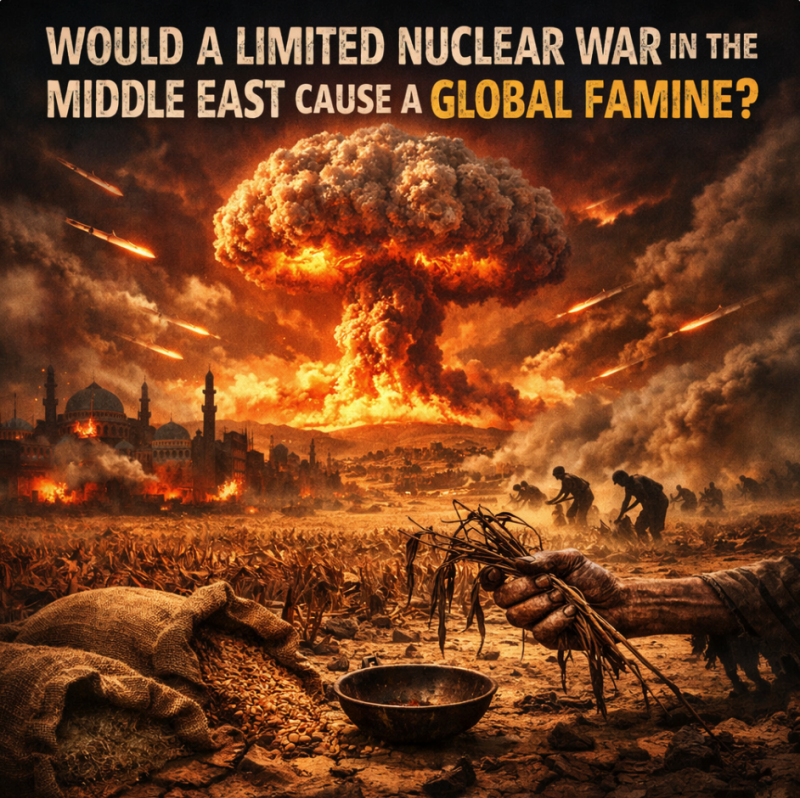
I have been thinking about nuclear war a lot lately. I realize that may sound a bit morbid, but considering where global events are taking us, I think that everyone should be considering what we could end up facing if we do not reverse course. Scientists have warned us that even in a scenario in which only a very limited number of nuclear weapons are used, a “nuclear winter” would be produced which would last for multiple years. Global food production would plummet and hundreds of millions of people would starve to death. So a limited nuclear exchange would not just be catastrophic for the particular nations that are directly involved. Ultimately, it would be a global cataclysm of epic proportions.
Since the 1980s, it has been well understood that a full-blown nuclear war between the United States and Russia would produce a nightmarish “nuclear winter” which could potentially kill billions of people…
In the 1980s and early 1990s, a series of scientific papers published by Soviet and Western scientists (including prominent scientists Carl Sagan, host of the PBS “Cosmos” TV series, and Nobel Prize winner Paul Crutzen) laid out the dire consequences to the global climate of a major nuclear exchange between the U.S. and Soviet Union. The nuclear explosions would send massive clouds of dust high into the stratosphere, blocking so much sunlight that a nuclear winter would result, they said. Global temperatures would plunge 20-40 degrees Celsius for months and remain 2-6 degrees Celsius lower for one to three years. Up to 70% of the Earth’s protective stratospheric ozone layer would be destroyed, allowing huge doses of ultraviolet, or UV, light to reach the surface. This UV light would kill much of the marine life that forms the basis of the food chain, resulting in the collapse of fisheries and the starvation of the people and animals that depend on it. The UV light would also blind huge numbers of animals, who would then wander sightless and starve. The cold and dust would create widespread crop failures and global famine, killing billions of people who did not die in the nuclear explosions.
But what about a limited nuclear war?
Would that cause a “nuclear winter” too?
A study that was conducted in 2014 envisioned a limited nuclear exchange in which each side detonated just 50 15-kiloton weapons. Yes, the “nuclear winter” that would be produced would not be as severe as one that would be produced by a full-blown war between the United States and Russia, but it would still be horrific. In fact, the authors of the study concluded that we would see “five to 10 consecutive Years Without a Summer and more than a decade of significantly reduced crop yields”…
The effects would be similar to what happened after the greatest volcanic eruption in history, the 1815 Tambora eruption in Indonesia. The cooling from this eruption triggered the infamous Year Without a Summer in 1816 in the Northern Hemisphere, when killing frosts disrupted agriculture every month of the summer in New England, creating terrible hardship. Exceptionally cold and wet weather in Europe triggered widespread harvest failures, resulting in famine and economic collapse.
However, the cooling effect of that eruption only lasted about three years. Cooling from a limited nuclear exchange would cause five to 10 consecutive Years Without a Summer and more than a decade of significantly reduced crop yields. Killing frosts would reduce growing seasons by 10-40 days per year for five years at midlatitudes. Global precipitation would fall 6% during the first five years and be reduced by 4.5% 10 years later, resulting in a crippling increase in regional droughts. Over the Asian monsoon region, including the Middle East, the Indian subcontinent, and Southeast Asia, annual rainfall would fall by 20-80%, so that even the “winner” of the nuclear war between India and Pakistan would experience devastating famine from the failure of the life-giving monsoon rains.
Destruction of ozone would lead to another global calamity. As smoke in the stratosphere absorbed sunlight, the stratosphere would heat by 30 degrees Celsius (54°F). In the hot stratosphere, chemical reactions would destroy ozone, causing global ozone losses of 20-50% over populated areas. Ultraviolet light would increase by 30-80% over the midlatitudes, likely causing widespread damage to human health, agriculture, and terrestrial and aquatic ecosystems.
Just think about those numbers for a moment.
They are based on the detonation of just 100 nuclear warheads.
Overall, there are more than 12,000 nuclear warheads in our world today.
Another study that was conducted in 2022 also examined a scenario in which we witnessed a very limited nuclear exchange. That study warned that the death toll could reach “hundreds of millions, perhaps even billions”…
A nuclear war using as few as 100 weapons anywhere in the world would disrupt the global climate and agricultural production so severely that the lives of more than two billion people would be in jeopardy from mass starvation.
A landmark report, Nuclear Famine (2022), published by IPPNW summarizes the latest scientific work which shows that a so-called “limited” or “regional” nuclear war would be neither limited nor regional. A war that detonated less than 1/20th of the world’s nuclear weapons would still crash the climate, the global food supply chains, and likely public order. Famines and unrest would kill hundreds of millions, perhaps even billions. The findings come at a time of greatly heightened tensions among nuclear states and amid warnings that we are closer to nuclear war than we have ever been.
Even a very small decrease in global food production would have the potential to be absolutely catastrophic, because we have already reached a major tipping point.
We are currently in the midst of a historic global food crisis. Hundreds of millions of people around the world go to bed hungry every night, and the lack of food has become particularly severe in deeply impoverished nations such as Somalia…
Somalia is facing a severe hunger crisis, with 6.5 million people experiencing high levels of food insecurity, the World Food Programme (WFP) reported on Tuesday.
More than 1.8 million children under the age of five are expected to suffer from acute malnutrition during 2026, including nearly half a million children projected to be severely malnourished.
“The drought emergency in Somalia has deepened alarmingly, with soaring water prices, limited food supplies, dying livestock, and very little humanitarian funding,” George Conway, the UN humanitarian coordinator for Somalia, said. He warned that urgent life‑saving assistance is essential, especially with no significant rain expected until the April‑to‑June season.
By now it should be apparent to everyone that this is just the beginning.
When someone decides to start using nuclear weapons, the global food crisis will suddenly become several orders of magnitude worse.
It should be unthinkable for anyone to use such weapons, but I believe we are living at a time when they will be used.
The drums of war are beating louder with each passing day, and we are rapidly approaching the final countdown.
Michael’s new book entitled “10 Prophetic Events That Are Coming Next” is available in paperback and for the Kindle on Amazon.com, and you can subscribe to his Substack newsletter at michaeltsnyder.substack.com.
About the Author: Michael Snyder’s new book entitled “10 Prophetic Events That Are Coming Next” is available in paperback and for the Kindle on Amazon.com. He has also written nine other books that are available on Amazon.com including “Chaos”, “End Times”, “7 Year Apocalypse”, “Lost Prophecies Of The Future Of America”, “The Beginning Of The End”, and “Living A Life That Really Matters”. When you purchase any of Michael’s books you help to support the work that he is doing. You can also get his articles by email as soon as he publishes them by subscribing to his Substack newsletter. Michael has published thousands of articles on The Economic Collapse Blog, End Of The American Dream and The Most Important News, and he always freely and happily allows others to republish those articles on their own websites. These are such troubled times, and people need hope. John 3:16 tells us about the hope that God has given us through Jesus Christ: “For God so loved the world, that he gave his only begotten Son, that whosoever believeth in him should not perish, but have everlasting life.” If you have not already done so, we strongly urge you to invite Jesus Christ to be your Lord and Savior today.