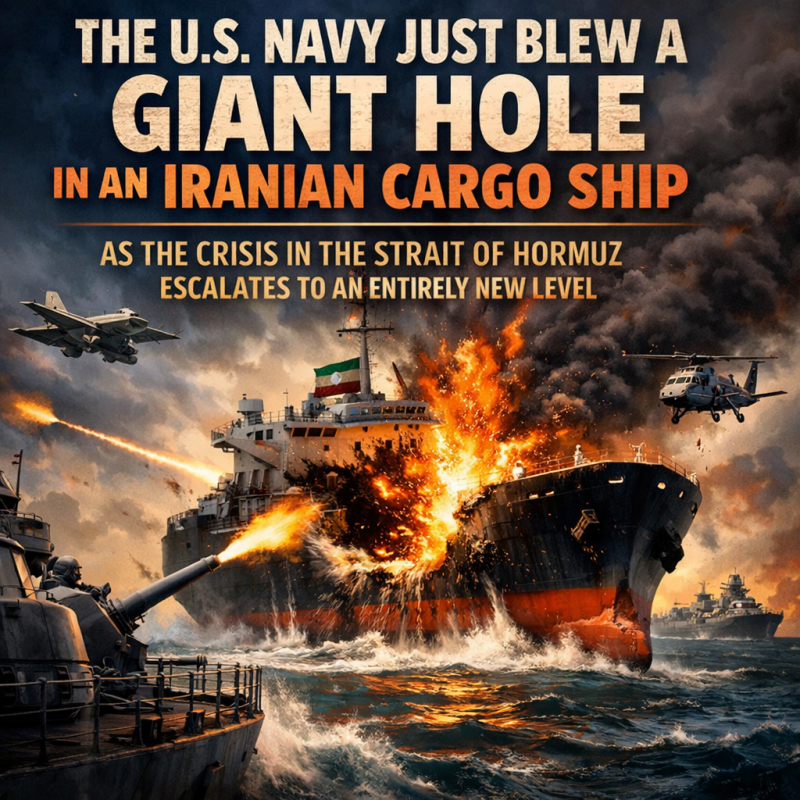
Apparently the Trump administration was not kidding when it warned that no Iranian ships would be allowed through the blockade. Just a little while ago, Donald Trump announced that the U.S. Navy has blown an enormous hole in the side of an Iranian cargo vessel that willingly chose to ignore a warning to turn around. Just two days after the completely irrational euphoria that we witnessed on Friday, the crisis in the Strait of Hormuz is worse than ever, and there is no end in sight.
On Friday, I explained why the extremely positive headlines that we were reading in the western world were dead wrong. When the two week ceasefire with Iran was originally unveiled, the Iranians were supposed to completely open the Strait of Hormuz for that two week period. But they hesitated because fighting was still raging in Lebanon, and the Iranians believed that the fighting in Lebanon was supposed to be part of the ceasefire. When Israel and Hezbollah finally agreed to a ten day ceasefire late last week, the Iranians finally fulfilled their obligation by opening the Strait of Hormuz for the remainder of the ceasefire. But the Iranians also warned that if the U.S. did not respond by lifting the naval blockade for the rest of the ceasefire the Strait of Hormuz would be quickly closed once again, and that is precisely what happened.
Just hours after opening it, the IRGC shut down all traffic through the Strait of Hormuz and announced that any attempt to pass through would be “considered cooperation with the enemy, and the violating vessel will be targeted”…
Iran’s Islamic Revolutionary Guard Corps (IRGC) reportedly issued a sweeping warning to ships in the region on Saturday, saying any movement toward the Strait of Hormuz will be viewed as cooperation with “the enemy.”
“Following the violation of the ceasefire conditions, the American enemy did not lift the naval blockade of Iranian vessels and ports; therefore, from this afternoon, the Strait of Hormuz is closed until this blockade is lifted,” the IRGC said, according to Tehran-based WANA News Agency.
The IRGC also instructed vessels in the Persian Gulf and Gulf of Oman to remain at anchor, warning that any ship approaching the strategic waterway “will be considered cooperation with the enemy, and the violating vessel will be targeted.”
Needless to say, the Iranians were not bluffing.
On Saturday, multiple commercial vessels were fired upon…
Gunfire was reported after at least two vessels tried to pass through the waterway on Saturday – with the captain of one tanker claiming his ship was approached by two Iranian gunboats.
US security sources claimed that Iran carried out at least three attacks on ships, Axios reports.
The UK Maritime Trade Operations centre confirmed a cargo vessel was attacked by a projectile near Oman – damaging containers on board.
The captain of an Indian oil tanker that was completely convinced that he had permission to go through the Strait was desperately asking for permission to turn around once the Iranians started shooting at his ship…
In the radio transmission, the captain of the Sanmar Herald oil tanker addresses ‘Sepah navy,’ which is the name of the Islamic Revolutionary Guard Corps (IRGC) Navy.
Clearly alarmed, he continues: ‘This is Motor Vessel Sanmar Herald. You gave me clearance to go! My name is second on your list.
‘You gave me clearance to go! You a firing now. Let me turn back!’
Marine tracking data shows the Sanmar got part of the way through the Strait before sharply doubling back on itself.
If the Trump administration would have just lifted the blockade for the duration of the ceasefire, a lot of tankers could have potentially gotten through the Strait, and that would have been a huge blessing to everyone.
But instead we are back to square one, and the Iranians are mocking us…
Ebrahim Azizi, the head of the Iranian parliament’s national security and foreign policy committee, taunted Trump over the closure.
In a post on social media, he said: “We warned you, but you ignored it. Now ENJOY the Strait of Hormuz returning to the status quo.”
This is a very alarming turn of events.
A reporter for CBS News traveled to the Strait of Hormuz to see things for himself, and he encountered dozens of large commercial vessels just sitting still in the water…
We crossed from one Gulf country into another and eventually found ourselves on a coastal road that felt almost too beautiful for the tensions that lay just offshore.
On one side were jagged mountains rising straight out of the earth, completely bare of vegetation. On the other, clear blue water stretched out into the Gulf.
And then, as the road curved, we saw the ships. Not one or two, but dozens. Sitting still. Waiting.
Overall, there are more than 3,000 ships that are currently trapped in the Persian Gulf with no way out.
Of course the Iranians cannot get any ships out either now that a U.S. Navy blockade is in place.
On Sunday, one of our guided missile destroyers blew a giant hole in the side of an Iranian cargo ship named “TOUSKA”…
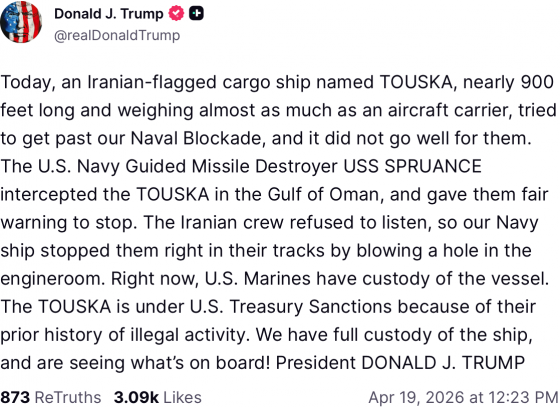
It took a while for that to sink in when I first came across that post by President Trump.
I could hardly believe what I had just read.
This is a major escalation.
And the U.S. is also threatening to seize Iranian vessels anywhere in the world during the days ahead…
The US military is preparing to board Iran-linked vessels and oil tankers in the coming days, a move that will expand a conflict largely confined to the Strait of Hormuz into a global crackdown.
General Dan Caine, the chairman of the Joint Chiefs of Staff, announced the escalation on Thursday, according to US officials who spoke with The Wall Street Journal.
Caine said the US ‘will actively pursue any Iranian-flagged vessel or any vessel attempting to provide material support to Iran’.
The Trump administration is convinced that this blockade is the key to ending the war.
They believe that the Iranians will be forced to give in eventually.
On the other side, the Iranians are convinced that holding the global economy hostage will force the Trump administration to give in.
Both sides are making tragic miscalculations, and meanwhile the entire world is suffering.
It is spring planting season, and we can’t get fertilizer from the Middle East into the hands of farmers all over the northern hemisphere that desperately need it…
Beginning in the 1960s, in an effort to diversify their economies, the Gulf countries invested heavily in their fertilizer industries, leveraging their abundant natural resources. Foreign fertilizer companies began flocking to Dubai in the United Arab Emirates, drawn by low taxes, a favorable geographic location, and the city’s seamless air and sea transport hubs.
The Gulf’s investment in fertilizer paid off, as by 2026, much of the developing world was reliant on Gulf fertilizers. Three of the top ten global urea exporters, the world’s most commonly used nitrogen-based fertilizer, are located within the Persian Gulf. One-third of internationally traded fertilizers and roughly 45% of sulphur exports, a key ingredient in phosphate fertilizers, pass through the Strait of Hormuz.
Iran’s blockade has brought all of these exports to a near-halt. The timing could hardly be worse, coming during planting season for much of the world.
In addition, nations such as India that normally import large amounts of natural gas from the Middle East in order to make their own fertilizer are being forced to cut back production…
The effects go well beyond halting shipments of fertilizer produced in the Gulf, which is situated at the head of a vast global supply chain. India, itself a big fertilizer producer, has had to scale back production due to fuel shortages linked to the war. New Delhi ordered fertilizer plants to scale back production to 70% capacity to cope with the shortage.
“This is not only an energy shock. It is a systematic shock affecting agrifood systems globally,” Chief Economist of the Food and Agriculture Organization of the United Nations, Máximo Torero, warned on Thursday.
We are facing a global fertilizer crisis that is far beyond anything that we have ever seen before.
Here in the United States, this has come at a time when we are already in the midst of a historic drought…
A massive drought has emerged across large swaths of the US agricultural belt, threatening crops and livestock and eventually affecting food prices, at a time when fertilizer and diesel costs are soaring. As of early April, 60% of the Lower 48 is in drought as the Northern Hemisphere growing season begins and farmers begin plantings, according to NOAA.
The southern US is already experiencing severe, extreme, and even exceptional drought conditions, putting pressure on key crops such as sugarcane, rice, and peanuts, while fruit trees have also been damaged by extreme temperatures.
Food production is going to be way down all over the planet in 2026.
José Andrés is warning that we are headed for “a very big increase in famine across the world by the fall of 2026 and 2027″…
The celebrity chef and humanitarian José Andrés has a warning for the suits in Washington and around the world: stop looking at the oil tickers and start looking at the soil.
The World Central Kitchen (WCK) founder believes that the world is sleepwalking into a massive, multi-year famine, being slow-walked by the “silent” collapse of the global fertilizer trade as a byproduct of the war with Iran.
“I foresee a very big increase in famine across the world by the fall of 2026 and 2027,” Andrés told the Guardian on the sidelines of Semafor’s global economy conference in Washington.
He is right.
If the Strait of Hormuz does not open soon, food shortages will hit the world like a freight train in 6 to 9 months.
But unless consequences are going to hit us immediately, most people in the western world don’t seem to care.
Instead, most of us just continue to go about our lives as if nothing unusual is going on, and for the moment ignorance is bliss.
Michael’s new book entitled “10 Prophetic Events That Are Coming Next” is available in paperback and for the Kindle on Amazon.com, and you can subscribe to his Substack newsletter at michaeltsnyder.substack.com.

About the Author: Michael Snyder’s new book entitled “10 Prophetic Events That Are Coming Next” is available in paperback and for the Kindle on Amazon.com. He has also written nine other books that are available on Amazon.com including “Chaos”, “End Times”, “7 Year Apocalypse”, “Lost Prophecies Of The Future Of America”, “The Beginning Of The End”, and “Living A Life That Really Matters”. When you purchase any of Michael’s books you help to support the work that he is doing. You can also get his articles by email as soon as he publishes them by subscribing to his Substack newsletter. Michael has published thousands of articles on The Economic Collapse Blog, End Of The American Dream and The Most Important News, and he always freely and happily allows others to republish those articles on their own websites. These are such troubled times, and people need hope. John 3:16 tells us about the hope that God has given us through Jesus Christ: “For God so loved the world, that he gave his only begotten Son, that whosoever believeth in him should not perish, but have everlasting life.” If you have not already done so, we strongly urge you to invite Jesus Christ to be your Lord and Savior today.