No matter what happens now, the world is facing a very painful energy crisis. Let’s be as wildly optimistic as we possibly can and assume that Iran agrees to allow free passage through the Strait of Hormuz with absolutely no tolls or restrictions starting tomorrow. Before normal traffic through the Strait could resume, Iran would first have to remove all of the mines that they have laid in the Strait, and that could take months. Once all of the mines have been removed, it will take the tankers that are currently trapped in the Persian Gulf weeks to arrive at their destinations. Moving forward, Persian Gulf countries will be exporting much less oil and natural gas for the foreseeable future because of all the oil and natural gas infrastructure that was damaged or destroyed during the war. It will take years before all of that infrastructure is fully repaired and rebuilt. Meanwhile, global supplies of oil and natural gas will be very tight for an extended period of time.
What I have just laid out for you is the best case scenario.
Ultimately, what we end up facing could be so much worse.
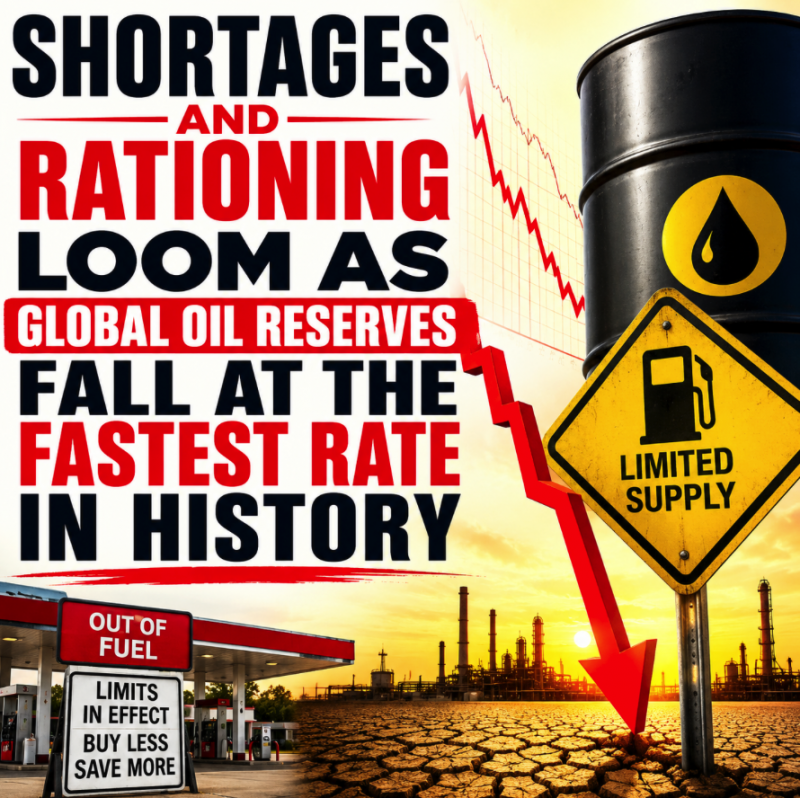
Over the past couple of months, global oil reserves have been falling at the fastest rate ever recorded…
Record inventory draw: Global oil stocks have fallen by 246 million barrels in March-April, with draws in May hitting a record 8.7 million barrels per day.
Hormuz closure impact: The Strait of Hormuz shutdown has cut off 25% of the world’s seaborne oil, compounding already low reserves and boosting prices.
US price outlook: Analysts expect U.S. gasoline prices could reach $5 this summer unless flows resume, with relief unlikely before autumn.
Needless to say, this is not sustainable.
Here in the United States, the strategic petroleum reserve has been dropping at a record-breaking pace…
The SPR’s most recent drawdown, covering the week ended May 22, shows a drop of 9.1 million barrels, leaving the reserves at 365 million barrels. The previous weekly drawdown, covering the week of May 15, was its steepest on record — the U.S. withdrew 9.92 million barrels from the SPR then.
Before that record-breaking decline, the largest weekly drop in the SPR’s history occurred in the week ended Oct. 7, 2022, when the reserves dropped by 7.41 million barrels, and was connected to the war in Ukraine.
Commercial oil inventories are being rapidly depleted as well.
At some point the tanks are going to hit minimum operating levels and we are going to have an enormous crisis on our hands.
The chief economist at Capital Economics is projecting that commercial oil inventories “could reach critically low levels by the end of June”…
“At the current pace of drawdown, commercial oil stocks could reach critically low levels by the end of June,” Neil Shearing, chief economist at Capital Economics, wrote in a research note on May 18.
If supply conditions don’t improve soon, “prices could rise sharply,” Shearing warned.
Jeff Currie is warning that Asia is already very close to minimum operating levels, and he is projecting that the U.S. could potentially be dealing with shortages in July…
Oil markets are nearing minimum operating levels in Asia, with Europe likely next and the U.S. potentially facing shortages by July, said veteran market strategist Jeff Currie on Monday, underscoring the global energy shock due to the Iran war.
Headline global inventory figures can be misleading as much of the oil stored worldwide cannot be used immediately, said Currie, Carlyle’s chief strategy officer of energy pathways and co-chairman of Abaxx Markets.
A large portion of that oil is needed to keep pipelines and storage systems running safely, leaving only a smaller share available for the market. Asia is already close to these so-called “minimum operating levels,” Currie told CNBC on the sidelines of the UBS Wealth Conference in Singapore.
This is really happening.
The Australian government is so concerned about what is ahead that they have already prepared a plan to limit the amount of fuel each vehicle can purchase per day when that becomes necessary…
Contained in documents obtained by Guardian Australian under freedom of information, one option the government had at its disposal to arrest a local fuel supply shortage would be to impose a “maximum transaction value per vehicle per day” – a rationing rule which would limit how much fuel a single vehicle can buy at a service station over a 24-hour period.
If the Strait of Hormuz does not get reopened, we could eventually see similar measures get implemented all over the world.
Of course rationing of motor oil has already started…
Nissan is rationing 5W-30 and 0W-20 Nissan Genuine Motor Oils. Starting this week, Nissan’s stock of these oils has dropped by 30% year-on-year. With only 70% left in the tank, the brand is already taking precautions, sending memos to dealers to manage its stock during the shortage.
The brand will prioritize certain owners, such as those claiming “warranty, extended warranty, recall repairs, goodwill, and prepaid maintenance,” according to Kim Less, the vice president of aftersales at Nissan Americas, in the bulletin addressed to Nissan dealers.
“Given these constraints, it is critical to prioritize the use of Nissan Genuine 0W-20 (and 5W-30, where applicable) for warranty, extended warranty, recall repairs, goodwill, and prepaid maintenance,” Kim Less, vice president of aftersales, Nissan Americas, said in the May 15 bulletin to Nissan dealers.
I would encourage my readers to stock up on motor oil while they still can.
Supplies are only going to get tighter from this point forward.
The pharmaceutical industry is also very dependent on raw materials from the Middle East, and one pharmacist is claiming that the current drug shortage is the “worst I’ve ever known”…
Some people living with heart conditions, stroke risks, eye infections and bipolar disorder are among those unable to get the medications they rely on, a pharmacist has said.
Graham Jones, who owns Shrivenham Pharmacy in Oxfordshire, said vital medication like aspirin was harder to obtain because of surging global prices and government funding which was not keeping up with costs.
Jones said the current medication shortage was the “worst I’ve ever known”.
Personally, I am even more concerned about the global fertilizer shortage.
The UN is telling us that we could be facing a worldwide food crisis that could last for “years”…
The de facto closure of the Strait of Hormuz risks a global food crisis that could extend for years, the UN warned.
Global fertilizer companies have slashed production over shortfalls of sulphur, required to make many farming inputs; about half of the global supply passed through the strait before the Iran war.
As a result, farmers are likely to produce lower yields in coming harvests. Richer economies like those in Europe are mulling building fertilizer stockpiles, reducing duties on imports, and onshoring production, but poorer ones have limited room to adapt.
I want to be very clear about what lies in front of us.
No matter what happens now, there will be shortages and rationing.
It is just a matter of how intense they will be and how long they will last.
Needless to say, the outlook for the global economy in the months ahead is not promising at all.
We really do have a major crisis on our hands, and it will become a historic nightmare if the Strait of Hormuz does not get reopened soon.
Michael’s new book entitled “10 Prophetic Events That Are Coming Next” is available in paperback and for the Kindle on Amazon.com, and you can subscribe to his Substack newsletter at michaeltsnyder.substack.com.

About the Author: Michael Snyder’s new book entitled “10 Prophetic Events That Are Coming Next” is available in paperback and for the Kindle on Amazon.com. He has also written nine other books that are available on Amazon.com including “Chaos”, “End Times”, “7 Year Apocalypse”, “Lost Prophecies Of The Future Of America”, “The Beginning Of The End”, and “Living A Life That Really Matters”. When you purchase any of Michael’s books you help to support the work that he is doing. You can also get his articles by email as soon as he publishes them by subscribing to his Substack newsletter. Michael has published thousands of articles on The Economic Collapse Blog, End Of The American Dream and The Most Important News, and he always freely and happily allows others to republish those articles on their own websites. These are such troubled times, and people need hope. John 3:16 tells us about the hope that God has given us through Jesus Christ: “For God so loved the world, that he gave his only begotten Son, that whosoever believeth in him should not perish, but have everlasting life.” If you have not already done so, we strongly urge you to invite Jesus Christ to be your Lord and Savior today.