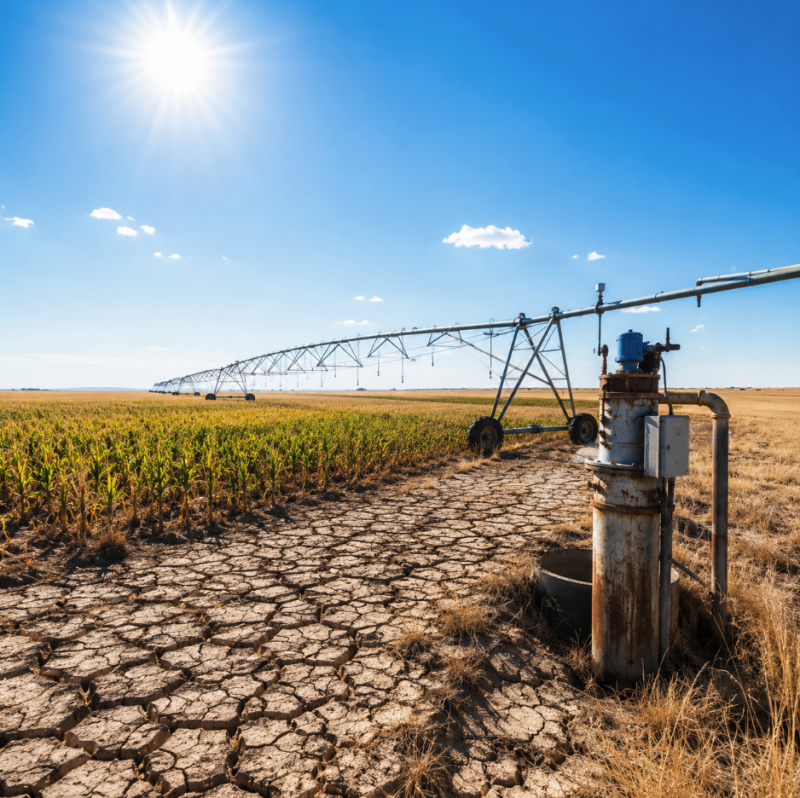
Gigantic underground aquifers are being rapidly depleted all over the world, and once that water is gone it will take a very long time for it to come back. In fact, in some areas of the United States the recharge rate is less than an inch per year. That is a major problem, because more than half of the water that U.S. farmers use for irrigation comes from underground aquifers. What in the world are our farmers going to do once that water is gone?
The largest underground aquifer in the United States is known as the Ogallala Aquifer. It covers a vast area under portions of eight different states, and it accounts for approximately 30 percent of all groundwater that is used for irrigation in our nation…
The Ogallala Aquifer (oh-gə-LAH-lə) is a shallow water table aquifer surrounded by sand, silt, clay, and gravel located beneath the Great Plains in the United States.
As one of the world’s largest aquifers, it underlies an area of approximately 174,000 sq mi (450,000 km2) in portions of eight states (South Dakota, Nebraska, Wyoming, Colorado, Kansas, Oklahoma, New Mexico, and Texas).[1] It was named in 1898 by geologist N. H. Darton from its type locality near the town of Ogallala, Nebraska. The aquifer is part of the High Plains Aquifer System, and resides in the Ogallala Formation, which is the principal geologic unit underlying 80% of the High Plains.[2][3]
Large-scale extraction for agricultural purposes started after World War II due partially to center pivot irrigation and to the adaptation of automotive engines to power groundwater wells.[4] Today about 27% of the irrigated land in the entire United States lies over the aquifer, which yields about 30% of the ground water used for irrigation in the United States.[5]
The Ogallala Aquifer is one of our most important natural resources.
Unfortunately, it is steadily drying up.
In fact, the amount of water that it has lost since the 1940s is roughly equivalent to the entire volume of Lake Erie…
The Ogallala Aquifer sits under eight states and 111.8 million acres of US farmland. A windmill can lift only a few gallons per minute, useful for drinking water but useless for agricultural purposes. In the 1940s, electrification reached the Great Plains and a Colorado farmer invented center pivot irrigation, a sprinkler line on wheels that rotated around a central wellhead. The 1949 version could lift thousands of gallons per minute and irrigate 40 acres.
Since then the aquifer has lost 286.4 million acre-feet of water, comparable to draining Lake Erie entirely. The parts of it beneath arid states have seen much bigger drops. Large parts of Western Kansas have lost 50 percent of their aquifer depth. Texan wells are down as much as 265 feet. On current trajectories, the water there will be gone in 20–30 years.
If we stay on our current path, farmers that depend on the Ogallala Aquifer will be faced with some very tough choices…
If large areas become effectively dry, farmers could be forced to switch from irrigated crops to less water intensive farming—or abandon production altogether.
Something must be done.
In Kansas, a plan to restrict water use has sparked a tremendous amount of controversy…
Southwest Kansas might take a big step toward water conservation in ways previously thought to be impossible.
Groundwater Management District 3, headquartered in Garden City, is looking for feedback from local farmers on its plan to use less water for crop irrigation in the region. A discussion on proposed water cuts recently attracted farmers from counties across the southwest part of the state, who filled a small community building.
Trevor Ahring, civil engineer for the district, told the sea of Kansas State University baseball caps and flannel shirts the details of the plan — all with the objective of easing the strain on the Ogallala Aquifer, which stretches from South Dakota to Texas.
Conserving water would make the Ogallala Aquifer last longer, but it would hurt agricultural production now.
One Kansas farmer is warning that even a small reduction in the amount of water used will make a huge difference in the number of bushels of corn that are produced at harvest time…
Roger Holmes, a long-time farmer in the area, said water cuts based on previous use won’t be fair to farmers who have been using water cautiously for years. And it puts those farmers at a disadvantage financially, he said.
“One inch of water produces about 15 bushel of corn. If you have three inches less than your neighbor, your average is going to be 50 bushel less per acre than that farmer across the road,” Holmes said.
Irrigated corn pays big. The loss of just 50 bushels could cost farmers up to $200 per acre. Most farmers in the room echoed Holmes’ concerns.
He is right.
Any short-term sacrifices will really hurt our farmers.
That is particularly true this year, because the first three months of 2026 were the driest first three months of a year in U.S. history, and now a “Godzilla El Niño” is coming.
During the months ahead, farmers in the heartland will need to irrigate their crops more than ever before.
But if we keep draining the water from our underground aquifers, eventually there will be nothing left.
Meanwhile, ranchers in the middle of the country are facing a new crisis that could potentially have a dramatic impact on beef prices.
On Friday, I wrote about the fact that a New World screwworm case had been confirmed in the state of Texas.
Now a second case has been confirmed, and USDA officials are starting to become extremely concerned…
The U.S. Department of Agriculture (USDA) confirmed a second New World screwworm (NWS) case in a one-month-old calf in Zavala County, Texas, roughly 5.6 miles from the first confirmed detection.
For now, both cases remain inside what the USDA calls an “established movement control zone and enhanced sterile insect dispersal area.” This suggests the outbreak is still contained within the USDA’s active response perimeter. Nearby suspect cattle tests have been negative so far, limiting signs of broader spread at this point.
USDA confirmed the second NWS case late Friday. The agency reported the first case on Thursday (read the report)
Our food supply is being hit by threats from so many directions right now.
And this is happening at a time when global supplies of food are just getting tighter and tighter.
All of the long-term trends are taking us in one direction, and it doesn’t take a genius to see where all of this is eventually heading.
Michael’s new book entitled “10 Prophetic Events That Are Coming Next” is available in paperback and for the Kindle on Amazon.com, and you can subscribe to his Substack newsletter at michaeltsnyder.substack.com.

About the Author: Michael Snyder’s new book entitled “10 Prophetic Events That Are Coming Next” is available in paperback and for the Kindle on Amazon.com. He has also written nine other books that are available on Amazon.com including “Chaos”, “End Times”, “7 Year Apocalypse”, “Lost Prophecies Of The Future Of America”, “The Beginning Of The End”, and “Living A Life That Really Matters”. When you purchase any of Michael’s books you help to support the work that he is doing. You can also get his articles by email as soon as he publishes them by subscribing to his Substack newsletter. Michael has published thousands of articles on The Economic Collapse Blog, End Of The American Dream and The Most Important News, and he always freely and happily allows others to republish those articles on their own websites. These are such troubled times, and people need hope. John 3:16 tells us about the hope that God has given us through Jesus Christ: “For God so loved the world, that he gave his only begotten Son, that whosoever believeth in him should not perish, but have everlasting life.” If you have not already done so, we strongly urge you to invite Jesus Christ to be your Lord and Savior today.