Now that the war with the Iranians appears to be fully back on, there will be no turning back now. President Trump just told reporters in the White House that “we’re going to be attacking them and attacking them very hard”, and so it should now be apparent to everyone that there isn’t going to be any sort of a “deal” any time soon. What this means is that we are headed for a historic energy squeeze of unprecedented magnitude.
So far, we have not experienced the full consequences of the war with Iran because we have been running through commercial oil inventories and national strategic stockpiles.
But that cushion is rapidly being depleted and in the not too distant future it will be gone.
Let me try to illustrate this in a way that just about everyone will be able to understand.
If you lost your job today, you probably would still have enough money to keep paying the bills for at least a few months.
But if you didn’t find a new job within a certain amount of time, you would potentially be in danger of getting kicked out into the streets.
We are facing a similar scenario with global oil supplies.
We had enough stored up to keep going for at least a few months, but some time this summer we will start hitting critical operating levels.
Once we reach that stage, gasoline prices will go nuts and shortages and rationing will begin to spread around the globe.
We won’t be out of oil.
But we won’t have enough for everyone to use as much as they normally would.
Today, it was being reported that by the end of this year global oil inventories will hit the lowest level since records began being kept…
Oil stockpiles in the world’s largest economies are headed toward the lowest levels since at least 2003 as inventories are drawn down at a record pace due to the lost output from the Iran war, the U.S. Energy Information Administration said on Tuesday.
Total oil inventories in the members of the Organization for Economic Cooperation and Development will fall to just under 2.3 billion barrels by December, the EIA said, based on its current assumption that marine traffic through the Strait of Hormuz is unlikely to return to pre-conflict levels until early 2027. The OECD stockpile has not been this low since the EIA began keeping records in 2003, the agency said in its monthly Short-Term Energy Outlook report.
The rapid inventory drawdown, which is needed to make up for 11 million barrels a day of lost Middle Eastern output, creates the foundation for a sharp increase in oil prices in the months ahead, the agency said.
Right now, the world is running an oil deficit.
In other words, we are consuming far more than we are producing and this cannot go on indefinitely.
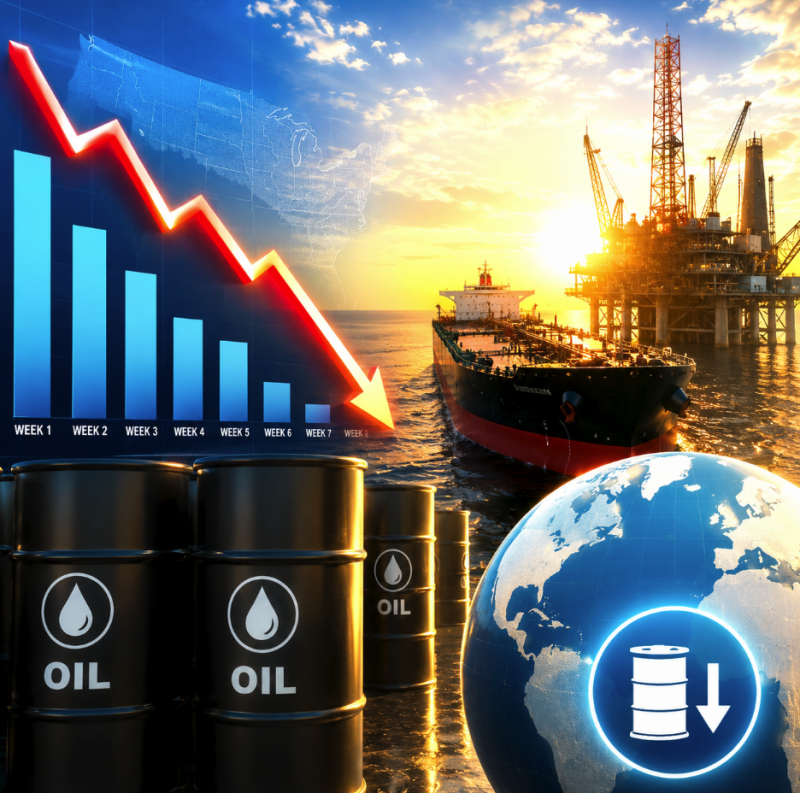
Here in the United States, oil inventories have dropped for a seventh week in a row…
U.S. crude oil inventories fell for a seventh consecutive week and product stocks were mixed as refineries stepped up their capacity use, according to data released Wednesday by the U.S. Energy Information Administration.
This is a slow-motion disaster that everyone can see coming.
One industry expert is warning that even if the Strait of Hormuz opened tomorrow, we are facing “disruptions that will probably last for at least three to six months”…
David Victor, the director of the Deep Decarbonization Initiative at the University of California, San Diego, said that in his analysis, even if the war ended tomorrow and the Strait of Hormuz was fully open, “we’ve already locked ourselves into disruptions that will probably last for at least three to six months.”
Prices, Victor explained, wouldn’t necessarily stay around their wartime highs for that whole time period. Rather, the end of the war would have a delayed impact on energy markets for the same reason the beginning of the war did: it takes time for such a change to work its way through global supply chains.
Of course the Strait of Hormuz is not going to reopen tomorrow.
In fact, there is no end to the war with Iran in sight.
So we are going to have some major problems on our hands.
It isn’t just an oil squeeze that we will be dealing with.
So many important commodities that normally come out of the Middle East are not getting exported, and this will manifest in thousands of different ways.
For example, hospitals in India are already facing a very serious shortage of cancer drugs due to the war in the Middle East…
Indian hospitals are running out of two life-saving cancer drugs as the war in Iran continues to disrupt the supply of raw materials.
Stocks of cisplatin and carboplatin, two of the most widely used chemotherapy drugs in the country, have begun running dry over the last three weeks, doctors and pharmaceutical industry representatives have said.
The two closely related drugs are derived from platinum, a precious metal that has surged in cost due to the Middle East conflict and the closure of the Strait of Hormuz, and form the backbone of treatment for about 60 per cent of advanced cancer cases.
And the UN’s World Food Program is already being forced to divert food from the hungry in order to give it to those that are starving…
Ripple effects from the war in Iran are threatening millions more of the most vulnerable people with crisis levels of hunger or worse, World Food Programme (WFP) acting Executive Director Carl Skau told CNN.
The closure of the Strait of Hormuz has driven up the cost of fuel exponentially, making the organization’s operations far more costly. The escalating fuel costs have also driven up the price of food around the world. And critically needed supplies of fertilizer from the Gulf to plant crops in places like Sudan have been stymied by the snarling of the critical waterway.
It is a devastating mix for an organization that was already having to make unimaginable choices due to significant cuts in funding.
“In many places, we’re already taking from the hungry to give to the starving,” Skau said.
This is the reality of life in 2026.
Widespread global food shortages are coming.
There is no way to avoid it now.
The consequences of the war in the Middle East are already being felt all over the world, but what we are witnessing now is just the beginning.
Michael’s new book entitled “10 Prophetic Events That Are Coming Next” is available in paperback and for the Kindle on Amazon.com, and you can subscribe to his Substack newsletter at michaeltsnyder.substack.com.

About the Author: Michael Snyder’s new book entitled “10 Prophetic Events That Are Coming Next” is available in paperback and for the Kindle on Amazon.com. He has also written nine other books that are available on Amazon.com including “Chaos”, “End Times”, “7 Year Apocalypse”, “Lost Prophecies Of The Future Of America”, “The Beginning Of The End”, and “Living A Life That Really Matters”. When you purchase any of Michael’s books you help to support the work that he is doing. You can also get his articles by email as soon as he publishes them by subscribing to his Substack newsletter. Michael has published thousands of articles on The Economic Collapse Blog, End Of The American Dream and The Most Important News, and he always freely and happily allows others to republish those articles on their own websites. These are such troubled times, and people need hope. John 3:16 tells us about the hope that God has given us through Jesus Christ: “For God so loved the world, that he gave his only begotten Son, that whosoever believeth in him should not perish, but have everlasting life.” If you have not already done so, we strongly urge you to invite Jesus Christ to be your Lord and Savior today.