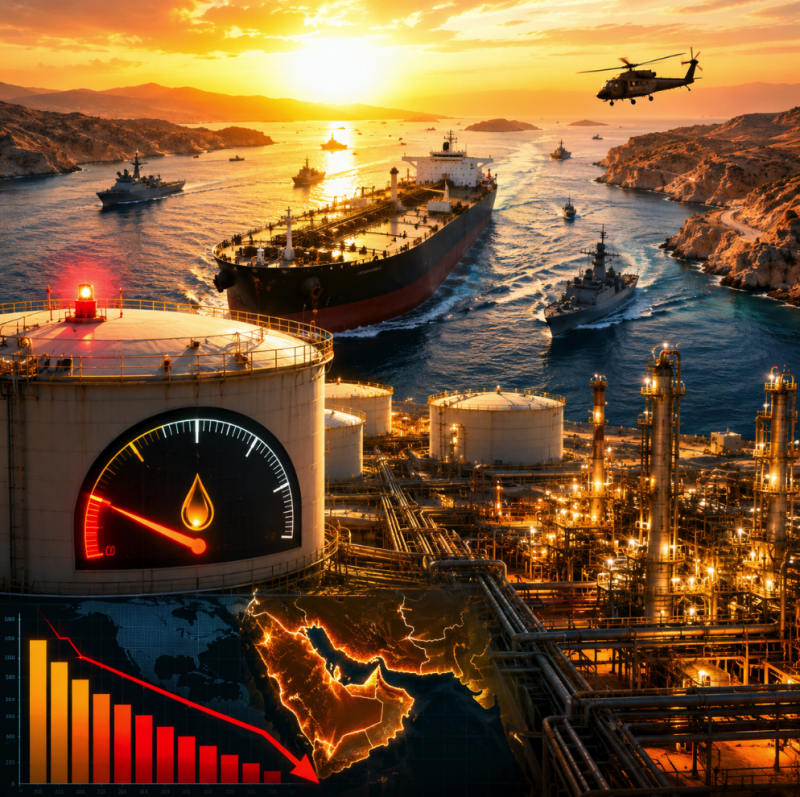
Those that believe that the global energy crisis is going to be magically solved by a “memorandum of understanding” that is already being violated by both sides are going to be in for a very rude awakening. As you will see below, the Iranians have continued to launch drones at commercial vessels in the Strait of Hormuz. How are shipowners and insurance companies supposed to feel comfortable while this is going on? In the “memorandum of understanding”, Iran agreed to allow commercial vessels to travel through the Strait at no charge for a period of 60 days. Hopefully that will actually happen. After the 60 day period is done, the Iranians have already announced that they are going to go back to charging ships to pass. Any ships that do not pay up will be subject to attack. Meanwhile, global oil supplies will just continue to get tighter and tighter.
Over the past couple of months, the U.S. has been the supplier of last resort for the entire world.
This has kept oil prices at reasonable levels.
But once our stockpiles are gone, we won’t be able to do that any longer.
Unfortunately, our stockpiles are rapidly disappearing. It is being reported that total U.S. oil inventories have now fallen for 10 weeks in a row…
U.S. crude oil inventories fell for a 10th straight week last week as demand surged, pushing total stockpiles to their lowest level in over 40 years as the Iran war continues to upend global energy markets, the U.S. Energy Information Administration said on Wednesday.
Total crude inventories, including commercial stocks and those in the Strategic Petroleum, plunged by 17.2 million to 758.5 million barrels last week, its lowest since March 1985, the EIA said.
The Strategic Petroleum Reserve is in better shape than commercial oil inventories, but even it has fallen to the lowest level since 1983…
The U.S. supply of emergency oil has hit its lowest level since 1983, according to newly released federal data.
The U.S. Strategic Petroleum Reserve (SPR) is down to 340.3 million barrels, according to the data released on Monday.
The last time that levels were this low was 1983, when the Reagan administration was filling up the reserve for the first time. The U.S. established the emergency oil reserve in 1975 after an oil producer embargo against the country triggered an energy crisis.
We should have never allowed ourselves to reach such a dangerously low level.
But I am far more concerned about what is happening to our commercial oil inventories.
The tanks in Cushing, Oklahoma are about to hit critical operating levels, and even CNN is writing about this…
Today, neighboring Cushing is the hub of America’s energy market. It literally provides the oil plumbing for the United States. It’s where America’s benchmark West Texas Intermediate oil is priced and warehoused. From there, it’s piped to refineries around the country.
In normal times, Cushing stores around 40 million barrels of oil with capacity of up to 75 million.
These are not normal times.
Right now, there are approximately 21.6 million barrels of oil at Cushing.
That sounds like a lot.
But as CNN has correctly noted, once the tanks at Cushing drop below 20 million barrels of oil “they effectively hit empty”…
Cushing’s current inventory is 21.6 million barrels, according to the US Energy Information Administration.
That’s dangerously close to operational stress levels, the tipping point at which Cushing struggles to supply all of its customers with the oil they demand.
When Cushing’s reserves get below 20 million, they effectively hit empty, scraping the bottom of the barrel of what is largely unusable sludge.
And when Cushing runs empty, strange things happen to the oil market.
To say that “strange things” will occur is a major understatement.
Once we hit the 20 million barrel mark at Cushing, there will be widespread panic.
We cannot drop below that level, because the storage tanks need a certain amount in them in order to be able to keep operating…
In oil storage tanks, “tank bottoms” refer to the unusable layer of sludge, sediment, water, paraffin, and other residues that settle at the base. These cannot be easily pumped or processed without operational issues.
At the Cushing hub level, the operational stress threshold is around 20 million barrels. Below this, pipelines lose pressure, blending and transfers between tanks become difficult or impossible, and outbound flows to refineries or export terminals can be curtailed or delayed.
Experts note that much of the remaining volume at current levels (potentially only 1–1.6 million barrels truly usable) consists of this sludgy material.
There is no way that we can keep supplying the rest of the world.
In fact, in very short order we won’t have enough oil to supply everyone in this country.
On Wednesday, President Trump openly told the press that the U.S. is on pace to “run out of reserves in about four weeks”…
President Trump’s comment at the tail end of the G7 press conference about rapidly depleting crude reserves may have been the clearest admission yet of what is really driving the urgent push for an MoU with Iran to reopen the Strait of Hormuz.
“We run out of reserves in about four weeks,” Trump told reporters.
This is one of the reasons why Trump was so desperate to make a deal with Iran.
But the deal is already failing.
According to NBC News, the Iranians “launched multiple drones toward commercial vessels in the Strait of Hormuz” after the memorandum of understanding was signed…
Iran has launched multiple drones toward commercial vessels in the Strait of Hormuz since the United States and Iran signed a memorandum of understanding on Sunday, according to a US official, NBC News reported on Tuesday.
The official said the Islamic Revolutionary Guard Corps (IRGC) has been carrying out repeated drone launches targeting shipping lanes in the strategic waterway. US forces have intercepted the drones before they could threaten commercial or military vessels, the report said.
According to NBC News, the official added that the IRGC has launched multiple drones each night since the agreement was signed, and that the US military continues to coordinate with commercial shipping operators to support safe transit through the Strait of Hormuz.
The Iranians were supposed to open the Strait of Hormuz.
Of course we were told the exact same thing when the first ceasefire agreement was signed, and that never materialized either.
But let’s assume that the Iranians stop attacking vessels in the Strait and decide to keep their word.
According to the text of the memorandum of understanding, the Iranians will have the right to control traffic through the Strait of Hormuz once a 60 day period of free passage is over…
Upon the signing of this MOU, Islamic Republic of Iran will make arrangements using its best efforts for the safe passage of commercial vessels with no charge for 60 days only from the Persian Gulf to the Sea of Oman, and vice versa. The traffic of commercial vessels will immediately start, and considering the need for removing the technical and military obstacles and demining by the Islamic Republic of Iran will be instated within 30 days. The Islamic Republic of Iran will conduct dialog with the Sultanate of Oman to define the future administration and maritime services in the Strait of Hormuz in discussion with other Persian Gulf or littoral states in line with the applicable international law and the sovereign rights of coastal states of the Strait of Hormuz.
As I have discussed previously, the Iranians have repeatedly stated that they intend to charge ships to pass through the Strait once the 60 day period has been completed.
And even if everything goes perfectly, it would still take many months for traffic through the Strait to return to close to pre-war levels.
Meanwhile, the world will continue to run an oil deficit.
Stockpiles will continue to be depleted, and there will be shortages.
Hopefully the shortages will be isolated.
But I wouldn’t count on that, because I am convinced that the war in the Middle East is far from over.
If all-out war erupts again, that will make the crisis that we are facing so much worse.
So let us hope for the best, but let us also get prepared for the worst.
Michael’s new book entitled “10 Prophetic Events That Are Coming Next” is available in paperback and for the Kindle on Amazon.com, and you can subscribe to his Substack newsletter at michaeltsnyder.substack.com.

About the Author: Michael Snyder’s new book entitled “10 Prophetic Events That Are Coming Next” is available in paperback and for the Kindle on Amazon.com. He has also written nine other books that are available on Amazon.com including “Chaos”, “End Times”, “7 Year Apocalypse”, “Lost Prophecies Of The Future Of America”, “The Beginning Of The End”, and “Living A Life That Really Matters”. When you purchase any of Michael’s books you help to support the work that he is doing. You can also get his articles by email as soon as he publishes them by subscribing to his Substack newsletter. Michael has published thousands of articles on The Economic Collapse Blog, End Of The American Dream and The Most Important News, and he always freely and happily allows others to republish those articles on their own websites. These are such troubled times, and people need hope. John 3:16 tells us about the hope that God has given us through Jesus Christ: “For God so loved the world, that he gave his only begotten Son, that whosoever believeth in him should not perish, but have everlasting life.” If you have not already done so, we strongly urge you to invite Jesus Christ to be your Lord and Savior today.