Since war with Iran erupted in February, the world has been using a lot more oil than it has been producing. The good news is that we had a tremendous amount of extra oil sitting around. As a result, we have been able to avoid shortages and we have been able to serve as the supplier of last resort for nations all over the globe. The bad news is that our commercial oil inventories are now almost entirely depleted, and the U.S. Strategic Petroleum Reserve is being drained very rapidly. We will soon hit a wall, and when that happens the global energy crisis will start getting really crazy.
According to the International Energy Agency, the amount of oil being produced globally each day is falling faster than they originally projected…
Global oil supply will fall by ~4% and oil demand is set for a deeper contraction this year, as renewed hostilities in the Middle East push up fuel prices and weigh on consumption, the International Energy Agency said in its monthly oil market report on Wednesday.
The Paris-based agency sees global oil supply falling by 4.3M bbl/day this year, compared with the 3.7M bbl/day forecast in the IEA’s July report, which would take total supply to the IEA’s lowest forecast yet for this year at 102M bbl/day.
At this stage, global demand for oil is well above global supply.
In fact, the International Energy Agency is now expecting the world to run an oil deficit of approximately 1.8 million barrels a day during the third quarter of this year. That is “more than double its previous estimate”…
The result would put global oil supply ~1.27M bbl/day below demand this year, widening from an 860K bbl/day deficit implied from the IEA’s July forecasts.
“Global oil supply has fallen well below demand due to the Strait of Hormuz shutdown, the U.S. blockade of Iranian exports, attacks within the Bab el-Mandeb Strait and reduced Kazakh CPC Blend exports,” the IEA said.
For Q3, the IEA expects the global oil market to run a deficit of 1.8M bbl/day, more than double its previous estimate of ~800K bbl/day and the deepest quarterly deficit since Q4 2021.
I realize that there is a lot of technical jargon there, and so let me try to break this down very simply.
Things are a lot worse than they thought they would be.
Now our commercial oil inventories have almost disappeared and the U.S. Strategic Petroleum Reserve has fallen under 300 million barrels for the first time since early 1983…
Crude oil stockpiles in the U.S. Strategic Petroleum Reserve have fallen below 300 million barrels, the lowest level in more than four decades, as global inventories stay under pressure due to the Iran war.
The SPR fell by 6.1 million barrels to 298.7 million barrels last week, according to data released by the Department of Energy on Monday. The reserve, created in 1975, is at its lowest level since January 1983.
Of course we will not be able to use all of that oil.
There is a certain level that we cannot go below, and apparently more than 25 percent of the oil is “physically inaccessible” for various reasons…
More than a quarter of that oil is physically inaccessible, blocked by failing pumps, corroded pipes, and underground salt caverns that have deformed beyond their operational parameters, according to internal government documents reviewed by Sputnik.
The finding means the actual emergency capacity of the American energy backstop is smaller, and slower to deploy, than any headline barrel count conveys.
We are being told that we have about 40 days left.
What will we do after that?
Already, diesel prices are starting to go through the roof…
U.S. and European diesel prices rose sharply on Monday after attacks on refineries in Russia and Saudi Arabia added to supply disruptions, raising concerns for farmers in need of the fuel for the planting season in the Northern Hemisphere and harvesting season in the Southern Hemisphere.
The U.S. ultra-low sulfur diesel futures contract rose 7.4% to settle at $4.19 a gallon on Monday, the biggest gains since July 13. European diesel refining margins, measured as the difference between the price of fuel and the cost of crude oil, rose nearly 10%.
The surge followed confirmation of an attack by Ukraine on a refinery in Russia’s Tatarstan region and another attack by Yemen’s Houthis on the Jazan refinery in Saudi Arabia. The Jazan refinery has been shut since July 27 due to an earlier strike by the Houthis, and plans to restart it have been postponed from August 15 to August 30, according to industry monitor IIR Energy.
It is just a matter of time before we see diesel shortages start to pop up all over the world.
This will greatly affect farmers and truckers.
What we really need is for the conflict in the Middle East to end and for traffic to start flowing through the Strait of Hormuz like it did before the war.
But that is not going to happen because there isn’t going to be a deal.
The Iranians are insisting that President Trump must agree to all of their demands before they will reopen the Strait, and there is no way that President Trump will ever do that.
So for now Trump is maintaining the naval blockade on Iran and he is declaring that the U.S. has “total control over the Strait of Hormuz”…
“The U.S.A. has total control over the Strait of Hormuz,” he wrote. “I THINK WE WILL KEEP IT! Our Naval Blockade is being called, by everyone, ‘A WALL OF STEEL,’ and there is nothing Iran can do about it. They have no Navy, they have no Air Force, their remaining soldiers are unpaid, the IRGC is decimated and fleeing, and their ‘Leadership’ is uncertain, at best! They have No Money – Their country is ‘shot.'”
Both sides can argue about who controls what, but nobody can deny that hardly anything is getting through.
In fact, only 8 vessels traveled through the Strait of Hormuz on Tuesday…
The number of vessels tracked transiting the Strait of Hormuz fell to a one-week low of eight, according to data reported by the Reuters news agency, as the ongoing conflict and stalemate kept shipping companies away from the vital waterway.
Tuesday’s tally of eight vessels fell below a 10-day average of about 12, for the lowest daily count since August 5, according to Kpler data reported by Reuters.
Around 130 ships a day passed through the vital waterway before the war started on February 28.
A drop from 130 ships to 8 ships is a disaster.
The world desperately needs the oil, natural gas, fertilizer and petrochemicals that normally travel through the Strait of Hormuz.
But now very few shipowners are willing to have their extremely expensive vessels make that trip.
Iran has been hitting one commercial vessel after another, and one tanker that recently got attacked has spilled oil over an area of 155 square miles…
Oil from a spill off Oman has started to reach the country’s mainland, the U.N.’s shipping body said on Wednesday, according to the Reuters news agency.
“Oil is drifting offshore to the northeast of [Oman’s] Al-Qibliyyah Island, with some oil reported to be reaching the mainland. Oil spill contingency planning is in place,” a spokesperson at the International Maritime Organization (IMO) said.
The oil is believed to be leaking from the grounded tanker Caroline Bezengi, with the slick now covering almost 155 square miles, according to the Omani government.
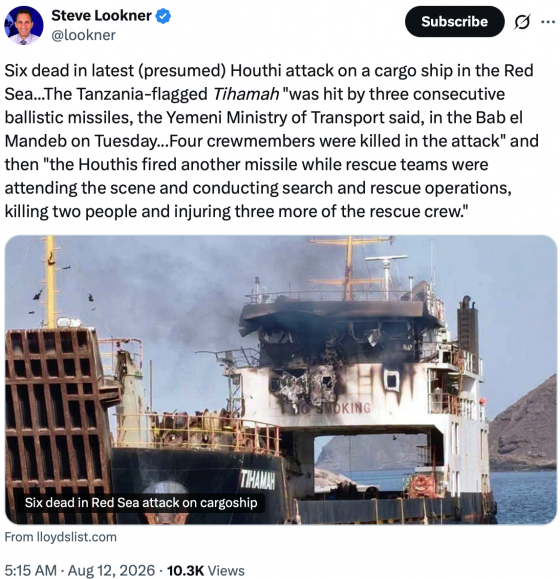
Meanwhile, the Houthis continue to fire missiles at commercial vessels in the Red Sea…
All of this has enormous implications for our economy.
An extended energy crisis will essentially guarantee a major global economic downturn.
We are already witnessing big problems in Japan and in Europe.
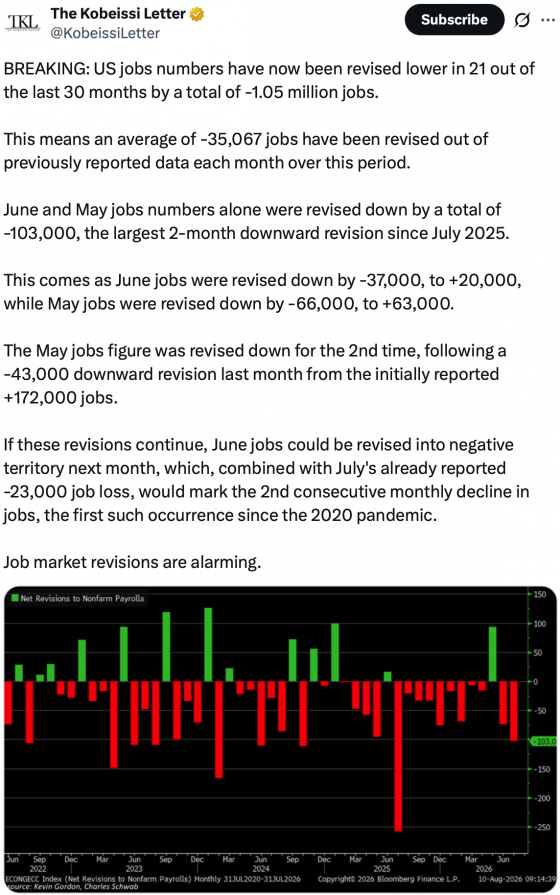
Here in the United States, we lost 23,000 jobs last month, and the employment numbers for 21 of the last 30 months have been revised down…
As I have discussed previously, the size of the U.S. workforce has shrunk by more than a million people over the past year.
Just think about that.
More than a million workers have simply disappeared from the workforce somehow.
Sadly, if the crisis in the Middle East is not resolved things will get a lot worse.
Our entire way of life depends upon cheap energy, and we now find ourselves in unprecedented territory.
Michael’s new book entitled “10 Prophetic Events That Are Coming Next” is available in paperback and for the Kindle on Amazon.com, and you can subscribe to his Substack newsletter at michaeltsnyder.substack.com.

About the Author: Michael Snyder’s new book entitled “10 Prophetic Events That Are Coming Next” is available in paperback and for the Kindle on Amazon.com. He has also written nine other books that are available on Amazon.com including “Chaos”, “End Times”, “7 Year Apocalypse”, “Lost Prophecies Of The Future Of America”, “The Beginning Of The End”, and “Living A Life That Really Matters”. When you purchase any of Michael’s books you help to support the work that he is doing. You can also get his articles by email as soon as he publishes them by subscribing to his Substack newsletter. Michael has published thousands of articles on The Economic Collapse Blog, End Of The American Dream and The Most Important News, and he always freely and happily allows others to republish those articles on their own websites. These are such troubled times, and people need hope. John 3:16 tells us about the hope that God has given us through Jesus Christ: “For God so loved the world, that he gave his only begotten Son, that whosoever believeth in him should not perish, but have everlasting life.” If you have not already done so, we strongly urge you to invite Jesus Christ to be your Lord and Savior today.