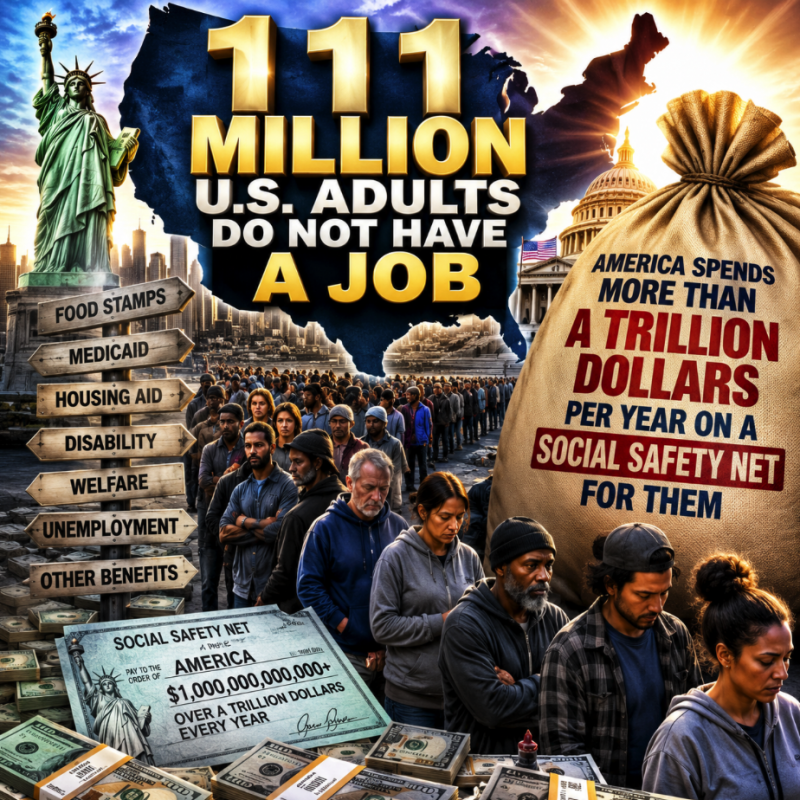
Did you know that the number of Americans that are out of work right now is far higher than it was at any point during the Great Recession? I know that sounds crazy, but I will prove it to you in this article. A whopping 111 million Americans do not have a job, and we are spending more than a trillion dollars a year on the social safety net that supports them. Of course we cannot afford to do this, because the national debt has already reached 39 trillion dollars and it is growing at an astounding rate. If we do not fix our economy, disaster is inevitable.
The bureaucrats in Washington keep telling us that the unemployment rate is low even though there are vast numbers of adults all around us that are not working.
The way that they are able to do this is by dumping almost everyone that is not working into a category known as “not in labor force”.
This allows them to keep the official rate of unemployment suppressed even as the labor force participation rate hits an insanely low level…
On the surface, a June drop in the unemployment rate helped provide some upside to what was an otherwise downbeat jobs report — but it was for all the wrong reasons.
That’s because the decline in the jobless level to 4.2%, the lowest in a year, came largely from an exodus of workers from the labor force, according to the Bureau of Labor Statistics data Thursday.
In fact, the measure of the working-age population either employed or looking for a job slid to 61.5%, the lowest since March 2021. Excluding the Covid-era jobs market, it was the lowest labor force participation rate in exactly 50 years.
Today, there are just over 7 million Americans that are officially unemployed.
That doesn’t sound bad at all.
But they rarely mention those that are considered to be not in the labor force. This is how the Federal Reserve defines that category…
Persons who are neither employed nor unemployed are not in the labor force. This category includes retired persons, students, those taking care of children or other family members, and others who are neither working nor seeking work.
As you can see from the chart below, the number of people that they have been dumping into that category has grown dramatically since 1990.
Right now, there are 104 million Americans that do not have a job that are considered to be not in the labor force…
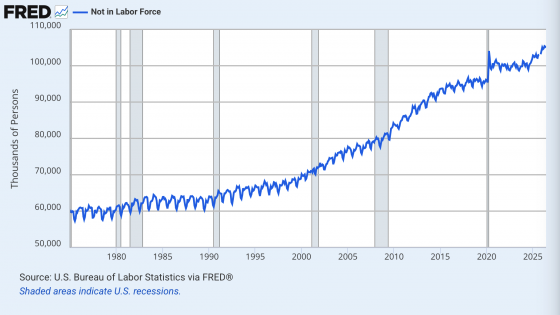
When you add the 7 million Americans that are officially unemployed to the 104 million Americans that are considered to be not in the labor force, you get a grand total of 111 million Americans that do not have a job right now.
At no point during the Great Recession did that combined figure ever reach 100 million.
That is how bad things are in the U.S. at this moment.
Of course the 111 million Americans that are not working need to be supported somehow.
Some of them are supported by other family members that have incomes coming in.
But most of them are either partially or totally supported by our social safety net.
According to the House Ways and Means Committee, we spend more than a trillion dollars a year on more than 80 different social safety net programs…
Buying Americans out of poverty is undermining incentives to work, with families living in poverty relying more on taxpayer-funded welfare checks than income from work, according to a newly released report from the Congressional Budget Office (CBO). Costing well over $1 trillion, America’s social safety net encompasses more than 80 federal programs, and is discouraging beneficiaries from seeking income from work.
The report, which was requested by Ways and Means Committee Chairman Jason Smith (MO-08), shows low-income families are becoming increasingly dependent on government transfers. In 1979, families living below the poverty line earned about 60 percent of their income from work. In 2021, that number dropped to an all-time low of around 25 percent. The report also shows how the dramatic increase in dependency on government transfers for low-income families was accelerated by COVID-era benefits.
Read that first paragraph again.
I had no idea that it was this bad.
For over a decade I have been writing about America’s ongoing economic collapse, and now we have reached a very advanced stage.
If the federal government was not supporting them, tens of millions more Americans would be living in poverty right now.
So what would our society look like if we stopped borrowing gigantic mountains of money to fuel this system?
And each day, even more Americans are losing their places in the middle class because they are getting laid off.
In fact, it is being reported that Microsoft is preparing for yet another round of massive layoffs…
Microsoft is reportedly planning another round of layoffs, expected to be announced as early as next week.
The cuts will impact thousands of roles across sales, consulting, and the Xbox gaming division. Total layoffs will amount to less than 2.5%% of the company’s workforce.
Microsoft employs roughly 220,000 people across the globe. The company eliminated approximately 15,000 positions just last year — 6,000 layoffs in May 2025 and another 9,000 layoffs in July 2025.
But if we just throw the entire country into the “not in labor force” category, we can pretend that the unemployment rate is at 0.0 percent and that everything is just fine, right?
What a joke.
Of course most Americans that are actually working are really struggling these days.
Home prices in the U.S. have risen by about 60 percent since the beginning of the last pandemic, and at this stage housing in the U.S. is more unaffordable than it has ever been before…
Home prices have grown by roughly 60 percent since the onset of the COVID-19 pandemic, according to JP Morgan data. Mortgage rates are historically high, and have been so since 2022. And the U.S. homeownership rate hit its lowest level since 2019 last year, at 65 percent, according to Census data.
“I think right now the housing market is pretty unprecedented,” Daryl Fairweather, chief economist at Redfin, told Newsweek. “We have the highest home prices that have ever been on record, along with pretty high mortgage rates. The mortgage rates aren’t the highest we’ve seen on record—they exceeded 18 percent in 1981—but they are higher than they have been for the last 10 years or so.
“And so housing affordability has gotten really bad, especially for young people who don’t already own homes. Breaking into the housing market is incredibly tough.”
How are young adults supposed to purchase homes in this environment?
Home prices have risen far faster than incomes have, and this has “put homeownership out of reach for millions of millennial and Gen Z Americans”…
Back in 1975, a typical home cost about 2.4 times as much as the average under-40 household earned in a year, a standard measure of housing affordability, according to a new report from Pew Research Center.
By 2019, that price-to-income ratio had risen to 2.9. In 2024, it reached 3.5.
Over the past decade, home prices have risen much faster than wages. The rising ratio of price to income, coupled with elevated interest rates, has put homeownership out of reach for millions of millennial and Gen Z Americans.
This is one of the biggest reasons why young adults are so angry.
They simply can’t afford to live normal lives.
Last year, the percentage of first-time homebuyers dropped to the lowest level ever recorded…
First-time buyers represented only 21% of all home purchasers in 2025, a record low, according to the National Association of Realtors. The typical age of a first-time buyer climbed to 40, an all-time high.
Meanwhile, virtually everything else is becoming more expensive too.
For example, the price of ground beef is up 13 percent over the past year, and that price of steak is up 16 percent over the past year…
The average price of ground beef was $6.75 per pound in May, according to U.S. Bureau of Labor Statistics data, up nearly 13% from a year ago and just below April’s record high of $6.90. Beef steak prices averaged $12.80 per pound, up 16% from a year earlier and the second-highest level on record.
Tens of millions of Americans are deeply hurting right now, and what we have experienced so far is just the beginning.
This is why I rant about the economy so much.
I hear from so many people out there that are in very real pain.
Decades of very foolish decisions have resulted in decades of economic decline, and now we really have reached a breaking point.
Michael’s new book entitled “10 Prophetic Events That Are Coming Next” is available in paperback and for the Kindle on Amazon.com, and you can subscribe to his Substack newsletter at michaeltsnyder.substack.com.

About the Author: Michael Snyder’s new book entitled “10 Prophetic Events That Are Coming Next” is available in paperback and for the Kindle on Amazon.com. He has also written nine other books that are available on Amazon.com including “Chaos”, “End Times”, “7 Year Apocalypse”, “Lost Prophecies Of The Future Of America”, “The Beginning Of The End”, and “Living A Life That Really Matters”. When you purchase any of Michael’s books you help to support the work that he is doing. You can also get his articles by email as soon as he publishes them by subscribing to his Substack newsletter. Michael has published thousands of articles on The Economic Collapse Blog, End Of The American Dream and The Most Important News, and he always freely and happily allows others to republish those articles on their own websites. These are such troubled times, and people need hope. John 3:16 tells us about the hope that God has given us through Jesus Christ: “For God so loved the world, that he gave his only begotten Son, that whosoever believeth in him should not perish, but have everlasting life.” If you have not already done so, we strongly urge you to invite Jesus Christ to be your Lord and Savior today.