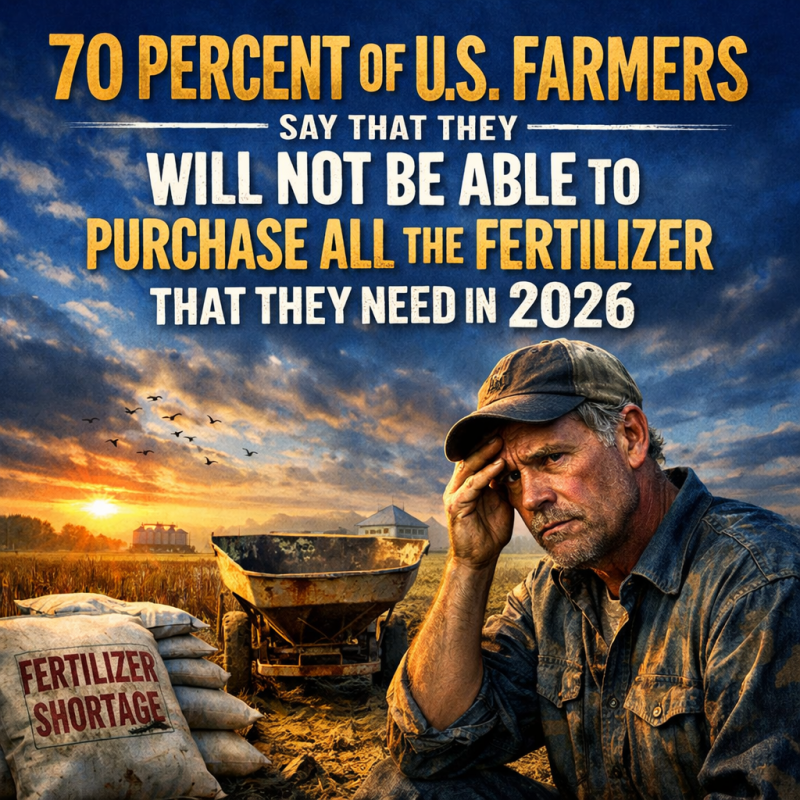
We might want to listen to what the farmers are telling us, because if they don’t grow our food we do not eat. Coming into this year, we were already facing the worst farming crisis in America in at least 50 years. Farmers all over the nation are drowning in debt, and farm bankruptcies have been soaring. In all my years, I have never seen America’s farmers so angry, and now the crisis in the Strait of Hormuz has made things much worse. Spring planting season is here and there is a global scramble for whatever supplies of nitrogen fertilizer that happen to be available. As a result, prices have skyrocketed and farmers all over the planet are facing some incredibly tough choices.
That is even true here in the United States.
According to a brand new survey that was just conducted by the American Farm Bureau Federation, 70 percent of U.S. farmers say that they will not be able to purchase all of the fertilizer that they need in 2026 because it has become so expensive…
Conducted by the American Farm Bureau Federation April 3-11, the survey shows 70% of respondents say fertilizer is so expensive that they will not be able to buy all the fertilizer they need.
More than 5,700 farmers, both Farm Bureau members and non-members, from every state and Puerto Rico took the survey. Farm Bureau economists analyzed the results in the latest Market Intel.
The analysis reveals that almost 8 in 10 farmers in the southern U.S. say they can’t afford all needed supplies this year, followed by the Northeast and West at 69% and 66%, respectively, compared to 48% of the farmers in the Midwest.
Fertilizer prices were already at frighteningly high levels even before the war with Iran started, and since that time they have surged dramatically…
Nitrogen fertilizer prices have gone up more than 30 percent since the start of the conflict on Feb. 28, according to Market Intel. Combined fuel and fertilizer costs have also risen between 20 and 40 percent, with urea prices jumping 47 percent since late February.
Many people out there don’t seem to understand this yet, but this is going to affect all of us.
If 70 percent of U.S. farmers use less fertilizer this year, those farmers will grow less food.
If there is less food available, prices will go up.
Needless to say, food prices are already at ridiculous levels, but they are going to go even higher.
In impoverished countries, conditions will be even worse.
Due to a historic lack of nitrogen fertilizer, hundreds of millions of families that are currently barely existing “may soon find they are only able to afford little or no food”…
In many parts of the world, vulnerable families who today are currently managing to put some food on the table may soon find they are only able to afford little or no food.
“If this conflict continues, it will send shockwaves across the globe, and families who already cannot afford their next meal will be hit the hardest,” said WFP Deputy Executive Director and Chief Operating Officer Carl Skau.
I wish that I could get people to understand how serious this is.
Goldman Sachs is publicly admitting that the global fertilizer crisis is spreading a lot faster than they were originally projecting.
We desperately need the Strait of Hormuz to be reopened immediately, but that simply isn’t going to happen.
The Iranians continue to strangle commercial traffic through the Strait, and the U.S. has now “completely” cut off traffic to Iranian ports…
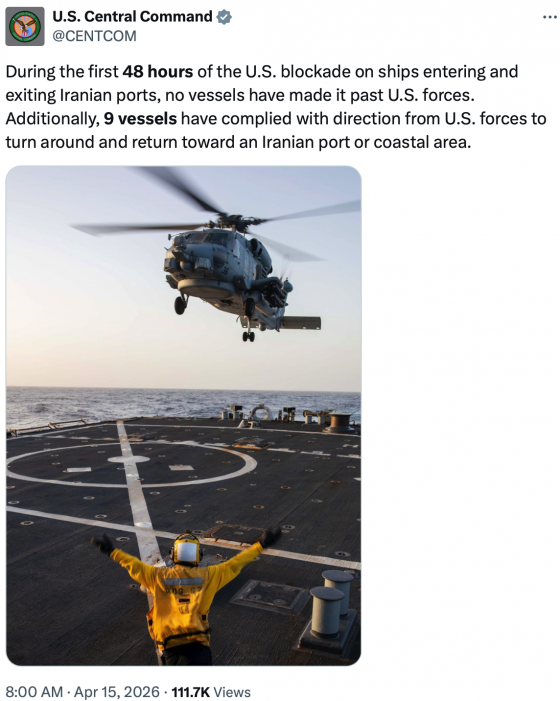
The U.S. blockade of Iranian ports is now fully into effect, “completely” cutting off Tehran’s international sea trade that powers about 90% of its economy, the U.S. Central Command said late Tuesday stateside.
The announcement comes at a time when the White House has been signaling a diplomatic solution to the conflict in the Middle East, as discussions around continuing negotiations with Iran are underway.
“A blockade of Iranian ports has been fully implemented as U.S. forces maintain maritime superiority in the Middle East,” said Brad Cooper, Centcom commander, highlighting that it was achieved under 36 hours of President Donald Trump’s order.
The Trump administration is convinced that this blockade will force the Iranians to give in.
According to U.S. Central Command, the first 48 hours of the blockade have been a resounding success…
But the Iranians are showing no signs of backing down.
On Wednesday, an official with the IRGC warned of severe consequences if the U.S. does not end the blockade…
Iran’s Revolutionary Guard announced Wednesday that Tehran would not allow the import or export of goods through the Persian Gulf, the nearby Gulf of Oman and the Red Sea unless the United States lifts the blockade it imposed earlier this week around the Strait of Hormuz.
Ali Abdollahi, commander of Iran’s Khatam al-Anbiya emergency headquarters, said the measures would be “firm and decisive” steps to protect Iran’s national interests and sovereignty.
According to Abdollahi, if the U.S. continues the blockade Iran has decided that it “will not allow any exports or imports to continue in the Persian Gulf, the Sea of Oman, and the Red Sea”…
In his statement broadcast by Iranian state television, Abdollahi said Iran would move to disrupt shipping routes in the Red Sea and elsewhere if the U.S. continued its blockade, initiated by President Donald Trump.
“The powerful armed forces of the Islamic Republic will not allow any exports or imports to continue in the Persian Gulf, the Sea of Oman, and the Red Sea,” the commander of the Khatam al-Anbiya Central Headquarters said.
If Iran is able to successfully stop commercial traffic from traveling through all of those waterways, it will greatly intensify the economic problems that we are starting to witness all over the globe.
In California, the average price of a gallon of gasoline has already almost reached 6 dollars…
Gas prices are soaring across the country, but especially in California. The Golden State average is now nearly $6 per gallon — 40 percent above the national figure. That gap is likely to widen: UC Davis economists estimate that Californians could soon be paying more than $2.50 a gallon above the national average.
In the United Kingdom, officials are bracing for widespread fuel shortages in “two or three weeks”…
Sources told ITV News that the UK is ‘two or three weeks away’ from shortages of diesel and jet fuel, although petrol supplies are healthier.
The Government is said to be facing ‘difficult decisions’ over how to allot fuel supplies, including how to keep ‘ancillary power’ going for NHS hospitals.
If the war with Iran is not resolved quickly, this will only be the tip of the iceberg.
The Iranians are holding the global economy hostage, and they fully realize that this gives them a tremendous amount of leverage.
But there is no way that the U.S. and Israel will ever agree to their demands.
So for now we seem to have an unsolvable problem on our hands, and meanwhile the damage that is being done to the global economy is getting worse with each passing day.
Michael’s new book entitled “10 Prophetic Events That Are Coming Next” is available in paperback and for the Kindle on Amazon.com, and you can subscribe to his Substack newsletter at michaeltsnyder.substack.com.

About the Author: Michael Snyder’s new book entitled “10 Prophetic Events That Are Coming Next” is available in paperback and for the Kindle on Amazon.com. He has also written nine other books that are available on Amazon.com including “Chaos”, “End Times”, “7 Year Apocalypse”, “Lost Prophecies Of The Future Of America”, “The Beginning Of The End”, and “Living A Life That Really Matters”. When you purchase any of Michael’s books you help to support the work that he is doing. You can also get his articles by email as soon as he publishes them by subscribing to his Substack newsletter. Michael has published thousands of articles on The Economic Collapse Blog, End Of The American Dream and The Most Important News, and he always freely and happily allows others to republish those articles on their own websites. These are such troubled times, and people need hope. John 3:16 tells us about the hope that God has given us through Jesus Christ: “For God so loved the world, that he gave his only begotten Son, that whosoever believeth in him should not perish, but have everlasting life.” If you have not already done so, we strongly urge you to invite Jesus Christ to be your Lord and Savior today.