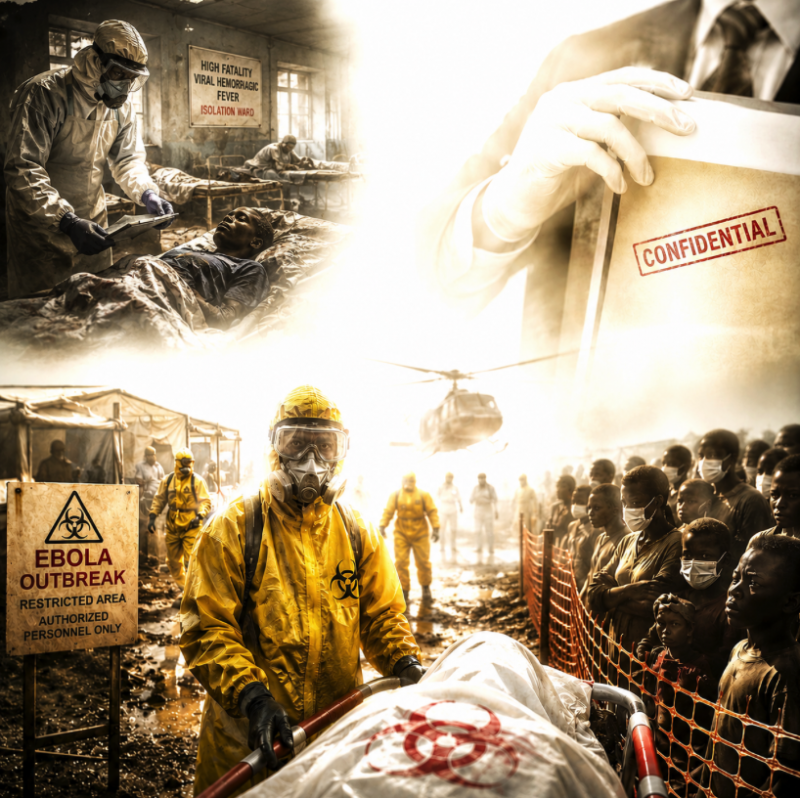
Hundreds of people have been dropping dead from a horrifying hemorrhagic disease in central Africa. We are being told that this isn’t the Zaire strain, which is the most common form of Ebola. Instead, authorities are telling us that this outbreak is being caused by the very rare Bundibugyo virus. Unlike the Zaire strain, there is no cure for the Bundibugyo virus. If you get infected, your odds of dying are somewhere between 25 and 50 percent. This is an extremely high death rate, but so far global health authorities have been able to keep everyone calm. They are assuring us that the threat outside of Africa is very low, and most people seem to be buying that story.
But is it accurate?
The International Rescue Committee is claiming that the Ebola outbreak is “likely far worse” than the official numbers suggest…
The Ebola outbreak surging in multiple African countries is ‘likely far worse’ than official reports make it seem, health experts have warned.
New York-based aid group the International Rescue Committee (IRC) warned Monday that response efforts in the Democratic Republic of the Congo (DRC), the epicenter of an ongoing Ebola outbreak, are struggling due to delayed detection and low levels of contact tracing.
Of course the “official numbers” have been fluctuating all over the place.
On Tuesday, the WHO released figures that were far lower than they had previously been giving us…
The United Nations’ World Health Organization significantly scaled back on Tuesday the number of suspected Ebola cases in central Africa, lowering it to 116 from more than 900, with 330 total cases confirmed.
The WHO said that as of May 31, there were 116 suspected cases of the deadly virus registered in Democratic Republic of Congo — a massive reduction from the 906 that had been on the books late last week.
If the WHO has determined that this outbreak is actually much less severe than originally thought, that would be great news.
But if they are simply trying to keep everyone calm by releasing smaller numbers, that would not be good at all.
One expert is warning that the statistics that are being fed to the public are simply not telling us the whole story…
“The true scale of this Ebola outbreak is likely far worse than official figures suggest,” Rachel Howard, Senior Technical Emergency Health Advisor at the IRC, said.
“When four out of five contacts are not being traced, it becomes incredibly difficult to contain the outbreak or even understand its true scale. We’re especially concerned about the virus spreading to other countries like Burundi or South Sudan,” Ms Howard added.
We do know that large numbers of people have been dying in local hospitals.
And we also know that the Trump administration is so concerned about this virus that they are absolutely refusing to allow any U.S. citizens that get infected to be treated on U.S. soil…
The Trump administration said it “cannot and will not allow” any cases to enter the U.S. That’s a departure from the U.S. handling of the Ebola outbreak in 2014, when several infected American patients were treated on U.S. soil.
If this outbreak isn’t that big of a deal, why would the Trump administration do this?
Personally, I think that it is a far bigger deal than global health authorities are admitting.
It seems that the very first case appeared in the Democratic Republic of the Congo in January…
The first Ebola case in the current epidemic in the Democratic Republic of Congo (DRC) may date back as far as January, according to local medics.
The information was shared with several international NGOs, including the International Rescue Committee (IRC), Action Aid and Doctors Without Borders (MSF), by local medics last week, sources have told The Telegraph.
The medics believe the outbreak began with a patient treated at a hospital in Rwampara, a town in eastern DRC, in late January. They said the patient went on to infect eight healthcare workers before dying in February.
If one infected individual was able to infect eight different healthcare workers before he died, that is a very bad sign.
And if that case in January really was “patient zero”, that means that the virus was spreading unchecked for four months before global health authorities started to respond.
On Wednesday, we learned that the outbreak has now reached yet another new area of the Democratic Republic of the Congo…
Ebola has reached a health zone more than 100 miles from the mining town where Democratic Republic of Congo’s outbreak is believed to have begun, as responders track fewer than 40% of known contacts in the epidemic’s hardest-hit province.
Health officials in Ituri province, which accounts for almost 94% of confirmed infections, were actively monitoring only 39.3% of identified contacts, the country’s National Institute of Public Health said in a report Tuesday. The newly affected health zone of Mambasa lies southwest of the town of Mongbwalu, considered the outbreak’s point of origin, bringing the total number of affected health zones nationwide to 24.
The fact that this strain of Ebola is now spreading in Mambasa is very troubling news, because that part of the DRC is controlled by Islamic State militants…
A rare strain of Ebola has reached a corner of the Democratic Republic of Congo controlled by Islamic State militants, a place too dangerous for health workers fighting to stop the deadly virus.
The Bundibugyo strain has killed one person in the militant-controlled territory of Mambasa, which is some 100 miles from the outbreak’s epicenter in a gold-mining town of Mongbwalu. Mambasa is the stronghold of the Allied Democratic Forces, an Islamic State affiliate conducting an insurgency against Congolese and Ugandan troops.
Health authorities aren’t going to be able to do much of anything as the virus spreads throughout Mambasa.
We can only hope that the outbreak there fizzles out somehow.
Meanwhile, cases have started to pop up outside of the DRC as well…
A growing number of cases have also been detected in neighboring Uganda and South Sudan and patients are under observation in Italy and Brazil. An American who tested positive for the virus was evacuated for treatment to Germany.
The variant, which has no current treatments or vaccines, kills up to 50 percent of those infected.
I think that any hope of successfully containing this outbreak has already been lost.
In Uganda, the number of confirmed cases has now risen to 15…
Neighboring Uganda also confirmed six new cases Tuesday, bringing its total to 15 infections, including one death.
In Brazil, one of the individuals that was suspected of being infected has tested negative…
One of two patients being monitored by Brazilian health authorities for possible Ebola infection in Sao Paulo and Rio de Janeiro has tested negative, officials said Sunday. The possible infections have sparked further concern over the deadly virus outbreak in central Africa spreading abroad.
A 37-year-old man from the Democratic Republic of the Congo, where the outbreak has been concentrated, “exhibited symptoms such as fever, meeting the definition of a suspected case” of Ebola, the Sao Paulo state government said in a statement on Saturday.
While initial tests did not detect the Ebola virus in the patient, he is being monitored and isolated as a precautionary measure at a specialized infectious disease facility, the statement said.
That is good news.
But what about the other suspected case?
And what about the two suspected cases in Italy?
Ebola has never spread outside of Africa before.
If this outbreak does make that jump, we are going to start to see a lot of panic all over the world.
During the global pandemic that we went through earlier this decade, the death rate was extremely low.
But for the Bundibugyo virus, the death rate is somewhere between 25 and 50 percent…
The mortality rate for the Bundibugyo virus ranges from 25 to 50 percent.
The Zaire strain, which is the most common form of Ebola, can be treated with the drugs Inmazeb and Ebanga and the Ervebo vaccine, which is administered only during outbreaks.
If this outbreak had been caused by the Zaire strain, I would not be concerned at all.
Unfortunately, the tools that are used to fight the Zaire strain are not effective against the Bundibugyo virus.
Every day more people are dropping dead, and I will be watching this story very closely.
There are two last things that I wanted to mention in this article.
First of all, it has come out that a laboratory worker in Montana was bitten by a monkey that had been infected with a strain of Ebola last November…
Senator Tim Sheehy said this month he called for Montana’s Inspector General to open a probe into the Rocky Mountain Lab, a government research laboratory focusing on infectious diseases.
According to a letter Sheehy sent to officials, a worker at the laboratory was bitten through their protective equipment by a monkey infected with Crimean-Congo hemorrhagic fever, a strain of Ebola, in November 2025.
The employee, who has not been publicly identified, was treated following the monkey attack but did not contract the lethal illness, and officials said they soon returned back to work.
Did the monkey bite puncture the skin of that employee?
And exactly how soon did that employee return to work?
Hopefully we will get answers to those two questions.
We have also just learned that two researchers that had been working at that exact same facility have been charged with attempting to smuggle the monkeypox virus into the United States…
Two researchers with the National Institutes of Health have been charged with allegedly trying to smuggle the infectious monkeypox virus into the United States, according to the Department of Justice.
In a news release issued Tuesday, the department announced Vincent Munster and Claude Kwe with the NIH Rocky Mountain Laboratory had been charged with “conspiracy to smuggle” the virus, as well as giving false statements to federal law enforcement in January.
The department says Munster and Kwe arrived at the Detroit Metropolitan Airport, with “a large black plastic case” after traveling from Brazzaville, Republic of Congo, where an outbreak of monkeypox was occurring. Monkeypox, also known as Mpox, is a viral illness that is spread through close contact, with symptoms that include fevers, headaches and a rash that looks like blisters or sores, according to the World Health Organization.
The large plastic case that you see someone carrying through an airport could have a deadly virus in it.
And as we have seen, it is way too easy for a lab accident to happen.
We live at a time when mad scientists all over the globe are “playing god” with some of the deadliest diseases that humanity has ever known.
It is probably inevitable that more diseases that have been purposely modified will get out.
So enjoy this period of relative stability while you still can, because I am convinced that global pestilences will be a major theme during the chaotic months and years that are ahead.
Michael’s new book entitled “10 Prophetic Events That Are Coming Next” is available in paperback and for the Kindle on Amazon.com, and you can subscribe to his Substack newsletter at michaeltsnyder.substack.com.

About the Author: Michael Snyder’s new book entitled “10 Prophetic Events That Are Coming Next” is available in paperback and for the Kindle on Amazon.com. He has also written nine other books that are available on Amazon.com including “Chaos”, “End Times”, “7 Year Apocalypse”, “Lost Prophecies Of The Future Of America”, “The Beginning Of The End”, and “Living A Life That Really Matters”. When you purchase any of Michael’s books you help to support the work that he is doing. You can also get his articles by email as soon as he publishes them by subscribing to his Substack newsletter. Michael has published thousands of articles on The Economic Collapse Blog, End Of The American Dream and The Most Important News, and he always freely and happily allows others to republish those articles on their own websites. These are such troubled times, and people need hope. John 3:16 tells us about the hope that God has given us through Jesus Christ: “For God so loved the world, that he gave his only begotten Son, that whosoever believeth in him should not perish, but have everlasting life.” If you have not already done so, we strongly urge you to invite Jesus Christ to be your Lord and Savior today.