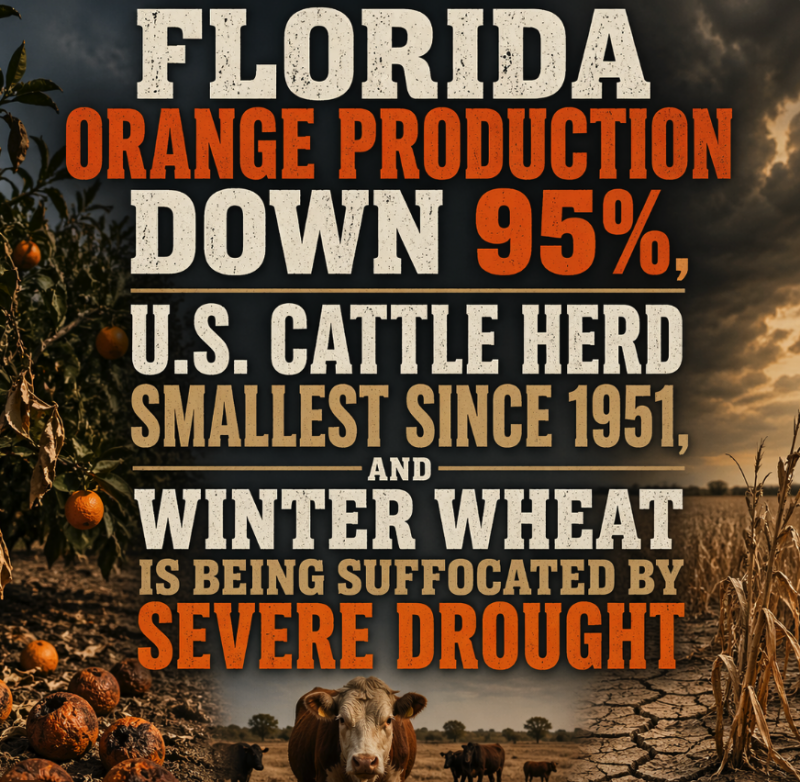
We live at a time when most people don’t know where their food comes from, and so they have no idea that we are facing an agricultural nightmare in 2026. Yesterday, I published an article about the historic drought that is devastating our heartland and the nightmarish fertilizer crisis that has been caused by the war in the Middle East. Today, I am going to talk about the stunning decline of the U.S. cattle herd, concerns about the winter wheat harvest, and the frightening drop that we have witnessed in Florida orange production.
I have said this before, but I will say it again.
If farmers don’t grow our food, we don’t eat.
When I was growing up, everyone was drinking Florida orange juice.
Sadly, that is no longer true.
This year, the number of oranges that will be harvested in Florida will be down 95 percent from 1996…
But now, the fruit that helped build Florida is disappearing. The orange is falling victim to disease, disasters and development.
Just how far the orange crop has fallen is shocking. Thirty years ago, 225 million boxes of oranges were picked from Florida orange groves. That was almost enough for one box of oranges for every American in the mid-1990s. This year, the forecast from the U.S. Agriculture Department is 12 million boxes. That is a drop of 95% in one generation.
How in the world could this have happened?
Well, the cold weather that Florida experienced during the month of February severely damaged orange production. But the far bigger problem is citrus greening disease. It is not going to go away, and it could potentially completely wipe out Florida’s oranges…
The cold weather in February cost the citrus industry almost $700 million according to a preliminary estimate from the state agricultural commission. Most of the loss is from a smaller crop and damaged trees.
And then there’s the decades-long fight against a small bug that has been turning Florida’s oranges green. Citrus greening disease is caused by a bacterial infection spread by the Asian citrus psyllid. The bug showed up in Florida almost 30 years ago. The first signs of the disease were visible in citrus groves about 20 years ago.
Meanwhile, the multi-year drought that the heartland of America is experiencing is making it very difficult to produce sufficient quantities of hard red winter wheat…
Hard red winter wheat (HRW) futures widened to their largest premium over soft red wheat (SRW) in more than two years as severe drought intensified across key breadbasket regions in the Great Plains and Midwest. This means traders are pricing in weather impacts and tightening expectations for higher-protein wheat supplies.
It is important to note that HRW is a more valuable protein and is primarily used in bread, rolls, and all-purpose flour. It is grown in the U.S. Plains (Kansas, Oklahoma, Texas), while SRW is used in cakes, cookies, crackers, and pastries, and is grown in the Eastern U.S. (Ohio Valley, Midwest, Southeast).
Just think about all of the things that you eat on a regular basis that have wheat in them.
If you feel that those products are expensive now, just wait until you see what the prices will be like later this year.
Beef prices have also become very painful, and that is because the size of the U.S. cattle herd has fallen to the lowest level that we have seen since 1951…
The U.S. cattle herd dwindled to its smallest size since 1951, the U.S. Department of Agriculture said on Friday, signaling that beef prices will stay high for consumers after setting records last year.
The nation had 86.2 million cattle and calves as of Jan. 1, the USDA said in a biannual report, after a persistent drought drove ranchers to slash their herds. That was down 0.4% from a year earlier, when the herd also hit its lowest level since 1951.
In 1951, approximately 154 million people lived in the United States.
Today, approximately 342 million people live in the United States.
So we are trying to feed more than twice as many people with the same amount of cattle that we had in 1951.
Unfortunately, this could be just the beginning of this crisis because the New World screwworm is on a relentless march north…
The flesh-eating parasite, called the New World screwworm, was detected this month in the Mexican state of Nuevo León, just 90 miles away from the U.S. border. As of last year, the insect was still 400 miles away.
“The New World screwworm is not some distant problem,” Texas Agriculture Commissioner Sid Miller said. “It is a direct and imminent threat to Texas, and we are treating it that way. This is a high-stakes situation for our ranchers, our livestock industry and our food supply, and we are moving aggressively to stay ahead of it.”
Ranchers are frightened out of their minds, because these little parasites love to ravage cattle.
All it takes for disaster to strike is for one female fly to find a body opening or an open wound…
This insect is attracted to the smell of wounds and body openings, including the nose, eyes, ears, mouth and genitals.
Once a female fly makes contact, it can lay 200 to 300 eggs in a wound or opening that can be as small as a tick bite. In some cases, the fly may lay up to 3,000 eggs during its 10 to 30-day lifespan.
The eggs then hatch into maggots that burrow into the wound or opening and feed on the flesh. After about seven days of feeding, the larvae drop to the ground and eventually emerge as adult screwworm flies.
Even without the war in the Middle East, this would be an exceedingly challenging year for our farmers and our ranchers.
But now thanks to the war, we are facing skyrocketing fuel costs and global fertilizer shortages…
Farmers around the world are facing fertilizer shortages and rising costs due to supply disruption caused by the war in Iran, which could make food more expensive later this year.
The war has almost halted shipments through the Strait of Hormuz, a narrow passage off Iran that handles about a fifth of the world’s oil and nearly a third of global fertilizer trade.
As I discussed yesterday, one survey found that 70 percent of U.S. farmers are admitting that they won’t be able to buy enough fertilizer this year because prices have simply gotten too high.
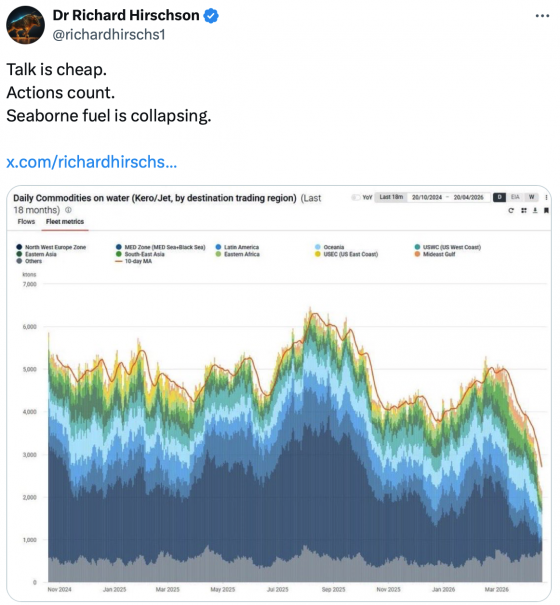
Diesel prices are spiking as well, and they are only going to go higher as global supplies of fuel get tighter and tighter…
Nobody can dispute any of the facts that I have presented in this article.
Food prices have risen steadily in recent years, but the truth is that what is ahead will be even worse.
In impoverished nations, the number of people experiencing acute hunger was already at an all-time record high before the war with Iran erupted, and now many experts are warning of widespread famines.
But most people out there just expect everything to turn out just fine somehow, because that is how the stories that they watch on television always end.
Of course what we are living through is not a television show.
This is the real world, and in the real world bad decisions can lead to severe consequences.
Michael’s new book entitled “10 Prophetic Events That Are Coming Next” is available in paperback and for the Kindle on Amazon.com, and you can subscribe to his Substack newsletter at michaeltsnyder.substack.com.

About the Author: Michael Snyder’s new book entitled “10 Prophetic Events That Are Coming Next” is available in paperback and for the Kindle on Amazon.com. He has also written nine other books that are available on Amazon.com including “Chaos”, “End Times”, “7 Year Apocalypse”, “Lost Prophecies Of The Future Of America”, “The Beginning Of The End”, and “Living A Life That Really Matters”. When you purchase any of Michael’s books you help to support the work that he is doing. You can also get his articles by email as soon as he publishes them by subscribing to his Substack newsletter. Michael has published thousands of articles on The Economic Collapse Blog, End Of The American Dream and The Most Important News, and he always freely and happily allows others to republish those articles on their own websites. These are such troubled times, and people need hope. John 3:16 tells us about the hope that God has given us through Jesus Christ: “For God so loved the world, that he gave his only begotten Son, that whosoever believeth in him should not perish, but have everlasting life.” If you have not already done so, we strongly urge you to invite Jesus Christ to be your Lord and Savior today.