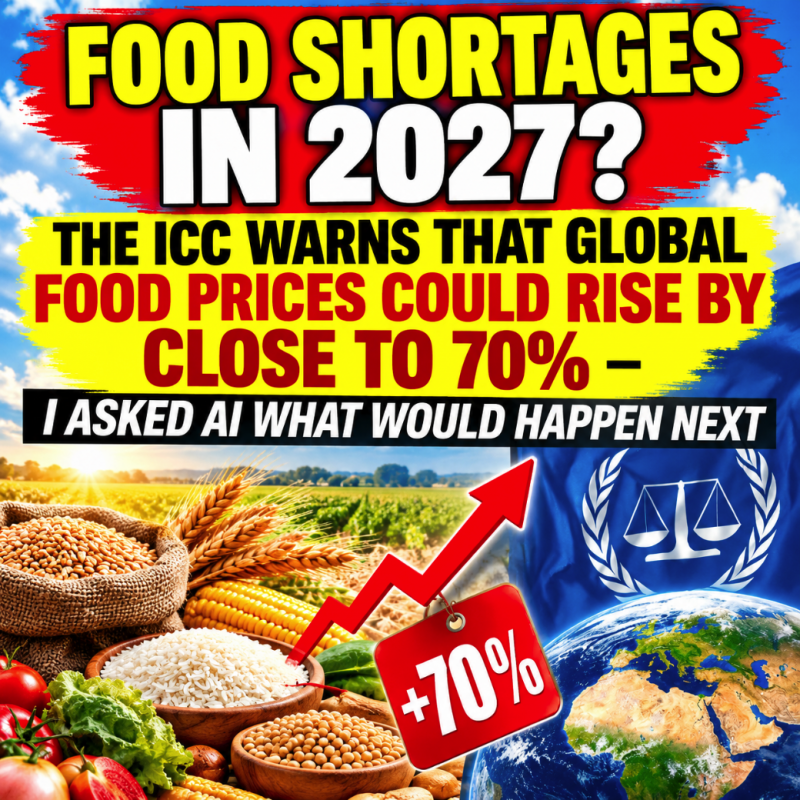
All over social media, people want to know if there will be food shortages in 2027. Coming into this year, the UN was warning that global hunger had reached an unprecedented level. Now we are facing a global fertilizer crisis, a global energy crisis, widespread droughts, a Super El Niño and World War III all at the same time. Of course global hunger is going to get even worse in the months ahead. Nobody can deny that. Wealthy nations such as the United States will theoretically be in the best shape, but even here in the U.S. approximately 1 out of every 7 people already live in food insecure households. Rapidly rising food prices will definitely be very painful for us, but for millions of people that live in deeply impoverished countries much higher food prices could suddenly make it impossible for them to buy enough food to properly feed their families.
How would you feel if members of your family were extremely hungry but you didn’t have anything to give them?
For many of us, that would be unimaginable.
Unfortunately, such a scenario could soon become a reality in needy households all over the planet.
For months, I have been warning that the global energy crisis and the global fertilizer crisis were going to have an enormous impact on food production.
Now harvest season is here, and the consequences are starting to become apparent. The following comes from a Wall Street Journal article entitled “Hormuz Gridlock Risks Global Food Crisis, International Chamber of Commerce Chief Says”…
Disruptions to a vital shipping route in the Middle East have created an energy shock. Now, a global food security crisis is brewing, warns the secretary-general of the International Chamber of Commerce.
The secretary general of the International Chamber of Commerce is a man named John Denton.
He is a legal expert on international trade and investment, and he is projecting that global grain prices could potentially increase by up to 80 percent…
The monthslong conflict between Iran and the US has curbed the flow of goods through the Strait of Hormuz, a waterway many countries rely on for imports of critical inputs like fertilizers and natural gas.
According to Denton, if the strait is not reopened, grain prices could rise by up to 80%, which would be particularly hard on the economies of import-dependent countries. He added that the situation in the Strait of Hormuz has caused a shortage of about 2.7 million tons of fertilizer on the world market.
Less fertilizer means less food.
That is the bottom line.
If we do see such a spike in global grain prices (and they have already been rising), an ICC-commissioned model determined that global food prices overall could increase by close to 70 percent…
A prolonged disruption to fertiliser and energy markets linked to the closure of the Strait of Hormuz could push global cereal prices sharply higher, with potentially severe consequences for food security and public health, according to new modelling commissioned by the International Chamber of Commerce (ICC).
In the study’s most severe scenario, global cereal prices rise by as much as 81% above 2020 levels. The shock also feeds through sharply to households, with consumer food prices in East Asia, the Pacific and Sub-Saharan Africa rising close to 70% above a 2020 baseline.
In recent years, the world has not even come close to producing enough food for everyone.
Now global food supplies are going to get substantially tighter.
As a result, there will be a mad scramble for whatever is available, and this will really drive up prices.
In the end, a lot more people will be malnourished and a lot more people will die from starvation…
Conducted by researchers at the University of Edinburgh, the University of Aberdeen and Scotland’s Rural College, the modelling shows how the shock would work its way through the global food system. Higher fertiliser and energy costs reduce nitrogen fertiliser use by approximately 37% and cereal productivity by up to 10%, tightening supply and raising prices for consumers.
For poorer households, these price increases translate into lower calorie consumption, less diverse diets and higher rates of underweight. Under the same severe and sustained scenario, the modelling suggests that the shock could contribute to approximately one million additional dietary health-related deaths in 2030 and leave 67 million more people underweight.
The burden would fall overwhelmingly on lower-income regions. South Asia, Sub-Saharan Africa and East Asia and the Pacific would account for around 80% of the additional mortality and more than 90% of the additional underweight burden. Modelled health outcomes would change little in higher-income regions.
The poorest nations will get hit the hardest.
But we will all be affected.
I asked Google AI to tell me what would happen if the type of scenario that the ICC is envisioning actually plays out. This is what I was told…
- Massive Food Inflation: Retail prices for bread, cereal, and packaged goods would skyrocket globally.
- Surging Meat Prices: Livestock feed costs would soar, forcing ranchers to cull herds and driving up the cost of beef, pork, and poultry.
- Severe Humanitarian Crisis: Lower-income nations that rely heavily on grain imports would face immediate, widespread food insecurity and potential famine.
- Geopolitical Instability: Historically, drastic food price spikes trigger civil unrest, protests, and political revolutions (similar to the 2011 Arab Spring).
- Protectionist Trade Policies: Major grain-exporting countries would likely ban or restrict exports to safeguard their domestic food supplies, worsening the global shortage.
That sounds about right.
There are some people out there that are touting the fact that they warned about this months in advance.
Of course there are others that were warning about all of this years in advance.
As long as commercial traffic through the Strait of Hormuz remains restricted, the global fertilizer crisis and the global energy crisis will both just continue to intensify.
Unfortunately, the Iranians are telling us that they will keep attacking commercial vessels that are traveling through the Strait of Hormuz until the United States agrees to their entire list of demands…
The Strait of Hormuz is going to remain closed until the United States accepts Tehran’s seven-day plan to reopen the waterway, Iran’s top negotiator and parliament speaker has said.
Iranian state-linked news agency Nournews, quoting Mohammad Bagher Ghalibaf, reported on Sunday that Washington made “some proposals through a mediator” days after the US replied to Iran’s diplomatic proposal.
The US should know “that the era of wasting time and dictating unilateral demands is over”, Ghalibaf said, adding Iran’s position remains “clear and definite”.
There is no way that the Trump administration will ever agree to all of Iran’s demands.
So on and on we go.
I realize that food prices are absurdly high now, but they are going to go even higher.
But as long as you have enough to eat, you should be very thankful, because there are many on the other side of the planet that are desperately hungry right now.
Yes, there will be food shortages in 2027.
At this stage, the debate is about how intense they will become.
Hunger is on the rise all over the planet, and the higher food prices go the worse it will get.
Michael’s new book entitled “10 Prophetic Events That Are Coming Next” is available in paperback and for the Kindle on Amazon.com, and you can subscribe to his Substack newsletter at michaeltsnyder.substack.com.

About the Author: Michael Snyder’s new book entitled “10 Prophetic Events That Are Coming Next” is available in paperback and for the Kindle on Amazon.com. He has also written nine other books that are available on Amazon.com including “Chaos”, “End Times”, “7 Year Apocalypse”, “Lost Prophecies Of The Future Of America”, “The Beginning Of The End”, and “Living A Life That Really Matters”. When you purchase any of Michael’s books you help to support the work that he is doing. You can also get his articles by email as soon as he publishes them by subscribing to his Substack newsletter. Michael has published thousands of articles on The Economic Collapse Blog, End Of The American Dream and The Most Important News, and he always freely and happily allows others to republish those articles on their own websites. These are such troubled times, and people need hope. John 3:16 tells us about the hope that God has given us through Jesus Christ: “For God so loved the world, that he gave his only begotten Son, that whosoever believeth in him should not perish, but have everlasting life.” If you have not already done so, we strongly urge you to invite Jesus Christ to be your Lord and Savior today.