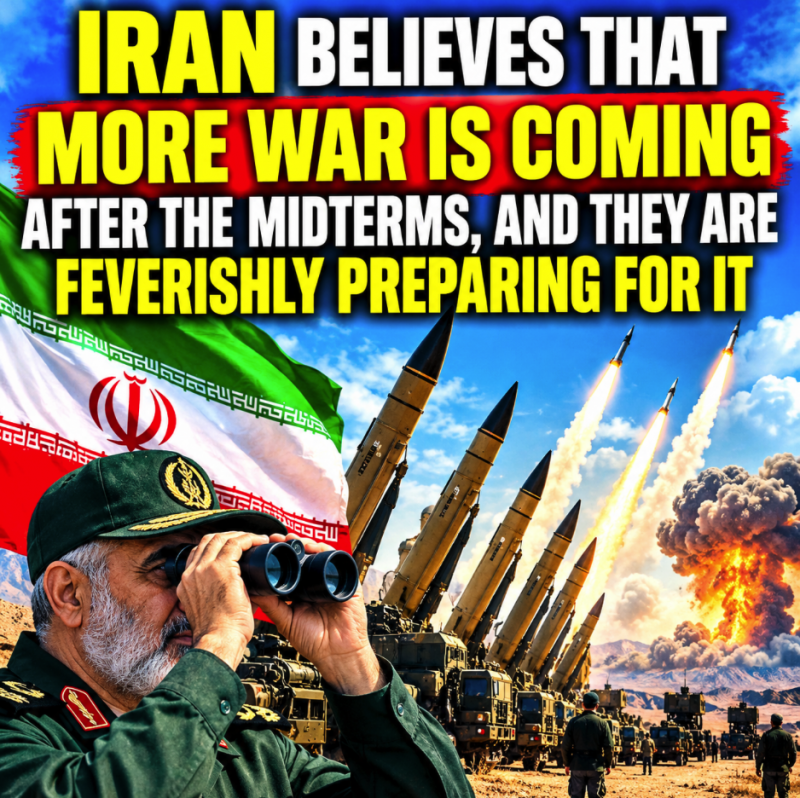
The war in the Middle East has been essentially put on pause until the midterm elections in the United States are over, but once we get to that point Iran is expecting the fighting to go to an entirely new level. So Iran is using this temporary lull in the action to get fully prepared. Ground forces are being trained, defenses are being strengthened, new missiles are being produced, and rallies are being held to bolster public support for the coming conflict. This time around, the Iranians don’t intend to just be on the defensive. They have openly warned that they could conduct ground incursions into neighboring countries, because they believe that this would give them even more leverage with the Trump administration. But if the Iranians get too aggressive, that could set off a chain of events that nobody will be able to control.
In recent weeks, President Trump has repeatedly stated that his administration will “make a decision” on Iran in the not too distant future.
Everyone knows that he is referring to military action, and he just said it again…
“We’ll make a decision on Iran very soon,” he concludes, amid reports of discussions about a resumption of fighting before Israel’s October 27 election and the United States’ November 3 midterm elections.
Trump has made similar comments repeatedly in the past, without following through with renewed strikes.
Last week, he said the US would not attack Iran before the US midterms.
I could be wrong, but at this stage I think that there won’t be any additional airstrikes in Iranian territory until after the midterms.
However, once the midterms are over it appears that the U.S. and Israel intend to absolutely hammer Iran.
The Iranians are fully convinced of this, and according to the Wall Street Journal they are in full war preparation mode…
Iran is fortifying its defenses, rallying loyalists and threatening a wider, harsher response against the U.S. and its Gulf allies as it prepares for potential American attacks after the midterms and seeks to deter them.
Iranian officials have warned publicly and in private conversations with regional officials that the Islamic Republic will respond with further escalation across the Middle East if the U.S. launches new strikes.
If fighting is going to inevitably erupt again, the Iranians don’t just want to absorb strikes and fire off missiles in return.
Instead, they want to go on the offensive.
One of the options that is reportedly being considered is launching “ground incursions into neighboring countries”…
Tehran has also suggested it could launch ground incursions into neighboring countries and target regional data centers and communications infrastructure.
Iran has the largest army in the Middle East by a wide margin.
With reserves, they can muster a force of more than a million fighting men.
That is one of their most important competitive advantages, and they are thinking about using it.
A ground incursion across southern Iraq to grab Kuwait would be an extremely shocking move.
But if the Iranians were to commit a couple hundred thousand troops to such an effort, there wouldn’t be much that Iraq, Kuwait or the U.S. would be able to do about it.
The U.S. has a few thousand Marines in the Middle East, but that wouldn’t be nearly enough to stop an Iranian ground invasion.
The Iranians are also strengthening positions around their most important nuclear sites…
Iran has also reinforced protection around its nuclear sites and other security-related bunkers. Last month, it built passive defense measures such as makeshift dirt mounds around its Pickaxe Mountain and Natanz nuclear sites to impede any attempted raid by ground forces, according to Vantor satellite images analyzed by the Institute for Science and International Security, a Washington, D.C.-based nonprofit.
Iranian officials are touting their efforts. The country’s airports, seaports and power plants “have prepared for wartime conditions,” installing shelters and backup supplies to continue operating in a crisis, Brig. Gen. Gholamreza Jalali, the official in charge of the country’s contingency plans, told reporters at the end of September.
The Iranian nuclear program is the core issue of this war, and the Iranians have no intention of backing down.
If you doubt Iranian resolve, just look at what they are doing in the Strait of Hormuz.
On Sunday, six commercial vessels were hit within the space of just 24 hours…
Six commercial vessels were reported struck in and around the Strait of Hormuz on October 11, including five tankers and a container ship, as attacks on merchant shipping continue to escalate across the region.
UK Maritime Trade Operations (UKMTO) issued five additional attack warnings, four of them time-late reports, adding to an earlier tanker attack already documented in Sunday’s Joint Maritime Information Center (JMIC) advisory.
The six reports describe five vessels struck while transiting the Strait of Hormuz and a sixth tanker attacked near Sohar anchorage, Oman, in the Gulf of Oman.
I really wish that the Iranians would just back off.
But that isn’t going to happen.
In fact, it appears that they just hit another tanker.
A lot of people seem to think that replacing these tankers will be easy.
But that is not true at all.
Building a modern commercial oil tanker typically takes 9 to 15 months of physical construction, but the total turnaround from signing a contract to actual delivery can take up to 3 years.
The cost to build a brand new oil tanker currently ranges from 60 million dollars to 140 million dollars.
So when a tanker is hit by an Iranian cruise missile, it is a very big deal.
It will be many years before the global tanker fleet is back up to full capacity.
Meanwhile, the Saudis and the Houthis are both attacking energy infrastructure.
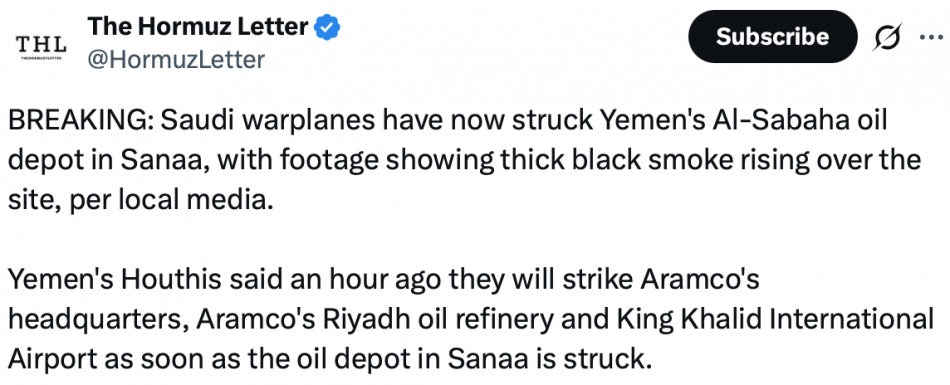
Just a little while ago, the Saudis bombed the Al-Sabaha oil depot in Sanaa…
This has made the Houthis really angry.
They are pledging to hit some of the most strategic targets in Saudi Arabia in response…
The Houthis warned Saudi Arabia Tuesday that any strikes on the Yemeni capital would trigger a “harsh and painful” retaliation.
“Any strikes on the capital, Sanaa, will be met with a harsh and painful response in the capital of the Saudi enemy, Riyadh,” Houthi military spokesman Brig. Gen. Yahya Saree warned in a post on X.
An hour later he expanded on the threat, saying in another post that if Saudi Arabia “proceeds with its announced targeting” of Sanaa, the Iran-backed rebels would attack state energy company Saudi Aramco’s headquarters in Damman, along with King Khalid Airport in Riyadh, which they have already targeted with deadly missile strikes, and Aramco’s refinery in Riyadh.
In addition, the Houthis are warning that there will be a “swift and painful response” if the U.S. joins the fighting…
“If the U.S. becomes involved in the aggression against Yemen, we will not deliberate over the decision to respond, rather, there will be a swift and painful response targeting the U.S. and all its interests in the region,” Houthi political bureau member Mohammed Al Bukhaiti told the Agence France-Presse news agency in an interview.
He also warned “all employees and workers at Saudi oil facilities and airports (should) stay away from these sites, as they have become legitimate targets”.
The longer the fighting in the Middle East goes on, the worse the global energy crisis will get.
Unfortunately, there is no end in sight.
Instead, it appears that the fighting in the Middle East could be about to greatly escalate.
The Iranians have warned us that they are ready to fight a “doomsday war” with the United States.
A lot of the “experts” are not taking that threat seriously, but I believe that they should.
If push comes to shove, I am convinced that the nuts that are running Iran would be willing to go all the way to the top of the escalation ladder, and that really would be a nightmare scenario.
Michael’s new book entitled “10 Prophetic Events That Are Coming Next” is available in paperback and for the Kindle on Amazon.com, and you can subscribe to his Substack newsletter at michaeltsnyder.substack.com.

About the Author: Michael Snyder’s new book entitled “10 Prophetic Events That Are Coming Next” is available in paperback and for the Kindle on Amazon.com. He has also written nine other books that are available on Amazon.com including “Chaos”, “End Times”, “7 Year Apocalypse”, “Lost Prophecies Of The Future Of America”, “The Beginning Of The End”, and “Living A Life That Really Matters”. When you purchase any of Michael’s books you help to support the work that he is doing. You can also get his articles by email as soon as he publishes them by subscribing to his Substack newsletter. Michael has published thousands of articles on The Economic Collapse Blog, End Of The American Dream and The Most Important News, and he always freely and happily allows others to republish those articles on their own websites. These are such troubled times, and people need hope. John 3:16 tells us about the hope that God has given us through Jesus Christ: “For God so loved the world, that he gave his only begotten Son, that whosoever believeth in him should not perish, but have everlasting life.” If you have not already done so, we strongly urge you to invite Jesus Christ to be your Lord and Savior today.