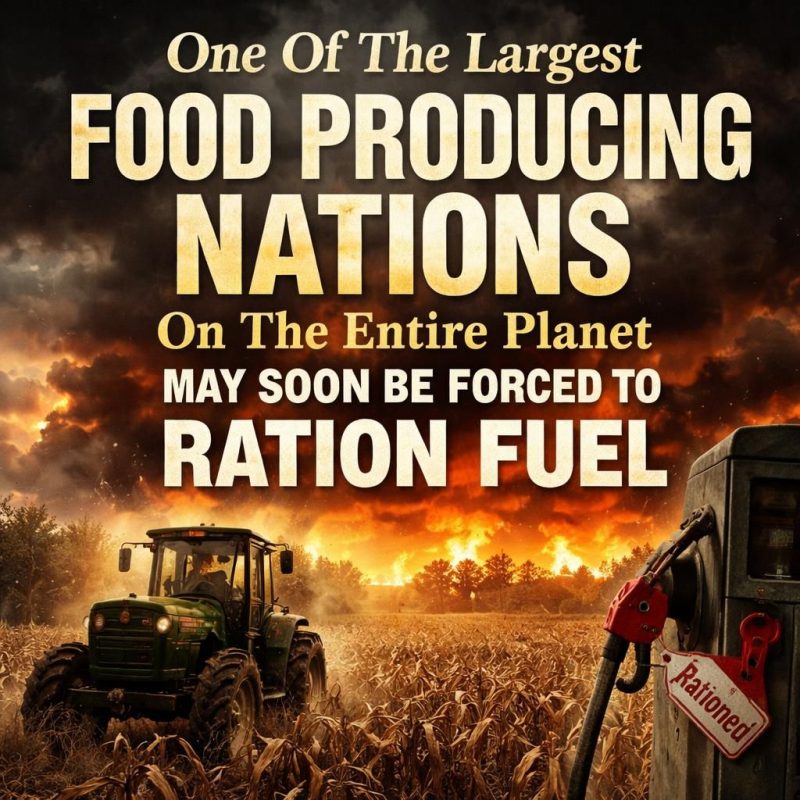
The real pain from the closure of the Strait of Hormuz hasn’t even hit us yet. All over the world, countries are running down their strategic energy reserves, and the last tankers that left the Persian Gulf before the war started will be arriving at their destinations this month. After that, things are going to start getting really crazy unless we get some sort of a miracle and the Strait of Hormuz is quickly reopened. The shortages that we have seen so far are nothing compared to what could be coming, and as you will see below, we are being warned that one of the largest food producing nations on the entire planet may soon be forced to ration fuel.
According to the Washington Post, less than 10 ships a day have been traveling through the Strait of Hormuz…
Shipping traffic through the Strait of Hormuz remains constrained a week after the United States and Iran said they would facilitate vessel passage under a two-week ceasefire agreement. Instead, tensions have escalated. After Iran said ships must coordinate with its forces — and, in some cases, pay a toll — President Donald Trump called the demands “extortion” and announced Sunday that the United States would block ships entering or exiting Iranian ports, adding pressure to an already fragile truce.
But even as Washington seeks to squeeze Iran economically, Tehran retains a powerful advantage: geography. Over six weeks of conflict, Iran has halted virtually all traffic in the strait by laying mines, according to its military forces, and exploiting the vulnerability created by its terrain. Even under a U.S. blockade, these factors allow Iran to continue exerting influence over who crosses — and at what risk.
That risk, more than any formal closure, is what is keeping ships away. According to data from Kpler, only nine vessels have crossed the strait daily on average since the ceasefire, compared with the prewar traffic of more than 130 ships. “De facto, the ceasefire has done absolutely nothing to change the situation [in the strait]. None whatsoever,” said Lars Jensen of Vespucci Maritime, a container shipping consultancy based in Copenhagen.
Now that the U.S. Navy is conducting a blockade of Iranian ports, no vessels will be traveling to or from Iran, and the level of traffic through the Strait of Hormuz will go down even more.
Both sides are expecting the other to give in.
Meanwhile, the rest of the world is really suffering.
For example, a lack of fuel has created an unprecedented crisis for the nation of Australia…
In the film Mad Max, an oil shortage leaves Australian society teetering on the brink of total collapse.
In real-life, things aren’t quite that dystopian yet Down Under. But with barely a month of stockpiled diesel left and hundreds of forecourts running dry, the anxiety is palpable.
Australia has one of the highest per-capita rates of diesel consumption in the world but it relies almost entirely on imports to meet that demand. There are two domestic refineries producing petrol but up to 90pc of that is imported, too.
If the conflict in the Middle East is resolved very soon, Australia will come through this okay.
But if the Strait of Hormuz remains closed for an extended period of time, Australia will find itself in all sorts of trouble, because it only has about a month of fuel left before rationing will become necessary…
The country has 38 days’ worth of petrol left in reserve before reaching critical levels, at which point rationing would need to kick in. For diesel, it’s 31 days and for jet fuel, just 28.
For truckers and farmers in particular, the supply crunch feels near-existential.
Without enough diesel, Australia’s trucking industry will come to a standstill.
Even worse, Australia’s farmers won’t be able to plant their crops if they can’t get the fuel that they need.
And that is really bad news for the entire planet, because Australia is the world’s “fifth-largest producer of wheat and second-largest grower of barley”…
In a country that is the fifth-largest producer of wheat and second-largest grower of barley, McIntyre warns that “most farmers will need to decide before Anzac Day [April 25] whether they will plant a crop this year”.
Mathew Munro, the chief executive of the Australian Trucking Association, sounds equally alarmed. He recently described the situation for the country’s 60,000 trucking businesses as “an emergency”.
Yet again, we see another mention of wheat and barley in the news.
As I have discussed in previous articles, wheat production and barley production are both going to be way down all over the globe in 2026 because we are not getting nitrogen fertilizer from the Middle East into the hands of farmers throughout the northern hemisphere that desperately need it.
Nitrogen fertilizer is the primary reason why we were able to grow the population of the globe to 8 billion people.
And without sufficient quantities of nitrogen fertilizer each growing season, there is no possible way that we will be able to continue to feed 8 billion people.
If the Strait of Hormuz is not reopened, 6 to 9 months from now we will be facing a global shortage of food of epic proportions.
The Trump administration is convinced that a naval blockade will be so painful that it will force the Iranians to give in.
According to U.S. Central Command, during the first 24 hours “no ships made it past the U.S. blockade”…
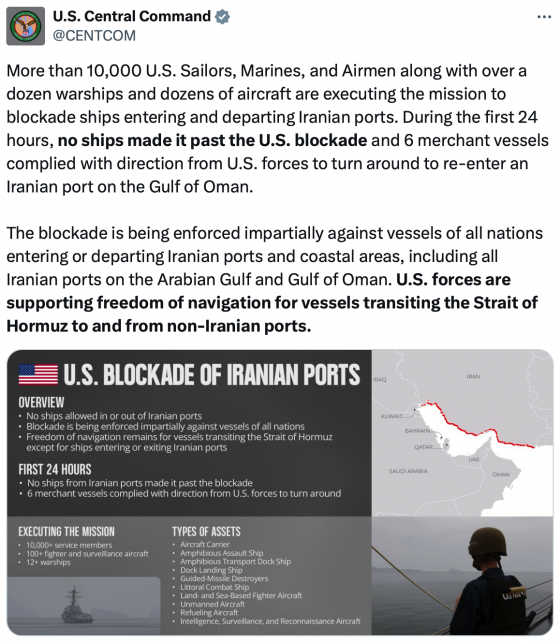
No ships will be arriving at Iranian ports, and no ships will be leaving.
This will cut off the flow of oil revenue to the regime, and it will also cause excruciating shortages of gasoline and diesel because Iran does not possess sufficient refining capacity to produce what they need domestically…
Within 10 to 14 days, Iran won’t be able to store oil and will have permanent long term damage to oil wells for extracting oil. Oil wells perform poorly after you stop the flowing process.
Iran exports oil, but it also imports gasoline and diesel. Iran lacks the ability to refine enough of their own oil into gasoline and diesel. So very soon Iran will be running out of fuel everywhere.
Meanwhile, this naval blockade is deeply upsetting the Chinese.
Most people do not realize this, but normally over half of the energy that China uses travels through the Strait of Hormuz…
More than half of China’s energy comes through the Strait of Hormuz, which normally carries one-fifth of the world’s oil and gas supplies.
“Such actions will only intensify contradictions, exacerbate tensions, undermine the already fragile ceasefire, and further jeopardize the security of navigation through the strait,” Chinese Foreign Ministry spokesperson Guo Jiakun told reporters Tuesday of the U.S. blockade. “This is dangerous and irresponsible behavior.”
For the moment, the Chinese are fine because they were wise enough to stockpile absolutely enormous reserves.
But if we get a few months down the road and the Strait of Hormuz is still closed, the Chinese are going to start to panic.
If push comes to shove, I believe that the Chinese Navy would start escorting tankers to ports in Iran.
At that point, the Trump administration would have a major decision to make.
Let’s hope that it never comes to that.
Let’s hope that the crisis in the Strait of Hormuz is resolved very rapidly.
But at this stage there is no end to this crisis in sight, and that is really bad news for the entire world.
Michael’s new book entitled “10 Prophetic Events That Are Coming Next” is available in paperback and for the Kindle on Amazon.com, and you can subscribe to his Substack newsletter at michaeltsnyder.substack.com.

About the Author: Michael Snyder’s new book entitled “10 Prophetic Events That Are Coming Next” is available in paperback and for the Kindle on Amazon.com. He has also written nine other books that are available on Amazon.com including “Chaos”, “End Times”, “7 Year Apocalypse”, “Lost Prophecies Of The Future Of America”, “The Beginning Of The End”, and “Living A Life That Really Matters”. When you purchase any of Michael’s books you help to support the work that he is doing. You can also get his articles by email as soon as he publishes them by subscribing to his Substack newsletter. Michael has published thousands of articles on The Economic Collapse Blog, End Of The American Dream and The Most Important News, and he always freely and happily allows others to republish those articles on their own websites. These are such troubled times, and people need hope. John 3:16 tells us about the hope that God has given us through Jesus Christ: “For God so loved the world, that he gave his only begotten Son, that whosoever believeth in him should not perish, but have everlasting life.” If you have not already done so, we strongly urge you to invite Jesus Christ to be your Lord and Savior today.