The U.S. government is $40,068,807,991,924.84 in debt, and all of a sudden the rest of the world has become a lot more hesitant to lend us money. Bond prices are crashing and rates are spiking. For years, I warned that our politicians were borrowing and spending way too much money. But those politicians just kept voting for budgets with bigger and bigger deficits. Now we find ourselves in the middle of a financial nightmare with no way out. The same thing could be said about Japan and most nations in Europe. Globally, bond prices have been steadily plummeting as bond yields have skyrocketed. Unfortunately for all of us, financial institutions all over the planet are holding gigantic mountains of government bonds that have collapsed in value. The unrealized losses that they are potentially facing will be off the charts. Meanwhile, rapidly rising interest rates could set off an unprecedented derivatives implosion. At this point, the total notional amount outstanding for global over-the-counter interest rate derivatives is well over 600 trillion dollars.
As long as investors still had faith in the game, everything was going to be fine.
But now investors are losing faith in the U.S. government, the Japanese government and governments all over Europe, because they have been borrowing money at insanely reckless levels.
So now we have a massive crisis on our hands, and last week things really started to get out of hand.
In fact, last week was definitely “a week of pain” for financially irresponsible governments throughout the world…
This has been a week of pain for anyone who borrows money.
All over the world, lenders are demanding higher interest rates. The global bond market is extracting higher yields from every borrower, starting with the biggest borrowers of all: national governments. But not every government is paying equally.
Trustworthy borrowers with solid finances and honest leadership pay less. Distrusted borrowers with disordered finances and corrupt leaders pay more. In times past, the United States would have headed that first list.
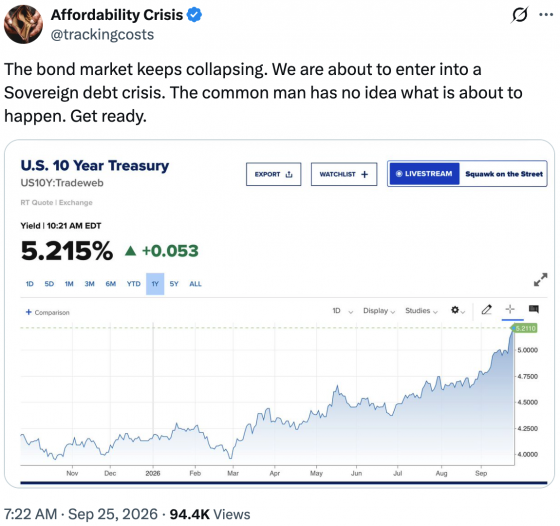
In a previous article, I explained that historically when the yield on 10 year U.S. Treasuries hits 5.25 percent things start to get really crazy.
Well, late last week the yield on 10 year U.S. Treasuries was hovering around 5.2 percent…
In trading yesterday, the yield on a U.S. 10-year Treasury bond hovered near 5.2 percent. Germany pays less than the United States. France pays less than the United States. Canada pays less than the United States. Even Greece pays less than the United States. Estonia—a country under constant threat of a Russian invasion and the annihilation of its sovereignty—pays much less than the United States: only 3.6 percent.
We were only going to be able to play this game for so long.
I don’t know why this was so difficult for so many of the “experts” to understand.
At one point on Friday, the yield on 10 year U.S. Treasuries reached 5.23 percent, which was the highest that we have seen since just before the last global financial crisis…
Investors were rattled this week as the benchmark 10-year Treasury yield soared to its highest level since 2007, but sticky inflation is just one of the factors behind this latest surge.
The key 10-year Treasury yield, which influences mortgages, leapt to 5.23% on Friday for its highest level since 2007. It was the latest leg higher for the benchmark yield, which earlier this month was trading just below 4.8%. Bond yields and prices move inversely to one another.
This is what a bond market collapse looks like, and we are still only in the early stages.
On X, one popular account warned that most people have “no idea what is about to happen”…
The era of easy money is over, and that is really bad news for all of us.
John Roque has pointed out that there have been 16 times throughout history when bond yields have spiked like this. Every single time, it has resulted in some sort of a financial crisis…
“Something always breaks,” proclaimed a recent note from John Roque, head of technical analysis at 22V Research.
Roque pointed out on a chart of the 10-year Treasury yield going back the last five decades 16 instances where it experienced a rapid advance like it is now. During each and every move, some sort of financial calamity resulted. While the scale of the crises varied in their market impact (from the jarring-but-short-lived Silicon Valley Bank failure of 2023 to the 1987 stock market crash), the jump in yields almost always led to some sort of disruption to financial markets that weighed on risk assets.
“As sure as day follows night, when the 10-year Treasury yield rises, something gets knocked out,” Roque remarked to CNBC. “It just pays to be cautious.”
Personally, I am very concerned about what all of this is going to mean for the stock market.
Stock prices are currently at a level that we have only witnessed “three times over the last 156 years”…
Currently, we’re witnessing the stock market do something that’s only been accomplished three times over the last 156 years. When this signal appears, it has consistently foreshadowed significant declines to come for Wall Street.
What goes up must come down.
Every time the CAPE Ratio has been this high, a bear market has followed…
Economists introduced the CAPE Ratio in the late 1980s and have backtested it as far back as January 1871. Over this roughly 156-year stretch, the average multiple is 17.42. As of the closing bell on Sept. 21, the S&P 500’s CAPE Ratio clocked in at 41.60.
Including the present, there have only been three times, spanning 156 years, in which the S&P 500’s Shiller P/E Ratio has topped 40 — and the previous two occurrences were followed by notable bear markets
The bottom line is that we are perfectly primed for a stock market crash, and signs of trouble are already apparent.
The performance of just a handful of tech stocks has been masking some very alarming developments that have been happening under the surface. At this point, 52 percent of all stocks in the S&P 500 are already trading beneath their 200 day moving averages…
The S&P 500’s latest trip back to near-record territory has been powered by a surprisingly small number of stocks.
As of Tuesday’s close, the S&P 500 was only 0.44% shy of a record closing high, and yet 52% of individual member stocks were trading below their long-term 200-day moving averages. This is a reflection of the fact that a handful of stocks, chiefly hyperscalers like Meta and semiconductor stocks like Micron Technology, have been doing much of the heavy lifting lately.
That is a major red flag.
In fact, there are major red flags all around us.
And now we are entering the pivotal month of October when some of the largest stock market crashes throughout history have occurred.
Historically, bonds normally start crashing before stocks do.
That exact same pattern is playing out right in front of our eyes in the fall of 2026.
If it was just the U.S. that was in trouble, that would be bad enough.
But what we are looking at is a truly global debt crisis.
This moment has been coming for a very long time, and the entire world is going to be stunned by what happens next.
Michael’s new book entitled “10 Prophetic Events That Are Coming Next” is available in paperback and for the Kindle on Amazon.com, and you can subscribe to his Substack newsletter at michaeltsnyder.substack.com.

About the Author: Michael Snyder’s new book entitled “10 Prophetic Events That Are Coming Next” is available in paperback and for the Kindle on Amazon.com. He has also written nine other books that are available on Amazon.com including “Chaos”, “End Times”, “7 Year Apocalypse”, “Lost Prophecies Of The Future Of America”, “The Beginning Of The End”, and “Living A Life That Really Matters”. When you purchase any of Michael’s books you help to support the work that he is doing. You can also get his articles by email as soon as he publishes them by subscribing to his Substack newsletter. Michael has published thousands of articles on The Economic Collapse Blog, End Of The American Dream and The Most Important News, and he always freely and happily allows others to republish those articles on their own websites. These are such troubled times, and people need hope. John 3:16 tells us about the hope that God has given us through Jesus Christ: “For God so loved the world, that he gave his only begotten Son, that whosoever believeth in him should not perish, but have everlasting life.” If you have not already done so, we strongly urge you to invite Jesus Christ to be your Lord and Savior today.