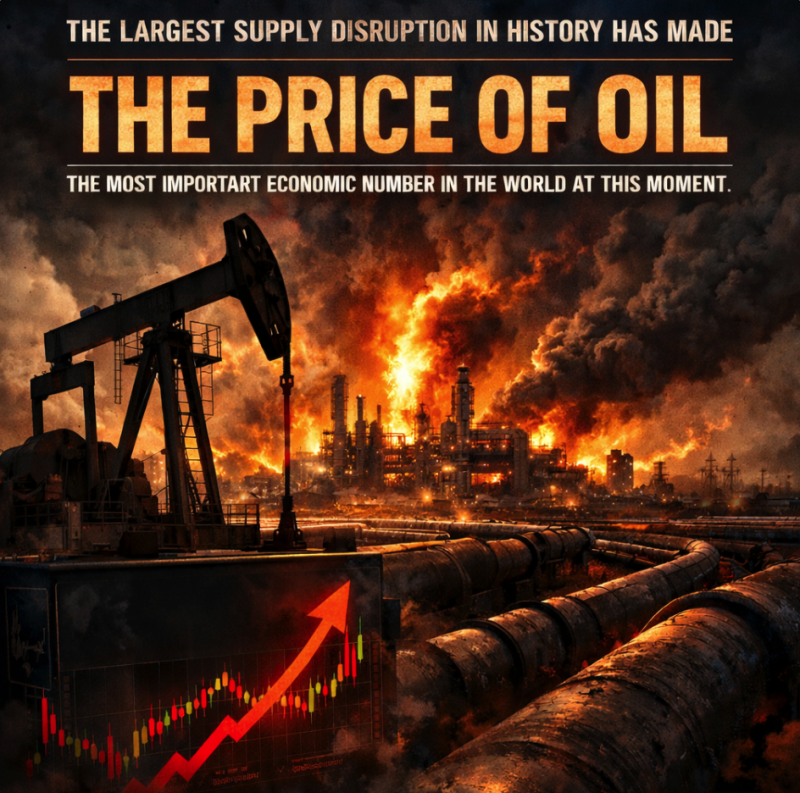
What a wild week it has been already. On Sunday night, I watched as the price of oil hit $116 a barrel. It was insane. Financial markets started to panic all over the world because investors know that if the price of oil stays above $100 a barrel for an extended period of time it will absolutely crush the global economy. Our entire way of life depends upon cheap energy, because virtually every type of human activity in the modern world uses energy. I am using energy as I write this article, and you are using energy as you read this article. After the crazy spike in the price of oil that we witnessed on Sunday night, authorities quickly shifted into damage control mode, and for the moment they have successfully pushed the price of oil back below 90 dollars a barrel. But how long will they be able to keep it there?
According to CNBC, we are currently experiencing the largest oil supply disruption in the history of the world…
The U.S. war against Iran has triggered the largest oil supply disruption in history, more than double the previous record set during the Middle East crisis of the 1950s, according to an analysis by consulting firm Rapidan Energy.
About 20% of the world’s oil supply has been disrupted for nine days now as tanker traffic through the Strait of Hormuz remains at a standstill. Crude prices have surged above $100 per barrel in response.
The biggest disruption before the current war was during the Suez Crisis of 1956 when Britain, France and Israel invaded Egypt’s Sinai Peninsula, the energy consulting firm told clients in a Sunday note. In that crisis, about 10% of the world’s oil supply at the time was disrupted.
Needless to say, there have been other times when the global supply of oil has been disrupted for one reason or another.
During those times, nations with spare capacity have been able to step up and bridge the gap.
But this time around, the nations that possess most of the spare capacity are being directly affected by this war…
The big difference between the supply shock of the Iran war and past crises is the world has no spare oil capacity to address the problem, the analysts said. Saudi Arabia and the United Arab Emirates hold the overwhelming majority of swing capacity but they have been cut off from the global oil market by the Hormuz closure, the analysts said.
“The conflict has not only taken offline a historically high share of global supply – it has simultaneously disrupted the primary holders of spare capacity,” the Rapidan analysts said. “The result is a market with no meaningful cushion. There is no swing producer positioned to step in.”
It appears that a lot of pain at the pump is ahead for all of us.
Already, the average price of a gallon of gasoline in the state of California has surpassed the five dollar mark…
Prices are currently highest in California, where drivers were paying an average of $5.20 per gallon on Monday morning, and in Washington state, where gas hit $4.63 per gallon.
We haven’t seen anything like this in a long time.
If you can believe it, one gas station in Los Angeles is actually charging more than 8 dollars for a gallon of gasoline…
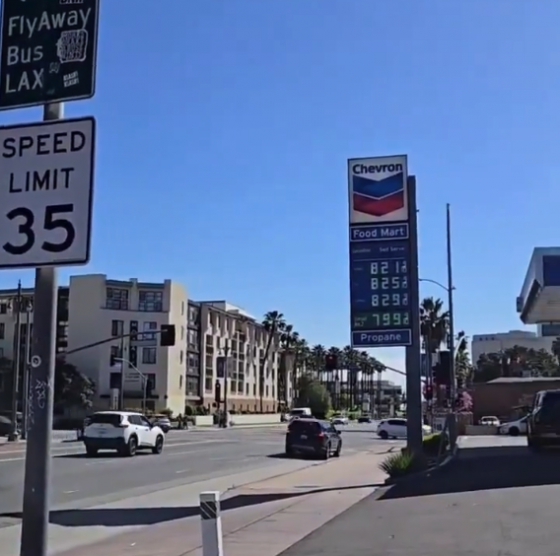
A lot of people actually thought that the article that I posted yesterday was exaggerating the threat.
I guess not.
The Iranians continue to insist that they will be able to push the price of oil up to $200 a barrel…
“If they can afford the price of oil at $200 per barrel, let them keep playing this game.”
The spokesman for a wing of the IRGC, Ebrahim Zolfighari, says the US has opened a new chapter in the war by bombing Iran’s energy infrastructure.
The good news is that for now western authorities have been able to push the price of oil back below $90 a barrel.
Early on Monday, G7 finance ministers suggested that there could soon be a coordinated release of emergency oil reserves…
The G7 said it was ready to take “necessary measures” to address the economic impact of the US-Israel war on Iran, after a meeting prompted by soaring oil prices, which rose above $100 (£74) a barrel for the first time since 2022.
Following a remote meeting on Monday, G7 finance ministers said they would closely monitor the situation but stopped short of agreeing to release emergency oil reserves.
“We discussed the current conflict in the Middle East, its impact for regional stability, global economic conditions, and financial markets, and the importance of secure trading routes,” they said in a statement.
When that news broke, it immediately ended the panic.
So that was a good thing.
But the truth is that releasing those oil reserves would only be a temporary measure, and it wouldn’t provide that much relief.
Later on Monday, the price of oil really started plummeting once President Trump said that “the war is very complete”…
President Trump told CBS News that he believes the U.S.-Israeli war with Iran is “very far ahead of schedule.”
“I think the war is very complete, pretty much,” he said. “They have no navy, no communications, they’ve got no air force. Their missiles are down to a scatter. Their drones are being blown up all over the place, including their manufacturing of drones. If you look, they have nothing left. There’s nothing left in a military sense.”
Of course the war is not even close to over, but Trump’s statement was able to push the price of oil way down.
And during that same interview, Trump warned that he was considering taking over the Strait of Hormuz…
Speaking to CBS News Senior White House Correspondent Weijia Jiang on Monday, U.S. President Donald Trump said that he is considering taking further action to secure the Strait of Hormuz, the critical waterway spanning from Iran to Oman through which a fifth of global oil supplies flow annually.
Trump said that while some ships are moving through the Strait despite the Iranian threat, he said that he is “thinking about taking it over.”
It would take boots on the ground to physically secure the Strait of Hormuz, and Trump knows that.
So what are we to make of his contradictory statements?
The Chinese have also been very alarmed by what has been going on in the Strait of Hormuz, because they get a lot of their oil from the Middle East.
Just hours ago, China warned that it “will take necessary measures to safeguard its own energy security”…
“Energy security is of paramount importance to the global economy, and all parties bear responsibility for ensuring stable and uninterrupted energy supplies,” Chinese Foreign Ministry spokesperson Guo Jiakun said Monday when asked whether Beijing would join G7 discussions about a coordinated release of strategic petroleum reserves.
“China will take necessary measures to safeguard its own energy security,” Guo added, referring reporters to the country’s “relevant authorities” for details.
China has repeatedly called for unimpeded tanker access through the strait, citing its importance to global trade, and Chinese officials have been holding talks with Iran about resuming safe oil passage, according to media reports last week. At the same time, Beijing has avoided directly blaming Tehran and has repeatedly condemned the U.S.-Israeli offensive as a violation of international law.
The Chinese are usually very hesitant to take military action.
But once they decide to pull the trigger, they don’t mess around.
Personally, I believe that this crisis is far from over.
And that means that the price of oil could ultimately go much higher.
Former IEA executive Neil Atkinson seems to agree with that assessment. In fact, he is convinced that “the sky is the limit” as for what this war could mean for the price of oil…
“Though there are oil stocks around the world, the point is that if this closure of the Strait persists, those oil stocks if they are deployed will be depleted and we are going to be in a situation where, with the oil production actually shut in, in Iraq and possibly in Kuwait and maybe even in time in Saudi Arabia, that we are going to be in a crisis the likes of which we have never seen before,” Atkinson told CNBC’s “Squawk Box Europe.”
Asked what this could mean for oil prices, Atkinson replied: “Sorry, we are getting into the realms of educated guesswork here. I mean, there is no precedent for this. The sky is the limit.”
It would be wonderful if this war comes to an end before the end of this month.
That would be a good thing for the entire world.
But if that doesn’t happen, it is going to be exceedingly difficult for western authorities to keep the price of oil down.
At this moment the price of oil is the most important economic number in the world, and if it rises above the $100 mark for an extended period of time the consequences will be disastrous.
Michael’s new book entitled “10 Prophetic Events That Are Coming Next” is available in paperback and for the Kindle on Amazon.com, and you can subscribe to his Substack newsletter at michaeltsnyder.substack.com.

About the Author: Michael Snyder’s new book entitled “10 Prophetic Events That Are Coming Next” is available in paperback and for the Kindle on Amazon.com. He has also written nine other books that are available on Amazon.com including “Chaos”, “End Times”, “7 Year Apocalypse”, “Lost Prophecies Of The Future Of America”, “The Beginning Of The End”, and “Living A Life That Really Matters”. When you purchase any of Michael’s books you help to support the work that he is doing. You can also get his articles by email as soon as he publishes them by subscribing to his Substack newsletter. Michael has published thousands of articles on The Economic Collapse Blog, End Of The American Dream and The Most Important News, and he always freely and happily allows others to republish those articles on their own websites. These are such troubled times, and people need hope. John 3:16 tells us about the hope that God has given us through Jesus Christ: “For God so loved the world, that he gave his only begotten Son, that whosoever believeth in him should not perish, but have everlasting life.” If you have not already done so, we strongly urge you to invite Jesus Christ to be your Lord and Savior today.