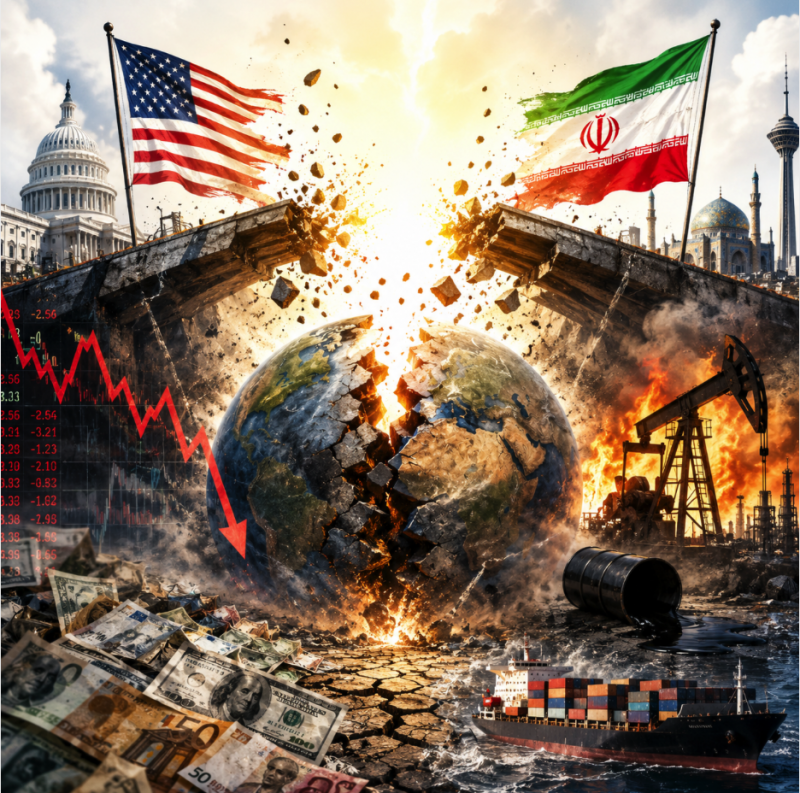
This is a moment in history that we will remember for a long time to come. Even though we were told over and over again that a deal with Iran was almost “finalized”, the truth is that there never was going to be a deal with Iran. It was all smoke and mirrors. The U.S. couldn’t give Iran what it was demanding, and Iran simply refused to give the U.S. what it was demanding. Now negotiations have totally collapsed, and it appears that the war is back on. Needless to say, this is going to be absolutely devastating for the global economy.
The Iranians are absolutely furious that Israeli troops have been advancing deep into Lebanese territory during the ceasefire period, and they are identifying that as the primary reason why they have decided to pull out of talks with the United States…
Iran negotiators will stop exchanging messages with the U.S. through intermediaries, and Tehran will move to fully close the Strait of Hormuz, in retaliation for ongoing ceasefire violations, Iran’s state-affiliated news outlet Tasnim said Monday.
The report, in a translated post on the social media site Telegram, homed in on Israel’s military operations in Lebanon against the Iran-backed militia Hezbollah.
“No dialogue will take place” until Israel fully withdraws from occupied areas in Lebanon and stops all attacks in both Lebanon and Gaza, per Tasnim.
Israel will stop shooting as long as Hezbollah agrees to stop sending attack drones into northern Israel.
But there is no way that we are going to see the IDF completely pull out of Lebanon.
If the Iranians are waiting for that to happen, they will be waiting for a really, really long time.
The Iranians are alleging that the U.S. naval blockade of the Iranian coastline is also a violation of the ceasefire, and they want that to end too.
President Trump has vowed to keep that blockade going until a deal is finally reached, and so the Iranians are not going to get that either.
So it appears that any hope for a deal is completely dead, and the Iranians apparently intend to “completely block the Strait of Hormuz and activate other fronts including the Bab al-Mandeb Strait”…
“Also, the resistance front and Iran have resolved to completely block the Strait of Hormuz and activate other fronts including the Bab al-Mandeb Strait, in order to punish the Zionists and their supporters,” the report said.
The Bab el-Mandeb Strait is a trade chokepoint that connects the Red Sea to the Gulf of Aden.
Since the war began, Saudi Arabia has still been able to export quite a bit of oil by sending it via pipeline to ports on the Red Sea.
But if the Bab al-Mandeb Strait is also closed, the Saudis won’t be able to export any oil at all.
Last week, I published an article that discussed the fact that global oil inventories have already been dropping at the fastest pace ever recorded.
Shutting down the Bab al-Mandeb Strait would dramatically accelerate the depletion of existing supplies.
In other words, we are about to enter unprecedented territory.
Once news broke that the Iranians were cutting off negotiations, the price of oil rose by quite a bit on Monday…
The price of oil rose sharply on Monday, after Iranian government-aligned media reported that the country was cutting off talks with the United States to end the ongoing war.
U.S. crude oil soared as much as 8.5% to nearly $95 per barrel, an increase of almost $8. International Brent crude climbed as much as 7.3% to more than $97 per barrel, a $6 spike.
Heating oil, a proxy for jet fuel, also rose 7%, while wholesale gas prices rose 4%.
Of course this is just the beginning.
If the crisis in the Middle East is not resolved, the price of oil is going to go absolutely haywire.
A few days ago, the CEO of Chevron made some very alarming comments that have received a lot of attention…
That is what made Chevron CEO Mike Wirth’s remarks at the Bernstein 42nd Annual Strategic Decisions Conference on May 28, 2026, so striking.
He wasn’t hedging.
“The buffers and the shock absorbers are being steadily drawn down, and the ability for the market to absorb this imbalance is drastically diminished today versus where we started,” Wirth said, according to Seeking Alpha.
He is exactly correct.
We are in a far worse position today than we were when this war began.
And Wirth is projecting that the months of June and July could represent a major turning point…
Wirth went further: “Over the next few weeks, we’re likely to see those pressures flow through more directly to physical prices, and there’s more upwards pressure that I would expect as we get into June and certainly into July.”
That is a specific, directional warning from the CEO of one of the world’s largest energy companies. The Iran war has been grinding through global oil reserves for more than ten weeks. The cushion that absorbed the initial shock is nearly gone. And the data is starting to confirm what Wirth is describing.
All along there was hope that we would be bailed out by a deal between the Iranians and the Trump administration.
But now the rug has been pulled out from underneath our feet.
Exxon Senior Vice-President Neil Chapman recently warned that once inventory levels start hitting critical levels, we could see the price of oil soar to 150 dollars or 160 dollars a barrel…
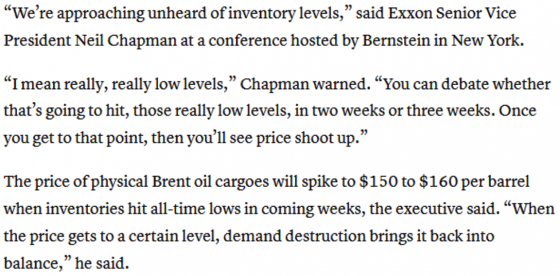
There have been others that have warned that the price of oil could soon hit 180 dollars a barrel.
It is difficult to project exactly how high the price of oil will go, because we have never faced anything like this before.
And the higher the price of oil goes, the worse it is going to be for the global economy.
Of course the collapse of negotiations is also really bad news for our farmers, because now there is no end in sight for the global fertilizer crisis…
The effective closure of the strait of Hormuz has throttled global supplies of fertilizer, as well as oil. So far, the effect on consumers has been mostly felt as high prices at the gas pump, but global food supply chains, from seed to grocery shelf, tend to have longer lags. On May 7, John Denton, Secretary General of the International Chamber of Commerce warned during an interview with Forbes TV that the fertilizer shortage could cause deadly food scarcity and price hikes.
In April, a statement by the American Farm Bureau Federation said that around 70% of U.S. farmers report being unable to afford all the fertilizer they need. The AFBF’s Fertilizer Availability Survey of nearly 6,000 farmers and ranchers across the country also found that nearly six in 10 U.S. farmers report worsening finances, because of rising fertilizer and fuel costs during spring planting.
We had one shot at avoiding a horrifying global economic implosion.
We desperately needed the Strait of Hormuz to be reopened, and that isn’t going to happen.
If you have been waiting for a sign that will make it clear which way things are going to go, you just got it.
From this point forward, global events are going to move at a blinding pace.
Negotiations have collapsed, Iran has chosen war, and the crisis in the Middle East is about to get really crazy.
Michael’s new book entitled “10 Prophetic Events That Are Coming Next” is available in paperback and for the Kindle on Amazon.com, and you can subscribe to his Substack newsletter at michaeltsnyder.substack.com.

About the Author: Michael Snyder’s new book entitled “10 Prophetic Events That Are Coming Next” is available in paperback and for the Kindle on Amazon.com. He has also written nine other books that are available on Amazon.com including “Chaos”, “End Times”, “7 Year Apocalypse”, “Lost Prophecies Of The Future Of America”, “The Beginning Of The End”, and “Living A Life That Really Matters”. When you purchase any of Michael’s books you help to support the work that he is doing. You can also get his articles by email as soon as he publishes them by subscribing to his Substack newsletter. Michael has published thousands of articles on The Economic Collapse Blog, End Of The American Dream and The Most Important News, and he always freely and happily allows others to republish those articles on their own websites. These are such troubled times, and people need hope. John 3:16 tells us about the hope that God has given us through Jesus Christ: “For God so loved the world, that he gave his only begotten Son, that whosoever believeth in him should not perish, but have everlasting life.” If you have not already done so, we strongly urge you to invite Jesus Christ to be your Lord and Savior today.