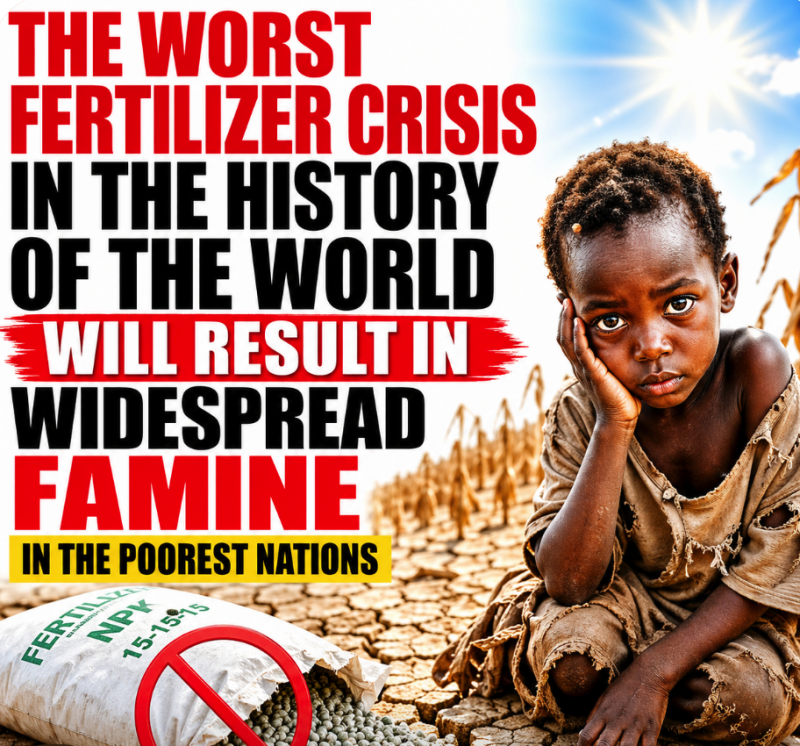
Thanks to the crisis in the Strait of Hormuz, there isn’t going to be enough fertilizer for everyone in 2026. What is available is going to be gobbled up by the wealthy countries because they have the most money. Of course higher fertilizer costs will ultimately be passed along to consumers, and so we will all be paying much higher prices for food in the months ahead. But in the poorest nations on the entire planet, a lack of fertilizer could mean the difference between life and death. A dramatic reduction in the amount of fertilizer that farmers use will result in a dramatic reduction in the amount of food that is grown in those countries. Of course many of those countries were already dealing with very high levels of food insecurity, and the UN has admitted that acute hunger was already at the highest level ever recorded even before the war with Iran began. What the world is facing is unlike anything that any of us have ever seen before, and large numbers of people could literally end up starving to death.
I wish that I was exaggerating.
Without sufficient quantities of fertilizer, there is no way that we could possibly feed the 8 billion people that are living on this planet today.
Unfortunately for all of us, spring planting season is here and much of the world’s supply of fertilizer is trapped because the Strait of Hormuz is closed…
But the share of world supply of urea – the most popular commonly used fertiliser – that typically passed through the strait before the conflict was more than twice that, at 43%.
For sulphur – used to produce phosphate fertilisers – the figure is 44%.
For anhydrous ammonia – another nitrogen fertiliser – 27% of global supply on average passed through the strait between 2019 and 2023.
In addition, many nations normally use natural gas that is exported through the Strait of Hormuz to make their own fertilizer.
So this is why it is so important for the Strait of Hormuz to be opened as soon as possible.
If that does not happen, one UN official is warning that the consequences will be “very significant and severe, particularly for the poorest countries and for the poorest citizens”…
In response, United Nations Secretary-General António Guterres established a task force to facilitate the safe passage of fertilizers and related raw materials for humanitarian purposes.
It is headed by Jorge Moreira da Silva, Executive Director of the UN Office for Project Services (UNOPS), which provides infrastructure, procurement and project management services across the world.
“We can’t wait until everything has been fixed,” he said in an exclusive interview with UN News.
“The planting season has already started…So if we don’t get some solution immediately the crisis will be very significant and severe, particularly for the poorest countries and for the poorest citizens.”
This is really happening.
I have many regular readers in Africa, and it is being reported that African farmers are facing a major fertilizer shortage this year…
Food security in Africa could face major disruptions due to continuing uncertainty in the Strait of Hormuz.
The conflict between the United States, Israel and Iran is disrupting global fertiliser trade flows – and this stands to leave millions of African farmers without the ammonia, urea, phosphate, sulphur and other fertiliser inputs vital to growing more food in sub-Saharan Africa.
Even a small drop in fertilizer availability could be catastrophic.
The UN’s Food and Agriculture Organization is telling us that just a 10 percent reduction in the fertilizer supply in Africa could mean that 25 percent less maize, rice and what is grown this year…
According to the Food and Agriculture Organization, even a 10 percent reduction in fertiliser availability could result in up to 25 percent less maize, rice and wheat grown in sub-Saharan Africa.
Nitrogen fertilizer causes explosive crop development.
Without it, many farmers will grow far less food in 2026.
Even here in the U.S., there are farmers that have decided not to use any nitrogen fertilizer this year because it now costs way too much…
The drought compounds economic strains, including elevated fertilizer costs tied to global events. US Representative Frank Lucas, a Republican from Oklahoma, noted he skipped nitrogen applications on his western Oklahoma wheat fields.
“I didn’t have enough moisture — it wouldn’t have done any good,’’ Lucas said. “Number two, I’m not even sure what the cost would be.”
U.S. farmers are currently facing a double crisis.
In addition to skyrocketing fertilizer prices, conditions throughout much of the middle of the nation are bone dry.
On Friday, I explained to my core supporters that March 2026 was the third driest month ever recorded in the United States.
Only July 1934 and August 1934 were drier, and that was during the Dust Bowl days.
Because things are so dry, massive wildfires are erupting with alarming frequency. For instance, two extremely large wildfires have already burned more than 40,000 acres in Georgia…
Two massive wildfires in south Georgia have scorched more than 40,000 acres and destroyed over 120 homes.
Extreme drought has turned the region into a tinderbox and allowed flames to spread. Overnight, new fires sparked in rural south Georgia. High winds have made efforts to contain the fires difficult, officials said in a news conference Saturday afternoon.
Brantley County Manager Joey Cason called the wildfires a “dynamic situation” in a Saturday morning video posted to social media and begged residents to “please evacuate” if they are ordered to do so. New evacuation orders were issued as the fire spread.
This is going to be such a challenging year.
Far less food will be produced in the U.S. than normal this year, and the same thing could be said about many other major food exporters.
In Australia, they are projecting that wheat production could be down by up to 25 percent.
If farmers do not grow our food, we do not eat.
What we really need is for the Strait of Hormuz to be reopened as quickly as possible, but that isn’t going to happen.
In fact, talks between the U.S. and Iran have totally broken down…
Hopes of a diplomatic breakthrough in the U.S.-Israeli war with Iran faded on Sunday, as efforts to revive talks stalled and both Tehran and Washington showed little sign of softening their positions.
Iranian Foreign Minister Abbas Araghchi flew back to the Middle East from mediation talks in Pakistan over the weekend, while U.S. President Donald Trump scrapped a planned visit to Islamabad by his envoys Steve Witkoff and Jared Kushner.
The Trump administration is not going to compromise on their key demands, because they are afraid that Israel could be destroyed “within minutes” if Iran is able to produce nuclear weapons…
US President Donald Trump said Sunday that Israel would be destroyed “within minutes” if Iran obtained a nuclear weapon, warning the world would be in danger.
He added that previous US administrations should have acted earlier to stop Iran’s nuclear ambitions.
On the other side, the Iranians have stated that they will not move from their key list of demands, and they are insisting that they are more than ready for fighting to resume…
Iran produces more than 1,000 types of weapons domestically, including missiles, drones and military systems, defence ministry spokesperson Reza Talaei-Nik said.
“Today, more than 1,000 types of weapons… are produced entirely domestically,” he said, adding the capability is the result of over 25 years of investment in the defence sector.
He said production is spread across the country so it can continue even if some facilities are damaged, and added that around 9,000 companies are involved in supporting the defence industry.
The Iranians can hit us much harder and in a lot more ways than most people realize.
Even the Trump administration is greatly underestimating Iran’s capabilities, and that could have tragic consequences for the entire globe.
Once fighting resumes, I am entirely convinced that we will witness some shocking escalations.
And it appears that the Strait of Hormuz will remain closed for the foreseeable future, and that probably means that widespread famine is inevitable now.
Michael’s new book entitled “10 Prophetic Events That Are Coming Next” is available in paperback and for the Kindle on Amazon.com, and you can subscribe to his Substack newsletter at michaeltsnyder.substack.com.

About the Author: Michael Snyder’s new book entitled “10 Prophetic Events That Are Coming Next” is available in paperback and for the Kindle on Amazon.com. He has also written nine other books that are available on Amazon.com including “Chaos”, “End Times”, “7 Year Apocalypse”, “Lost Prophecies Of The Future Of America”, “The Beginning Of The End”, and “Living A Life That Really Matters”. When you purchase any of Michael’s books you help to support the work that he is doing. You can also get his articles by email as soon as he publishes them by subscribing to his Substack newsletter. Michael has published thousands of articles on The Economic Collapse Blog, End Of The American Dream and The Most Important News, and he always freely and happily allows others to republish those articles on their own websites. These are such troubled times, and people need hope. John 3:16 tells us about the hope that God has given us through Jesus Christ: “For God so loved the world, that he gave his only begotten Son, that whosoever believeth in him should not perish, but have everlasting life.” If you have not already done so, we strongly urge you to invite Jesus Christ to be your Lord and Savior today.