When this war with Iran erupted, everyone knew that it would have an impact on the global economy. But very few anticipated that it would be this bad. We are facing the worst oil disruption in history, the worst natural gas disruption in history, the worst helium disruption in history and the worst fertilizer disruption in history simultaneously. The Iranians have control over which ships are allowed through the Strait of Hormuz, and they are determined to keep it that way for as long as possible. But even if the war ended and traffic through the Strait of Hormuz was fully restored tomorrow, it would take years for the global economy to return to normal because of all the energy infrastructure that has been destroyed on both sides.
With no end in sight for the war, oil prices in the western world just continue to move higher.
But if you want to see where oil prices are eventually headed if this crisis persists, just check out what has been happening in Dubai.
At one point on Thursday, the price of oil in Dubai briefly hit an all-time record of $166 a barrel…
The extreme spike in oil prices seen in local markets in the Middle East could give investors a glimpse into to where U.S. and Europe prices are headed if the Strait of Hormuz isn’t opened soon.
Dubai crude oil prices surpassed $166 a barrel to a new record high on Thursday, according to market data provider Platts. Dated Brent and West Texas intermediate Cushing’s are trading around the $100 mark after historic runs higher.
Normally, the price of oil in Dubai falls somewhere between West Texas oil and Brent oil.
But once the war began, it started selling at an unprecedented premium.
In Saudi Arabia, officials are projecting that the price of oil could eventually surpass $180 a barrel if this war persists until the end of next month…
Saudi Arabia’s oil officials are working frantically to project how high oil prices might go if the Iran war and its disruption of energy supplies doesn’t end soon-and they don’t like what they are seeing.
The base case, several oil officials in the Gulf’s biggest producer said, is that prices could soar past $180 a barrel if the disruptions persist until late April.
While that would sound like a bonanza for a kingdom still heavily leveraged to oil revenue, it is deeply concerning. Prices that high could push consumers into habits that slash their oil use-potentially for the long term-or trigger a recession that also hurts demand. They also would risk casting Saudi Arabia in the role of profiteer in a war it didn’t start.
If the price of oil reaches that level and stays there for an extended period of time, it will crash everything.
Our system is simply not designed to be able to handle a shock like that.
Of course we are also facing a historic natural gas crisis as well.
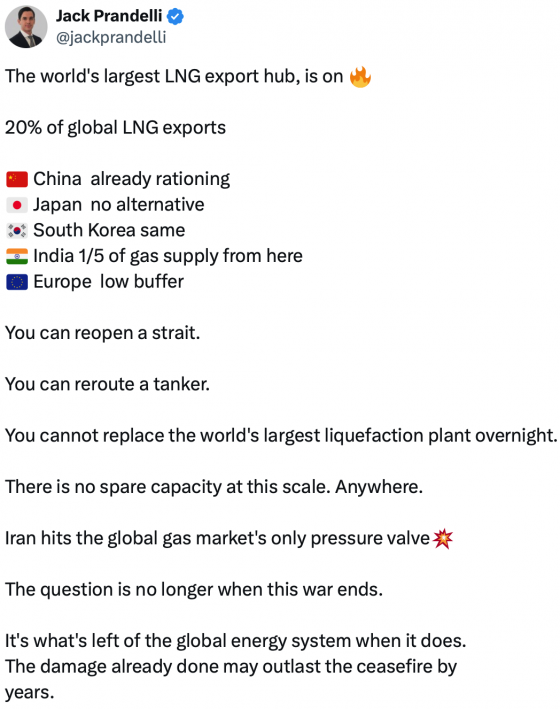
Normally, approximately one-fifth of the world’s supply of liquified natural gas is produced by Qatar’s Ras Laffan complex.
That complex is nearly three times the size of Paris, and it cost hundreds of billions of dollars to build.
So it was a really, really big deal when Iranian missiles started raining down.
The CEO of QatarEnergy is telling us that output at the complex has been reduced by 17 percent, and it will take three to five years to rebuild the capacity that has been lost…
Qatar could face years of reduced natural gas exports after Iranian strikes damaged key energy infrastructure, wiping out a significant share of its liquefied natural gas (LNG) production capacity, QatarEnergy’s chief executive told Reuters.
Saad al-Kaabi said the attacks disabled two LNG production units out of 14 and one gas-to-liquids facility out of two, reducing output by about 17% at a time when Qatar sits at the heart of global gas supply.
He said the affected facilities alone account for roughly 12.8 million tonnes of annual LNG production, and warned repairs could keep them offline for three to five years depending on security conditions and technical recovery timelines.
This is a catastrophic blow for the global economy.
As Jack Prandelli has accurately observed, there is no spare capacity elsewhere on the planet that can replace what has been destroyed…
So what do we do now?
It is going to take years to repair the damage that has already been done.
And what is going to happen if Iran attacks Qatar’s Ras Laffan complex again?
Meanwhile, the world is also facing a looming helium shortage.
Prior to the war, Qatar’s Ras Laffan complex produced over one-third of the world’s entire supply of helium…
The war in the Middle East could pose a threat to the semiconductor industry and other sectors dependent on a resource produced in the Gulf — helium.
Helium is a little-known but key input in many industries, most notably technology. In semiconductor manufacturing, its cooling properties are used to transfer heat. Helium is also indispensable in photolithography, a technique used to print each chip’s intricate circuitry.
The U.S. Geological Survey estimates that before the war Qatar produced more than one-third of the world’s helium supply. Lately, however, operations at QatarEnergy’s Ras Laffan Industrial City — the world’s largest liquefied natural gas export facility, which produces helium as a byproduct — were halted after it was struck by an Iranian drone early in the war. On Wednesday, Iranian missiles crippled the plant.
Without that helium, tech companies all over the planet are going to be thrown into a state of chaos.
So that is a huge problem.
But personally I am even more concerned about what this war is going to mean for global food production.
Farmers all over the northern hemisphere are preparing to plant their crops, and so if we can’t get the fertilizer that they need through the Strait of Hormuz we are going to be in for a world of hurt…
The Strait of Hormuz is a critical channel for fertilizer, including about 50% of global nitrogen-rich urea fertilizers, according to the Fertilizer Institute, the industry’s trade association. The strait has been effectively impassable since President Donald Trump launched the assault, which is now in its third week with no end in sight.
The closure has spiked fertilizer prices just before planting season, potentially scrambling decision-making for farmers across the U.S. And it comes on top of already low commodity prices that have lingered for years and eaten into farmers’ margins.
There will be a wild scramble for whatever is available, and those with the most money will be victorious.
But since western farmers will be paying much, much more for fertilizer this year, they will be forced to pass those costs along…
“We’re in uncharted territory,” Matt Frostic, a Michigan farmer who sits on the board of the National Corn Growers Association, said in an interview with CNBC. “It’s like a code red.”
Frostic said he purchased nitrogen fertilizer, critical for corn crops, in January for around $350 per ton. That same product, he said, is now closing in on $600 per ton.
Of course large numbers of farmers in poorer nations won’t have access to nitrogen fertilizer at all.
As a result, global food production will be way down and there simply won’t be enough food for everyone.
So we really need traffic to start flowing through the Strait of Hormuz like it normally does.
But that is not going to happen any time soon.
I think that we are about to see a lot of chaos erupt in global financial markets.
Already, we are witnessing a confluence of developments that we haven’t seen since 2008…
Thursday’s bond-market selloff caused the Treasury yield curve to exhibit what traders describe as a “bear-flattening” pattern. This actually began back in early February. Typically, the pattern emerges when bond traders are bracing for a difficult economic environment ahead.
The confluence of these three developments — oil above $100 a barrel, a 2-year yield above the fed funds rate, and a bear-steepening dynamic in the bond market — is making some investors nervous.
The last time all three things unfolded simultaneously was in the late spring of 2008, according to Bloomberg data. About four or five months later, Lehman Brothers collapsed, ushering in the most acute phase of the 2008 financial crisis. The S&P 500 declined 38.5% that year. Widespread mortgage defaults also resulted in many Americans losing their homes.
Hold on tight, because if this war doesn’t come to a conclusion soon this is only just the beginning.
The Iranians are trying to inflict so much pain on the rest of the world that the U.S. and Israel will be forced to agree to never attack Iran again.
On the other side, the U.S. and Israel are absolutely determined to win this war, and they would love to bring the regime in Iran to an end.
So I think that this war is going to go on for a while.
If it lasts into the summer, we really will be facing an economic “Armageddon scenario”, and that is not good news for any of us.
Michael’s new book entitled “10 Prophetic Events That Are Coming Next” is available in paperback and for the Kindle on Amazon.com, and you can subscribe to his Substack newsletter at michaeltsnyder.substack.com.

About the Author: Michael Snyder’s new book entitled “10 Prophetic Events That Are Coming Next” is available in paperback and for the Kindle on Amazon.com. He has also written nine other books that are available on Amazon.com including “Chaos”, “End Times”, “7 Year Apocalypse”, “Lost Prophecies Of The Future Of America”, “The Beginning Of The End”, and “Living A Life That Really Matters”. When you purchase any of Michael’s books you help to support the work that he is doing. You can also get his articles by email as soon as he publishes them by subscribing to his Substack newsletter. Michael has published thousands of articles on The Economic Collapse Blog, End Of The American Dream and The Most Important News, and he always freely and happily allows others to republish those articles on their own websites. These are such troubled times, and people need hope. John 3:16 tells us about the hope that God has given us through Jesus Christ: “For God so loved the world, that he gave his only begotten Son, that whosoever believeth in him should not perish, but have everlasting life.” If you have not already done so, we strongly urge you to invite Jesus Christ to be your Lord and Savior today.