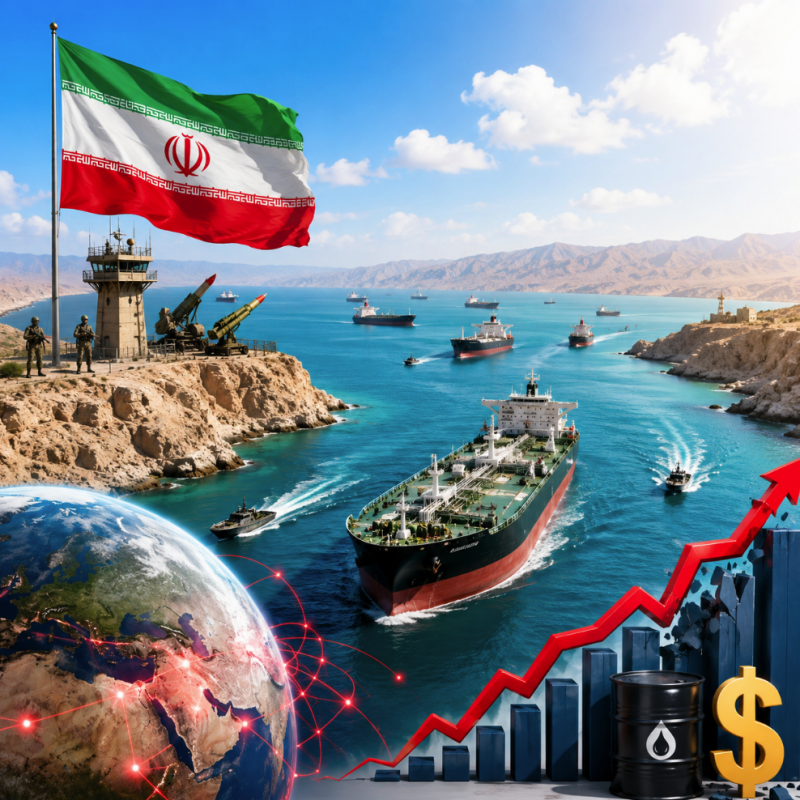
When we were told that the ceasefire extension with Iran would include “the toll-free opening of the Strait of Hormuz”, I didn’t realize that this was only for a period of 60 days. As you will see below, once the 60 days are over the Iranians will be allowed to charge vessels for passing through the Strait of Hormuz on a permanent basis. Any vessels that attempt to pass through the Strait without permission will be subject to attack by the Iranian military. In other words, the nightmare scenario that we have been enduring for the past several months will be institutionalized. I am shocked that U.S. negotiators would actually agree to this. With the Iranians in control, I seriously doubt that the flow of oil and natural gas out of the region will return to pre-war levels any time soon, and any oil and natural gas that does get exported will cost quite a bit more thanks to the protection racket that the Iranians will be running.
This is so humiliating.
The one thing that U.S. negotiators were supposed to get from this first stage of negotiations was the permanent toll-free opening of the Strait of Hormuz.
But instead, they handed sovereignty over the Strait of Hormuz to Iran…
Iran’s state-run Fars News Agency on Monday cited a “knowledgeable source” who said the U.S.-Iran peace deal “includes U.S. acceptance, for the first time, of Iran’s right to collect fees for maritime services” in the Strait of Hormuz.
According to the source, “explicit emphasis on Iranian-Omani sovereignty over the Strait of Hormuz” was added to the deal during “the final moments of the negotiations.”
These final revisions to the deal supposedly stated that “future administration of maritime services in the Strait of Hormuz” will be “determined” by Iran and Oman, which lies on the opposite side of the strait.
Iranian negotiators wiped the floor with U.S. negotiators at the negotiating table.
I could think of other less polite ways of saying that, but I think that I shall refrain from doing so.
The only good news is that there will be a 60 day period for vessels that are currently trapped in the Persian Gulf to pass through the Strait of Hormuz without being charged…
The source told Fars that these revisions to the deal mean “the United States has effective accepted Iran’s right to collect related service fees,” after a 60-period of toll-free travel through the strait has elapsed.
“This principle is repeated elsewhere in the text. Iran will accept the passage of ships without charge only for 60 days. This means the United States has accepted the principle of collecting fees, while securing only a 60-day exemption from Iran,” the source said.
Now that this precedent has been set, how long will it be before we see other nations start to monetize key chokepoints around the globe?
This is a red line that should have never, ever been crossed.
Iran’s foreign ministry has confirmed that once the 60 day period has concluded, a “maritime service fee” will be imposed upon all vessels that wish to travel through the Strait of Hormuz…
Iran will charge a “maritime service fee” in the Strait of Hormuz, its foreign ministry spokesperson said on Monday, as Tehran expressed “deep mistrust” in the US despite signing a memorandum of understanding with Washington to stop the war.
Talking to reporters, Iran foreign ministry spokesperson Esmail Baghaei said Iran would not charge a toll for ships crossing the key strait under a new framework deal with the US.
“We have always maintained that we do not seek to collect transit tolls, but fees for navigation services, environmental protection, ship insurance and other necessary services will be charged,” he said during a press briefing.
So how much will “navigation services, environmental protection, ship insurance and other necessary services” cost for each ship?
A million dollars?
Two million dollars?
The regime in Tehran could soon be absolutely swimming in cash.
And as they have shown in the past, they like to use their money to export their “revolution” to other countries.
If you feel sick after reading that, it is certainly an understandable reaction.
But for a moment, let’s imagine a wildly optimistic scenario in which Iran allows all vessels to travel through the Strait of Hormuz and only charges a “reasonable” protection fee.
Even in such a scenario, it would take an extended period of time to remove all of the mines that the Iranians have laid.
Some say that could take weeks, while others insist that it could take months.
In addition, shipowners and insurance companies will need time before they are convinced that it is safe to travel through the Strait of Hormuz once again…
Meanwhile, shipowners, insurers and vessel crews will need to be convinced that it is safe to pass through the Strait of Hormuz before full-scale maritime transit could resume.
“Even if the Strait is considered reopened, this does not automatically mean traffic will normalize immediately,” Dimitris Ampatzidis, Maritime Risk & Compliance Manager at Kpler, told NBC News.
“Vessels that have been delayed or held back would need time to exit, complete voyages, and potentially return for new loadings,” he said. “That process could take roughly 2–3 months.”
I very much agree with that assessment.
On top of everything else, it could take months for oil and natural gas production in the region to fully ramp up…
Middle Eastern producers have been forced to shut in more than 10 million barrels per day of oil production since the Strait of Hormuz was closed three and a half months ago. Producers will need months to fully ramp up wells to previous output levels, while the status of the Strait of Hormuz – even if it re-opens on Friday as expected – is still unclear.
This is a very important factor that is not getting nearly enough attention from the mainstream media.
One industry expert has warned that it would take Iraq “about a year” to get production back to previous levels…
“Places like Iraq could be much more challenged because they’ve had a much bigger shut-in, their fields are more difficult,” Alan Gelder, senior vice president of refining, chemicals, and oil markets at Wood Mackenzie, said.
“It may well take about a year before they get back,” the expert told AP.
Of course there are also oil and natural gas facilities all over the Persian Gulf region that have either been seriously damaged or destroyed.
Fully repairing and rebuilding all of that infrastructure could take years.
Meanwhile, global energy inventories will continue to get tighter and tighter.
What I have just described is the absolute best cast scenario.
So what would happen if the ceasefire breaks down and more war erupts?
Personally, I believe that is a far more likely scenario.
It has been said that the original ceasefire with Iran was the most violated ceasefire in history, and those that are convinced that a 60 day extension of that ceasefire will magically make everything better are not being rational.
Michael’s new book entitled “10 Prophetic Events That Are Coming Next” is available in paperback and for the Kindle on Amazon.com, and you can subscribe to his Substack newsletter at michaeltsnyder.substack.com.

About the Author: Michael Snyder’s new book entitled “10 Prophetic Events That Are Coming Next” is available in paperback and for the Kindle on Amazon.com. He has also written nine other books that are available on Amazon.com including “Chaos”, “End Times”, “7 Year Apocalypse”, “Lost Prophecies Of The Future Of America”, “The Beginning Of The End”, and “Living A Life That Really Matters”. When you purchase any of Michael’s books you help to support the work that he is doing. You can also get his articles by email as soon as he publishes them by subscribing to his Substack newsletter. Michael has published thousands of articles on The Economic Collapse Blog, End Of The American Dream and The Most Important News, and he always freely and happily allows others to republish those articles on their own websites. These are such troubled times, and people need hope. John 3:16 tells us about the hope that God has given us through Jesus Christ: “For God so loved the world, that he gave his only begotten Son, that whosoever believeth in him should not perish, but have everlasting life.” If you have not already done so, we strongly urge you to invite Jesus Christ to be your Lord and Savior today.