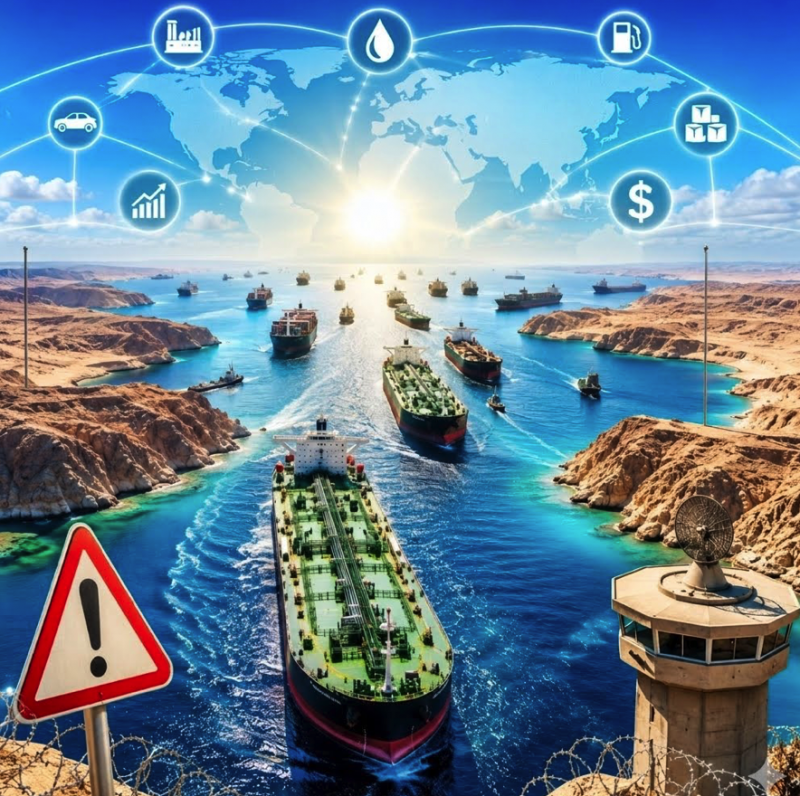
The Iranians have never wavered from their position that they intend to control traffic through the Strait of Hormuz permanently. They just underscored this point by launching an attack on a cargo vessel near the coast of Oman. During the 60 day negotiation window with the United States, Iran is not charging commercial vessels to pass through the Strait of Hormuz, but they are insisting that coordination with the Iranian military is mandatory. Any travel that does not go through “designated corridors” is strictly prohibited…
The IRGC Navy said that only the shipping routes designated by Iran are permitted for passage, and that coordination with Iranian forces via the designated communication channel is mandatory, according to Iranian local media.
“Navigation outside these routes is highly dangerous and prohibited, and we warn all vessels to strictly avoid any movement outside the designated corridors,” the IRGC Navy said, according to the report.
The warning came after a key naval information group had proposed alternative shipping corridors on Saturday, asking shipowners to consider transiting the strait along the southern route with their transponder signals on. “The southern transit route, along Omani [territorial waters], has been confirmed clear of mines and is the recommended route,” the notice said.
It is true that there are certain areas of the Strait of Hormuz that are highly unsafe because they still have mines in them.
But the routes that have been designated by Iran are not the only safe routes.
Some ships have been getting through the Strait of Hormuz by sailing close to the coast of Oman, and one such vessel was just attacked…
A cargo vessel in the Strait of Hormuz was struck by an “unknown projectile” on Thursday evening near the Oman coast, according to the U.K. Maritime Trade Operations.
The vessel suffered damage to its bridge, but said no one was injured, according to the UKMTO, which receives reports of suspicious activity from all vessels in the Gulf region.
The strike took place at 5:40 p.m. local time (10:10 a.m. ET).
There is no use in pretending.
Everyone knows that it was the Iranians that did this.
They are making it clear that they intend to control all traffic through the Strait of Hormuz from this point forward.
And once the 60 day negotiating window with the United States is over, they intend to impose “hefty fees” on all vessels that pass through the Strait…
Despite Rubio’s warning while meeting with GCC allies in Bahrain, Iran is planning to move forward on charging hefty fees for vessels wishing to transit the Strait of Hormuz under its protocol, which is to be enforced by the IRGC. What’s more is that it’s seeking Beijing’s approval and help.
Iran’s chief negotiator and Parliament Speaker, Mohammad Bagher Ghalibaf, asserted during a prior visit to Oman this week: “Everyone needs to know that management of the strait will never return to the way it was before.”
When the Iranians say “never”, they actually mean never.
According to the Wall Street Journal, the Iranians plan to make about 40 billion dollars a year by holding the global economy hostage…
Iran is pushing to make billions of dollars from the Strait of Hormuz as the regime positions itself to manage the global oil artery it severed at the start of the war.
The Islamic Republic estimates that charging for security, safety and environmental services in the strait would bring in $40 billion a year in revenue for states involved, according to officials familiar with the matter. The idea, if implemented, would give Tehran cash flow and control that it didn’t command before the war.
Those that pay up will be able to go through.
Those that do not pay up will not.
U.S. Secretary of State Marco Rubio is insisting that what the Iranians intend to do cannot ever be allowed…
Secretary of State Marco Rubio warned Thursday that allowing Iranian tolls on ships passing the Strait of Hormuz would create a precedent to other waterways, risking “total chaos.”
“International waterways do not belong to any nation state. This is a foundational principle in the world today, without which the world would be in total chaos,” he told a Gulf Cooperation Council meeting in Bahrain.
“If in fact we accepted that you can charge money to use an international waterway because it happens to be near your territorial space, well then this will spread throughout the world like a contagion.”
He is right.
But it would take war to stop the Iranians from imposing tolls.
And if war erupts again, it would completely close the Strait of Hormuz until the war was finally resolved one way or the other.
Of course it is inevitable that more fighting will erupt between Israel and Iran.
It is just a matter of time.
Meanwhile, global supplies of oil just keep getting tighter and tighter…
Iran’s closure of the Strait of Hormuz cut off around 13 million barrels of oil per day, roughly a fifth of the world’s supply. All told, the global economy will lose 1.6 billion barrels of oil supply between February and August, according to JPMorgan.
The good news is that traffic through the Strait of Hormuz has increased this week, but it is still way below pre-war levels…
70 ships transited the Strait of Hormuz on Wednesday, a 105% increase of traffic day on day, according to maritime business intelligence firm Kpler.
In a social media statement, the firm said ships were increasingly using a southern route through the strait that hugs Oman’s coastline, as opposed to one that brings them close to Iran’s coast in the north of the waterway.
Even if Iran fully reopened the Strait of Hormuz permanently with no restrictions and no tolls, the amount of oil and natural gas coming through the Strait of Hormuz would not return to normal for a very long time because it is going to take years to fully repair and rebuild all of the oil and natural gas infrastructure that was damaged or destroyed during the war.
And that is a major problem, because oil stockpiles all over the planet continue to drop even lower.
In Cushing, Oklahoma, the storage tanks are now “dangerously close to empty”…
The amount of crude oil inventory at the Cushing Hub in Oklahoma fell to a 12-year low in the past week, according to the latest report from the U.S. Energy Information Administration, and in the opinion of some experts, puts the hub at nearly empty. Dangerously close to empty.
The inventories at the northern Oklahoma storage site, known as the “Pipeline Crossroads of the World,” fell by 6 million barrels. Considered the delivery hub for West Texas Intermediate futures traded on the New York Mercantile Exchange, Cushing’s new total as of this week was just 19 million barrels. Cushing is where dozens of pipelines intersect, carrying oil from the Permian, Bakken, SCOOP/STACK, Rockies and Western Canada.
The new level means the Cushing Hub is dangerously close to “empty” according to some experts. The 19 million barrels reflects about 25% of the 76-million barrel working capacity at the hub. It also results in an operational stress level which is the point where tanks struggle to supply customers with usable oil due to pipeline residue and structural minimums.
Those that are convinced that the global energy crisis is behind us need to explain where we are going to get enough oil and natural gas to keep inventories from continuing to decline throughout the world.
Even in a best case scenario, things are going to be very tough for many months to come.
Of course if a worst case scenario materializes and all-out war between Israel and Iran erupts, we really will have a major energy disaster on our hands.
The global economy cannot operate normally without sufficient quantities of oil and natural gas from the Middle East.
The Strait of Hormuz must be reopened permanently without any restrictions or tolls, but the Iranians are absolutely refusing to compromise.
Michael’s new book entitled “10 Prophetic Events That Are Coming Next” is available in paperback and for the Kindle on Amazon.com, and you can subscribe to his Substack newsletter at michaeltsnyder.substack.com.

About the Author: Michael Snyder’s new book entitled “10 Prophetic Events That Are Coming Next” is available in paperback and for the Kindle on Amazon.com. He has also written nine other books that are available on Amazon.com including “Chaos”, “End Times”, “7 Year Apocalypse”, “Lost Prophecies Of The Future Of America”, “The Beginning Of The End”, and “Living A Life That Really Matters”. When you purchase any of Michael’s books you help to support the work that he is doing. You can also get his articles by email as soon as he publishes them by subscribing to his Substack newsletter. Michael has published thousands of articles on The Economic Collapse Blog, End Of The American Dream and The Most Important News, and he always freely and happily allows others to republish those articles on their own websites. These are such troubled times, and people need hope. John 3:16 tells us about the hope that God has given us through Jesus Christ: “For God so loved the world, that he gave his only begotten Son, that whosoever believeth in him should not perish, but have everlasting life.” If you have not already done so, we strongly urge you to invite Jesus Christ to be your Lord and Savior today.