Unless we witness some sort of a crazy diplomatic miracle, the price of gasoline will soon rise into unprecedented territory. The Iranians have closed the Strait of Hormuz, the Houthis are blocking Saudi tankers from getting through the Bab el-Mandeb Strait, and with a big helping hand from the United States the Ukrainians are relentlessly attacking Russian oil refineries. Meanwhile, the oil inventory buffers that existed before the war with Iran are rapidly being depleted. Nations around the world are doing whatever they can to adjust to this crisis, but time is running out.
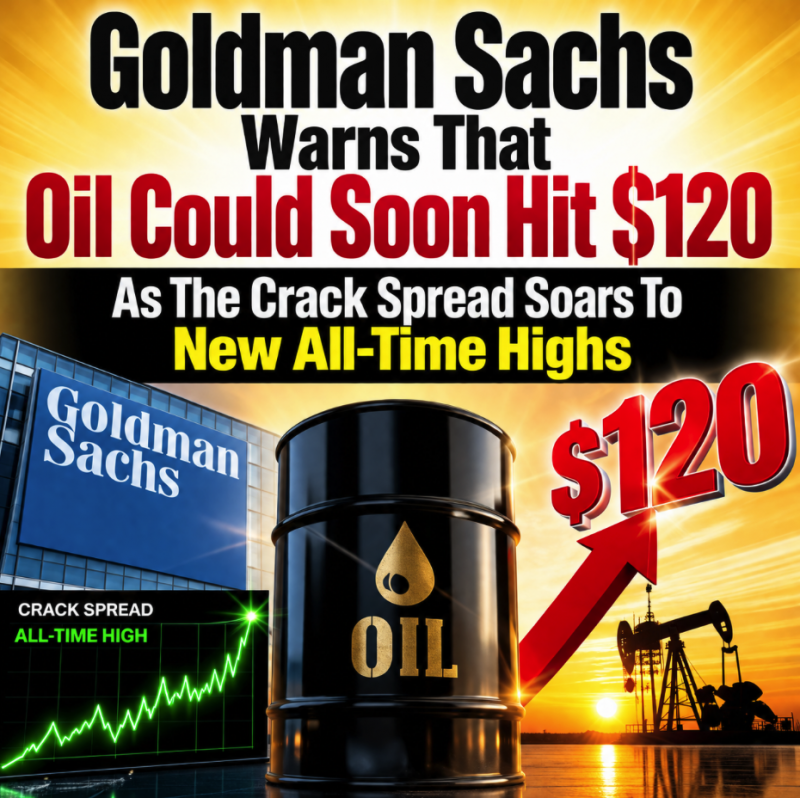
According to analysts at Goldman Sachs, the price of oil could soon hit $120 a barrel if a diplomatic solution to the conflict in the Middle East is not found…
Oil prices could reach upward of $120 a barrel if tensions between the U.S. and Iran don’t start to ease soon.
Analysts at Goldman Sachs, led by Daan Struyven, wrote in a note published on Monday night that Brent crude may surpass $120 a barrel by next quarter and average $100 a barrel the following year if the Strait of Hormuz remains disrupted throughout 2027. In this scenario, output from the Persian Gulf doesn’t recover until December next year, with the support of oil-pipeline extensions.
If the price of oil reaches that level and stays there for an extended period of time, a major global economic downturn is essentially guaranteed.
The good news is that the price of oil is not anywhere near that level yet.
But on Tuesday the price of Brent crude did exceed the $90 barrier for the first time since June 11th…
After 10 consecutive days of U.S. strikes on Iran, Brent crude oil futures settled above the key threshold of $90 a barrel Tuesday.
Brent futures ended the day at $91.01, up 2.1%. The last time they settled above $90 a barrel was on June 11, less than a week before the U.S. and Iran signed a memo of understanding aimed at ending hostilities in the Strait of Hormuz while a longer-term peace deal was negotiated. But that 60-day truce ended less than a month after it was signed.
The trend is not our friend at this stage.
Of course the price of crude oil is not the only number that we need to be watching.
The “crack spread” has been soaring, and that should deeply alarm all of us.
If you are not familiar with the “crack spread”, the following is a pretty good explanation…
The process works like this: Refiners take in raw crude oil (the price mostly referred to in headlines) and “crack” it into usable petroleum products. But just like crude is its own commodity, gasoline and diesel have their own trading prices as well. The profit that oil refineries make from converting crude into usable fuels is the “crack spread.”
Prior to the war, the “crack spread” was usually about 10 to 15 dollars a barrel.
This week, it reached a whopping 70 dollars a barrel…
But while everyone has been watching crude oil, a different oil measure — the one that arguably matters more for the price at the gas pump — has never stopped climbing. That measure, called the “crack spread,” is at all-time highs.
The crack spread is the gap between what a refinery pays for crude and what it earns selling the gasoline and diesel it makes from it. For most of the past decade that gap fluctuated between $10 and $15 a barrel. This week it hit $70, the widest spread ever recorded.
The margin for refining a barrel of oil is now more than what an entire barrel of crude cost the day this war began. And here is the tell: It kept climbing while crude collapsed, and it is still climbing now that crude is rising. It does not care which way the headline price moves.
The crack spread is the market telling you, in dollars, that the right crude is not reaching the right refineries. The price of oil can do whatever it likes. The machines that turn it into fuel are screaming either way.
The conflicts in the Middle East and in Ukraine are the primary reason why the “crack spread” has been steadily widening.
Many refineries in the Persian Gulf region are currently not operating due to the war with Iran, and we keep helping Ukraine damage refineries all over Russia…
The current conflict between Russia and Ukraine that started in February 2022 has significantly damaged global refining capacity, with Russian crude runs falling to a 22-year low of 3.8 million barrels per day in June, according to a Truist report.
It also resulted in a Russian ban on diesel exports, limiting how much crude oil can actually be turned into fuel and reach the global market.
“When 1 in 9 barrels of diesel is produced in Russia, and suddenly they’re banning exports, it’s problematic,” De Haan said.
The U.S.-Iran war has made matters even worse. Despite previous talks to de-escalate the conflict, the International Energy Agency said in its July oil-market report that Middle East export refineries have yet to restart.
We desperately need peace.
But there isn’t going to be peace.
Instead, there were some dramatic escalations last week, and there have been more dramatic escalations this week.
On Monday, the Houthis announced that Saudi commercial vessels would no longer be allowed to travel through the Bab el-Mandeb Strait…
A successful effort by Yemen’s Houthis to shut the Bab el-Mandeb Strait would strike at one of the world’s most important oil shipping routes, potentially triggering a fresh surge in crude prices, disrupting fuel supplies and adding to strains on the global economy.
Yemen’s Iran-aligned Houthis on Monday declared a naval blockade against Saudi Arabia, its military spokesperson said. A closure of the Red Sea’s southern gateway would remove a critical alternative route for the kingdom to the Strait of Hormuz and intensify fears of shortages.
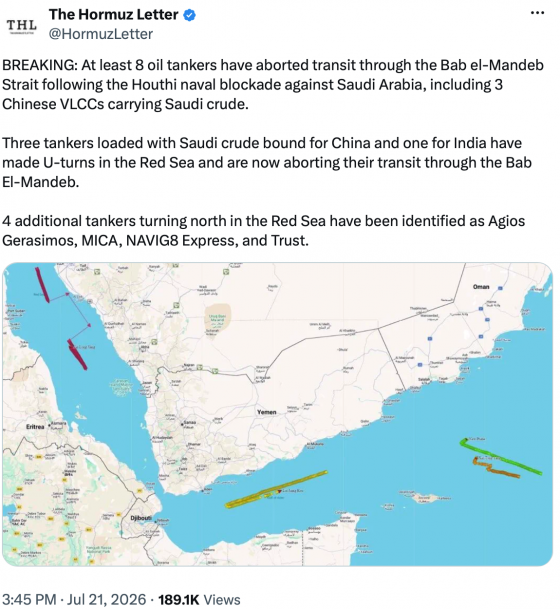
This blockade seems to be working, because at least 8 oil tankers have already been forced to turn around…
One analyst is warning that the impact that this move will have on global markets will be “massive”…
A full closure would have the biggest immediate impact on Saudi crude exports from the Red Sea port of Yanbu. Matt Smith, commodity research director at Kpler, said Asian refiners receiving those barrels could face delays of around a month as tankers are forced to sail around the Cape of Good Hope.
“The impact is going to be massive in the first month,” Smith said. “The biggest impact is going to be on Saudi flows.”
The bottom line is that everyone in the world will soon be paying much more for gasoline unless a miracle happens.
And once all of our buffers are totally gone, shortages and rationing will begin to manifest in various parts of the globe.
I expect Asia to feel the pain first, and Europe will quickly follow.
There is still time for peace to prevail, but that window is getting narrower each day.
For a long time I have been warning my readers that crazier times were on the way, and what we are experiencing now is just the beginning.
Michael’s new book entitled “10 Prophetic Events That Are Coming Next” is available in paperback and for the Kindle on Amazon.com, and you can subscribe to his Substack newsletter at michaeltsnyder.substack.com.

About the Author: Michael Snyder’s new book entitled “10 Prophetic Events That Are Coming Next” is available in paperback and for the Kindle on Amazon.com. He has also written nine other books that are available on Amazon.com including “Chaos”, “End Times”, “7 Year Apocalypse”, “Lost Prophecies Of The Future Of America”, “The Beginning Of The End”, and “Living A Life That Really Matters”. When you purchase any of Michael’s books you help to support the work that he is doing. You can also get his articles by email as soon as he publishes them by subscribing to his Substack newsletter. Michael has published thousands of articles on The Economic Collapse Blog, End Of The American Dream and The Most Important News, and he always freely and happily allows others to republish those articles on their own websites. These are such troubled times, and people need hope. John 3:16 tells us about the hope that God has given us through Jesus Christ: “For God so loved the world, that he gave his only begotten Son, that whosoever believeth in him should not perish, but have everlasting life.” If you have not already done so, we strongly urge you to invite Jesus Christ to be your Lord and Savior today.