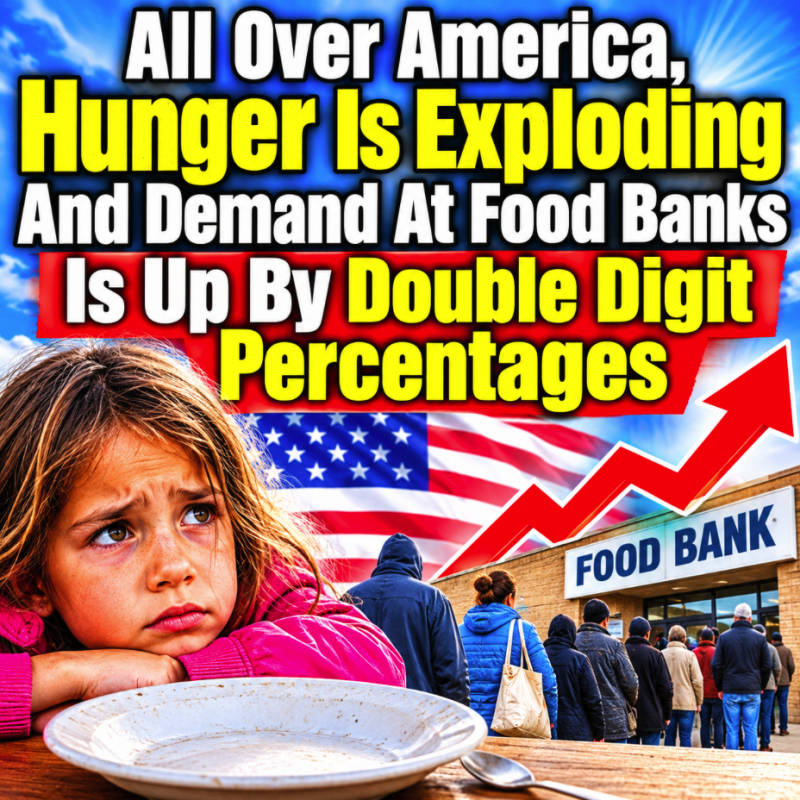
If you have enough food to eat this Thanksgiving, you should be very grateful, because millions of Americans do not. In all the years that I have been writing, hunger has never been this widespread in the United States. As I discussed last month, one survey discovered that 44 percent of Americans now struggle to afford even the most basic necessities. A different survey found that 27 percent of all U.S. adults are now skipping meals due to high food prices. 42 million Americans are on food stamps, but there are tens of millions of other hungry Americans that live in households that make too much money to be eligible for food stamps. The “working poor” are turning to food banks for assistance like never before, and this is putting an enormous amount of strain on those food banks.
All over the country, we are witnessing record demand.
For example, at one food bank in San Antonio demand is up 17 percent compared to last year…
With Thanksgiving just two days away, the San Antonio Food Bank says more families are turning to them for help putting food on the table.
The food bank reports a 17% increase in demand this year, with CEO Eric Cooper saying they’re serving about 30,000 more people coming in for the holidays.
Cooper says the increase comes amid cuts in federal funding and restrictions on SNAP benefits. Tariffs and high diesel prices have also made it more difficult to secure food, particularly meat.
A 17 percent increase in one year is quite dramatic, but things are much worse at other food banks.
In Oregon, a network of food banks has seen demand rise by 51 percent over the past two years…
“Over the last two years alone, we’ve seen an increase in 51% visits to our food sites,” said Andrea Williams, the President of the Oregon Food Bank. “Since the pandemic, visits to our food sites have increased by 90%.”
That is insane.
But demand is growing even faster in North Carolina.
In fact, some food bank distribution sites in the state “are serving up to 60% more people than a year ago”…
More North Carolina families are turning to food banks as the Thanksgiving holiday nears — in part the result of cuts to federal food assistance programs.
The Food Bank of Central & Eastern North Carolina said Monday some of its partner pantries are serving up to 60% more people than a year ago.
“We have over 630,000 people who don’t know where their next meal is coming from,” Jason Kanawati Stephany, the food bank’s vice president, said Monday. “… It’s the worst crisis that we’ve seen in at least a generation.”
These are the types of numbers that you would expect to see in the midst of a horrifying economic depression.
So what will demand be like if a horrifying economic depression actually breaks out?
In New York City, one of of every five people is experiencing food insecurity right now…
City Harvest, which works with food providers across the five boroughs of New York, told CNBC 1 in 5 New Yorkers is currently experiencing food insecurity, or limited access to enough food because of a lack of money or other resources. That is up from 1 in 6 a year earlier, and 1 in 8 before the pandemic.
Average monthly visits to food pantries and soup kitchens in New York are also 85% higher than before the pandemic, said Rodriguez.
More than 8 million people live in New York City.
One out of every five of them do not have enough food to eat on a regular basis, and a technology platform that connects people with food pantries is seeing explosive growth…
Data from Plentiful, a technology platform that connects people with food pantries and tracks their usage, also points to growing demand and limited resources.
“For pantries using our reservation and pre-registration features, we see that the overwhelming majority of those are at or over capacity,” said Catherine Compitello, CEO of Plentiful. “Demand is growing while supply is not.”
First-time users of Plentiful in New York City rose roughly 56% from August to October, Compitello said.
The rising cost of living is absolutely crushing those at the bottom of the economic food chain.
But they aren’t important people, and so we don’t talk about them much.
The Atlanta Community Food Bank is claiming that the number of people that it helps has risen over 70 percent in just five years…
In Atlanta, the pressure extends beyond the city itself to the surrounding region. The Atlanta Community Food Bank serves about 270,000 households a month, or nearly 700,000 people, through partner pantries across North Georgia. President and CEO Kyle Waide said the number of people it serves has jumped more than 70% in five years.
“Much of that increase is among people whose incomes are too high to qualify for federal benefit programs,” said Waide.
Where does this end?
How high do the numbers have to go before we will finally admit that we have a major national crisis on our hands?
In Colorado, one food bank is actually “serving more than five times as many people each day as it did six years ago”…
The Weld Food Bank is serving more than five times as many people each day as it did six years ago, as rising living costs and the loss of pandemic-era food assistance push more families to seek help. Despite spending millions more dollars purchasing food, the organization says it has had to reduce the amount of food distributed to each household to keep up with demand.
“We’re serving over 1,800 people a day, every day, five days a week. Six years ago, that was about 350 people a day,” said Weston Edmunds, the food bank’s chief impact officer.
That increase has forced the organization to stretch its resources further. Six years ago, people received approximately 60 to 70 pounds of food per visit. Today, they receive between 30 and 40 pounds.
After reading this article, some people will still try to make all sorts of excuses about why the economy is just fine.
But it is obvious that the economy is not fine at all.
We have been caught in a downward spiral ever since the beginning of this decade.
Yes, for the moment those at the very top of the economic pyramid are still thriving, but things have gotten worse for almost everyone else.
Every single day, more members of the middle class join the ranks of the working poor.
Every single day, more members of the working poor join the ranks of the impoverished.
And every single day, more members of the impoverished lose everything and end up in the streets.
If you are able to afford a big Thanksgiving meal this year, you should deeply cherish it.
Because by this time next year things are going to look far different than they do now.
Michael’s new book entitled “10 Prophetic Events That Are Coming Next” is available in paperback and for the Kindle on Amazon.com, and you can subscribe to his Substack newsletter at michaeltsnyder.substack.com.

About the Author: Michael Snyder’s new book entitled “10 Prophetic Events That Are Coming Next” is available in paperback and for the Kindle on Amazon.com. He has also written nine other books that are available on Amazon.com including “Chaos”, “End Times”, “7 Year Apocalypse”, “Lost Prophecies Of The Future Of America”, “The Beginning Of The End”, and “Living A Life That Really Matters”. When you purchase any of Michael’s books you help to support the work that he is doing. You can also get his articles by email as soon as he publishes them by subscribing to his Substack newsletter. Michael has published thousands of articles on The Economic Collapse Blog, End Of The American Dream and The Most Important News, and he always freely and happily allows others to republish those articles on their own websites. These are such troubled times, and people need hope. John 3:16 tells us about the hope that God has given us through Jesus Christ: “For God so loved the world, that he gave his only begotten Son, that whosoever believeth in him should not perish, but have everlasting life.” If you have not already done so, we strongly urge you to invite Jesus Christ to be your Lord and Savior today.