
After this week is over, there may be no turning back. President Trump is literally threatening to “obliterate” Iran’s power grid, and the Iranians cannot do a thing to prevent that from happening. But in response, the Iranians are threatening to destroy oil and gas infrastructure all over the Persian Gulf. The Iranians have already destroyed 17 percent of Qatar’s Ras Laffan natural gas complex, and if they destroy the remaining 83 percent of that facility it will immediately plunge us into the greatest natural gas crisis in human history by a very wide margin. There would be widespread natural gas shortages, fertilizer plants all over the world would be forced to shut down, and hunger would run rampant. Approximately 20 percent of the world’s entire supply of liquified natural gas comes from Ras Laffan, and it will take 3 to 5 years to rebuild the portions of the complex that have already been destroyed. If the rest of the complex gets destroyed by Iran, it will be a cataclysmic event. When I say that, I am not exaggerating one bit. We really have reached a moment in human history that could change everything.
It all depends on what Donald Trump does next.
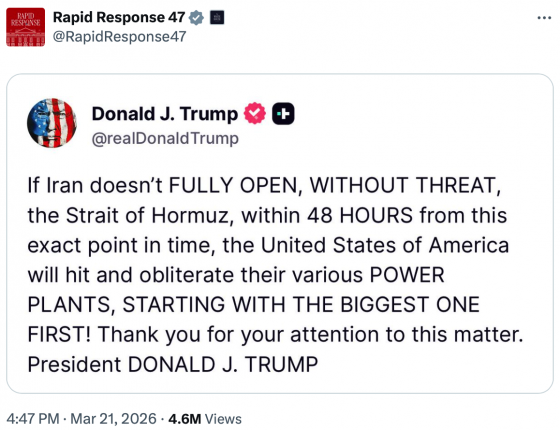
On Saturday, Trump gave the Iranians an ominous ultimatum.
Either they fully open the Strait of Hormuz within 48 hours, or the U.S. military will destroy their power grid…
For reasons that I have discussed in previous articles, the Iranians are not going to give Donald Trump what he wants.
It just isn’t going to happen.
Instead of giving in to Trump’s demands, the Iranians are threatening to attack energy infrastructure throughout the Persian Gulf, and they are pledging to completely close the Strait of Hormuz…
In a response to Trump’s statements, the Khatam al-Anbiya Central Headquarters, which is the central headquarters of the Iranian armed forces, said that it will fully close the Strait of Hormuz if “America’s threats regarding Iran’s power plants are implemented.”
Iran also warned that it would start targeting “all power plants, energy infrastructure, and information technology,” while any company in the region with American shareholders would also become a target.
Finally, Iran threatened to attack the power plants of any country in the region hosting American military bases.
“Everything is ready for a great jihad with the aim of completely destroying all economic interests of America in the Middle East,” the statement said.
So what happens if the Iranians wipe out Qatar’s Ras Laffan natural gas complex and other extremely critical energy production facilities in other Gulf countries?
What would Trump’s next move be then?
Would he send in U.S. ground troops?
CBS News is already reporting that U.S. officials have “made detailed preparations for deploying U.S. ground forces into Iran”…
Pentagon officials have made detailed preparations for deploying U.S. ground forces into Iran, multiple sources briefed on the discussions told CBS News.
Senior military commanders have submitted specific requests aimed at preparing for such an option as President Trump weighs moves in the U.S.-Israel-led conflict with Iran, the sources said.
The most likely target for U.S. ground troops would be Kharg Island, and the Iranians are promising that we will “suffer losses that are unprecedented since World War II” if Trump tries to do that…
An Iranian military source warned that new U.S. strikes or an invasion of Kharg Island, a key Iranian oil export hub, could prompt Tehran to escalate by threatening nearby waterways, including the Red Sea and the Bab al-Mandab Strait, telling the Islamic Revolutionary Guard Corps (IRGC)-affiliated Tasnim News Agency the United States would face an “unprecedented” response.
On a potential U.S. invasion of the island, the official warned that American troops would struggle to defend it and would “suffer losses that are unprecedented since World War II.”
How far up the escalation ladder are we willing to go?
It sounds like Israel is ready to raise the stakes as well.
The Iranians have been hitting Israeli population centers with cluster munitions, and Israeli Defense Minister Israel Katz is warning that if this continues his nation will “hit Iran so hard it will be sent back decades”…
Israeli Defense Minister Israel Katz said Israel would send Iran “back decades” if it continues targeting cities, accusing Tehran of deliberately firing on civilian population centers.
“If this continues, we’ll be sure to hit Iran so hard it will be sent back decades,” Katz said while visiting the site of a missile strike in Arad that injured scores.
If the U.S. and Israel push Iran to the wall, will the Iranians unleash any unconventional weapons that they have been holding in reserve?
In such a scenario, how would the U.S. and Israel react?
We are only a couple of steps away from an apocalyptic scenario.
Already, the damage that this war has done has set the global economy back for years.
The price of oil is causing major problems all over the globe, and experts are warning that we could eventually see it reach $200 a barrel…
Vandana Hari, founder of oil market analysis firm Vanda Insights, warned: “Benchmark Middle Eastern crudes like Oman and Dubai have already crossed the $150 threshold, so $200 is already within sight, even if not for Brent and West Texas Intermediate.”
Analysts at consultancy Wood Mackenzie have also said Brent could soon hit $150 and that $200 oil is not “outside the realms of possibility” in 2026.
If this war stretches on for an extended period of time, the pain that we will experience is going to be immense.
I am already hearing of diesel shortages in some parts of the world, and United Airlines has already canceled approximately 5 percent of this year’s planned flights…
United Airlines (UAL) CEO Scott Kirby said on Friday the airline will cancel about 5% of this year’s planned flights in the short term, as jet fuel prices surge due to the Middle East conflict.
“If prices stayed at this level, it would mean an extra $11 billion in annual expense just for jet fuel,” Kirby said in a message to employees posted on its website.
Of course the natural gas crisis that we are facing could potentially be even worse.
If this war lasts for a number of months, we could literally have to deal with “a full-blown economic emergency across Europe, the UK and large parts of Asia”…
Bank of America has warned European gas prices could surge from around €29 to as high as €500 this winter if the strait stays shut for an extended period, far exceeding levels seen after Russia’s invasion of Ukraine.
Such a spike would trigger what analysts describe as a full-blown economic emergency across Europe, the UK and large parts of Asia, with energy costs spiralling and industries forced to cut back, The Telegraph reports
Needless to say, natural gas is also a primary raw material that is used in the production of nitrogen fertilizer.
Normally, close to a third of all fertilizer that is traded globally travels through the Strait of Hormuz…
About a third of all fertilizer shipped globally goes through the Strait of Hormuz, the narrow passage between the Persian Gulf and the Gulf of Oman. Now, shipping traffic has been reduced to a trickle because of the U.S.-Israeli war with Iran, and the prices of goods like oil, natural gas, and fertilizer have been rising.
“Fertilizer prices are way up. They’re up around 30 percent more in some parts of the world, and that’s significant,” says Noah Gordon, fellow at the Carnegie Endowment for International Peace.
Gulf countries like Saudi Arabia, the United Arab Emirates, Kuwait and Iran are big global producers of fertilizer, and they export the raw ingredients other countries use to make their own fertilizers, like natural gas and minerals.
But that is only part of the story.
Because they are not able to get liquified natural gas from the Persian Gulf right now, fertilizer plants in other parts of the globe are being forced to close down…
The Carnegie Endowment noted fertilizer production in India, Bangladesh and Pakistan has shut down because those countries cannot get natural gas from Qatar, and Egypt, another producer, has had to turn to the more expensive LNG market because its supplies from Israel have been disrupted.
This is planting season for farmers all over the northern hemisphere.
In many poorer countries, there simply won’t be enough fertilizer this year.
In wealthier countries, fertilizer will be available, but it will cost far more than it usually does…
Tennessee farmer Todd Littleton expects to pay $100,000 more for fertilizer this season, a 40% spike from his bill last year thanks to the war in Iran — and he is scrambling to cover that extra cost.
“The problem is, is we’re so strained financially coming into this issue,” said Littleton, a third-generation farmer from Gibson County in the state’s northwest corner. “We have had a couple of record losses the last couple years, so everyone’s kind of grabbing at straws anyway, and then to have input prices increase yet again, it just really couldn’t happen at a worse time.”
Littleton, who grows corn, soybeans and wheat, is among thousands of farmers across the country who will pay far more this spring than they expected for fertilizer that is essential to their crops. Nitrogen-based fertilizer is especially vital for corn, usually the largest crop in the U.S. — and one that feeds the nation’s livestock and is converted into fuel that helps power most U.S. cars and trucks.
The crops that will be primarily affected by this fertilizer crisis will be those that are planted annually.
This is such an important point.
For example, nitrogen fertilizer is widely used by wheat farmers to maximize yield, improve grain quality, and promote healthy growth. A lack of fertilizer will mean that less wheat will be grown around the world in 2026 and prices will soar.
Barley is another example of an annual crop that is heavily dependent on nitrogen fertilizer because it promotes leaf and stem development, significantly affecting both yield and crop quality. By the end of this year, barley prices are likely to be far higher than they are now.
On the other hand, crops that do not have to be planted annually will fare much better.
Grape vines can live for 50 to 100 years, and they will just keep producing year after year.
Olive trees commonly live for hundreds of years, and some can even survive for more than 1,000 years. Incredibly, there are examples of olive trees that have been around for more than a millennium that are still bearing fruit.
What I am saying is that annual crops like wheat and barley could be absolutely devastated by this current crisis, while crops that do not have to be planted annually such as grapes and olives will not experience much disruption.
So much is going to depend on what happens this week.
Decisions that are being made right now are going to deeply affect every single one of us, and so let us hope that our leaders make their decisions wisely.
Michael’s new book entitled “10 Prophetic Events That Are Coming Next” is available in paperback and for the Kindle on Amazon.com, and you can subscribe to his Substack newsletter at michaeltsnyder.substack.com.

About the Author: Michael Snyder’s new book entitled “10 Prophetic Events That Are Coming Next” is available in paperback and for the Kindle on Amazon.com. He has also written nine other books that are available on Amazon.com including “Chaos”, “End Times”, “7 Year Apocalypse”, “Lost Prophecies Of The Future Of America”, “The Beginning Of The End”, and “Living A Life That Really Matters”. When you purchase any of Michael’s books you help to support the work that he is doing. You can also get his articles by email as soon as he publishes them by subscribing to his Substack newsletter. Michael has published thousands of articles on The Economic Collapse Blog, End Of The American Dream and The Most Important News, and he always freely and happily allows others to republish those articles on their own websites. These are such troubled times, and people need hope. John 3:16 tells us about the hope that God has given us through Jesus Christ: “For God so loved the world, that he gave his only begotten Son, that whosoever believeth in him should not perish, but have everlasting life.” If you have not already done so, we strongly urge you to invite Jesus Christ to be your Lord and Savior today.