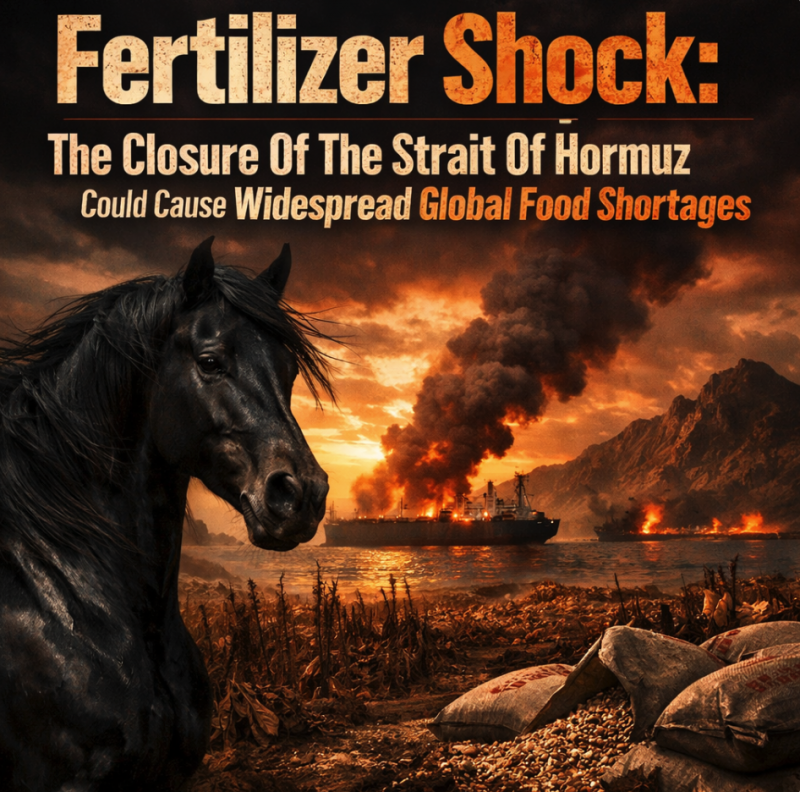
If commercial traffic through the Strait of Hormuz remains paralyzed for months, we will witness a global food crisis on a scale that many experts would have once considered to be unthinkable. Over the past couple of weeks, there has been much written about how the closure of the Strait of Hormuz has caused the price of oil to rise, has caused the price of natural gas to soar to insane levels and has caused the average price of diesel in the United States to jump above five dollars a gallon. But I think that the bigger story is what the closure of the Strait of Hormuz could mean for global food supplies.
Normally, approximately one-third of all globally-traded nitrogen fertilizer and approximately one-half of all globally-traded sulfur passes through the Strait of Hormuz…
Another world crisis sparked by the war in Iran may also be in the offing. That’s because the region’s oil and gas production has made it one of the world’s leading exporters of nitrogen fertilizers, which are indispensable to the global food system. To produce the chemicals used to grow much of the planet’s crops, natural gas is broken down to extract hydrogen, which is combined with nitrogen to make ammonia, and then mixed with carbon dioxide to make urea. All told, nearly a third of the global trade for nitrogen fertilizer passes through the Strait of Hormuz, while almost half of the world’s sulfur, essential in producing phosphate fertilizers, also travels through the corridor.
Reading that should chill you to the core.
But that is just part of the story.
Fertilizer producers in other countries will also be forced to shut down if they are not able to get the liquified natural gas that normally comes to them through the Strait of Hormuz…
Already, fertiliser plants in India and Pakistan are facing production declines given the disruption to natural gas supplies from the Middle East. Gulf countries targeted in the war supply nearly all of Pakistan’s LNG imports, 72% of Bangladesh’s and 53% of India’s.
Even if deescalation occurs, the conflict has likely locked in a food price hike in the coming months. The longer the war continues, the greater the shock to food security as energy and fertiliser prices remain elevated.
What we are facing is truly a global problem.
A farmer in Virginia named John Boyd recently admitted to NBC News that local dealers are telling him that “we can’t get the fertilizer” that he needs…
John Boyd Jr., a fourth-generation farmer in Virginia who grows soybeans, corn and wheat, said his fertilizer supplier recently warned him that shipments may not arrive as expected.
“The dealers are telling me we can’t get the fertilizer,” Boyd told NBC News in an interview this week. “Due to the war and the bombing through that area, the fertilizer isn’t moving.”
Fertilizer is essential to food production, he said, and it must be applied before crops are planted.
“If I don’t apply fertilizer, that means I won’t have the yields to make my crop,” Boyd explained.
If one U.S. farmer can’t grow enough, that isn’t a big deal.
But if hundreds of thousands of U.S. farmers can’t grow enough, that will be a full-blown national crisis.
Stacy Simunek, the president of the Oklahoma Farm Bureau, is warning that we really are facing a worst-case scenario…
The war in Iran has led to the closure of the Strait of Hormuz, a critical shipping route not only for oil and gas, but also for fertilizers needed to produce the world’s food.
“We cannot grow without it. There is absolutely no way you get around it,” said Stacy Simunek, president, Oklahoma Farm Bureau.
If farmers do not grow our food, we do not eat.
The U.S. is actually in better shape than much of the rest of the world, because we produce much of the fertilizer that we use.
But as Simunek has very aptly observed, if this crisis in the Middle East results in a major global fertilizer shortage, there is no way that we are going to be able to feed the entire world…
“Who’s going to feed us? Where are we going to get the food to eat? Where are we going to feed the world? This is critical,” said Simunek.
Already, hundreds of millions of people around the world go to bed hungry every night.
So a very large disruption to global food production would push us very deep into nightmare territory.
Today, approximately half of the population of the world eats food that is grown using nitrogen fertilizer…
About 4 billion people on the planet eat food grown with synthetic nitrogen fertilizers. Roughly half of the global population, in other words, is alive because of these chemicals converted into nutrients for plants, said Lorenzo Rosa, who researches sustainable energy, water, and food systems at the Carnegie Institution for Science at Stanford University.
Spring planting season in the northern hemisphere is rapidly approaching.
The fertilizer that would normally be traveling through the Strait of Hormuz now would get into the hands of farmers around the middle of April.
But that isn’t going to happen, and that means that a lot of farmers around the world are simply not going to have the fertilizer that they need in 2026.
China produces more fertilizer than anyone else, and there was hope that they could help ease the potential global supply shock that we are facing, but instead they have chosen to implement very strict restrictions on fertilizer exports…
China is tightening controls on fertilizer exports as disruptions linked to the conflict in Iran ripple through global crop-nutrient markets and push prices higher. Authorities have asked exporters to halt outbound shipments of nitrogen-potassium fertilizer blends while reiterating existing restrictions on urea exports, according to people familiar with the matter. The steps appear aimed at protecting domestic supply and stabilizing prices as farmers prepare for the spring planting season, a period when demand typically peaks in the country’s vast agricultural sector.
People familiar with the situation said the latest directives have effectively paused overseas shipments of most fertilizer types, including compound varieties that had still been moving abroad after China loosened some urea limits last year. One key exception is ammonium sulfate, which accounted for about half of the country’s fertilizer shipments last year and remains unaffected for now.
The Chinese want to make sure that they have enough fertilizer for themselves.
A global scramble for what is available has begun, and nobody can blame the Chinese for putting themselves first.
But what is the rest of the world supposed to do?
White House National Economic Council Director Kevin Hassett is telling us that the Trump administration is “all over the fertilizer problem”…
The Trump administration is seeking alternative fertilizer supplies for U.S. farmers as the war in Iran disrupts a key global trade route just weeks before the spring planting season.
“We’ve been all over the fertilizer problem,” White House National Economic Council Director Kevin Hassett said on CNBC Tuesday. “I’m not saying that we can eliminate what disruption there is so far, but we can minimize it for sure.”
Hopefully he is right.
But words alone can’t magically get fertilizer into the hands of the farmers that need it.
What we really need is for traffic through the Strait of Hormuz to return to normal.
Unfortunately, the Iranians are telling us that traffic through the Strait of Hormuz “cannot be the same as before and return to its previous conditions”…
In a televised interview Tuesday, Iranian parliamentary speaker Mohammad Baqer Qalibaf said the Strait of Hormuz remained under threat because of the American and Israeli presence in the Gulf region.
“The Strait of Hormuz cannot be the same as before and return to its previous conditions,” Qalibaf said, adding that “there is no longer any security.” He also cautioned that US bombs and jets could not destroy Iran’s weapons facilities.
Since the Iranians are not willing to allow commercial traffic to flow through the Strait, it will be up to the United States and Israel to reopen it, because everyone else has decided that they do not want to be involved. This is something that President Trump just posted about on his Truth Social account…
The United States has been informed by most of our NATO “Allies” that they don’t want to get involved with our Military Operation against the Terrorist Regime of Iran, in the Middle East, this, despite the fact that almost every Country strongly agreed with what we are doing, and that Iran cannot, in any way, shape, or form, be allowed to have a Nuclear Weapon. I am not surprised by their action, however, because I always considered NATO, where we spend Hundreds of Billions of Dollars per year protecting these same Countries, to be a one way street — We will protect them, but they will do nothing for us, in particular, in a time of need. Fortunately, we have decimated Iran’s Military — Their Navy is gone, their Air Force is gone, their Anti-Aircraft and Radar is gone and perhaps, most importantly, their Leaders, at virtually every level, are gone, never to threaten us, our Middle Eastern Allies, or the World, again! Because of the fact that we have had such Military Success, we no longer “need,” or desire, the NATO Countries’ assistance — WE NEVER DID! Likewise, Japan, Australia, or South Korea. In fact, speaking as President of the United States of America, by far the Most Powerful Country Anywhere in the World, WE DO NOT NEED THE HELP OF ANYONE! Thank you for your attention to this matter. President DONALD J. TRUMP
The Europeans are being hurt by the closure of the Strait of Hormuz, but they have announced that they are simply not willing “to put their people in harm’s way”…
“Nobody is ready to put their people in harm’s way in the Strait of Hormuz,” EU foreign policy chief Kaja Kallas told the Reuters news agency on Tuesday. “We have to find diplomatic ways to keep this open so that we don’t have a food crisis, fertilizers crisis, energy crisis as well.”
I see three ways that the Strait of Hormuz could potentially be reopened soon.
The first option would be for the U.S. and Israel to give the Iranians everything that they are demanding and the war would end. But that is certainly not going to happen.
The second option would be for the U.S. and Israel to put boots on the ground and secure the Iranian side of the Strait of Hormuz. But that is not going to happen any time soon.
The third option would be for the U.S. and Israel to completely destroy the Iranian regime using nuclear weapons, but that would be absolutely unthinkable. The use of nuclear weapons is completely off the table, and I don’t know anyone that would argue with that.
So it appears that the Strait of Hormuz will be closed for an extended period of time.
In the western world, that will mean that food prices will likely be going up quite substantially.
But in impoverished nations all over the globe, the consequences will be much more serious.
We are potentially facing widespread global food shortages, and most of us don’t even want to think about what that could look like.
Michael’s new book entitled “10 Prophetic Events That Are Coming Next” is available in paperback and for the Kindle on Amazon.com, and you can subscribe to his Substack newsletter at michaeltsnyder.substack.com.

About the Author: Michael Snyder’s new book entitled “10 Prophetic Events That Are Coming Next” is available in paperback and for the Kindle on Amazon.com. He has also written nine other books that are available on Amazon.com including “Chaos”, “End Times”, “7 Year Apocalypse”, “Lost Prophecies Of The Future Of America”, “The Beginning Of The End”, and “Living A Life That Really Matters”. When you purchase any of Michael’s books you help to support the work that he is doing. You can also get his articles by email as soon as he publishes them by subscribing to his Substack newsletter. Michael has published thousands of articles on The Economic Collapse Blog, End Of The American Dream and The Most Important News, and he always freely and happily allows others to republish those articles on their own websites. These are such troubled times, and people need hope. John 3:16 tells us about the hope that God has given us through Jesus Christ: “For God so loved the world, that he gave his only begotten Son, that whosoever believeth in him should not perish, but have everlasting life.” If you have not already done so, we strongly urge you to invite Jesus Christ to be your Lord and Savior today.