They aren’t telling you the truth about what is coming. Even if the Strait of Hormuz reopens tomorrow, and there is no way that is going to happen, oil production will not return to pre-war levels for years. In other words, we are facing an extended global energy crisis no matter what happens now. Of course if the fighting resumes and more oil and gas infrastructure is destroyed, the consequences that we will experience will be even worse. We are already witnessing rationing and shortages in some parts of Asia because they are more dependent on energy from the Middle East than anyone else. But as nations all over the world run through their strategic reserves, rationing and shortages will become a lot more widespread during the months that are ahead of us.
Most people living in the western world have no idea how much damage has already been done to oil and gas infrastructure in the Middle East.
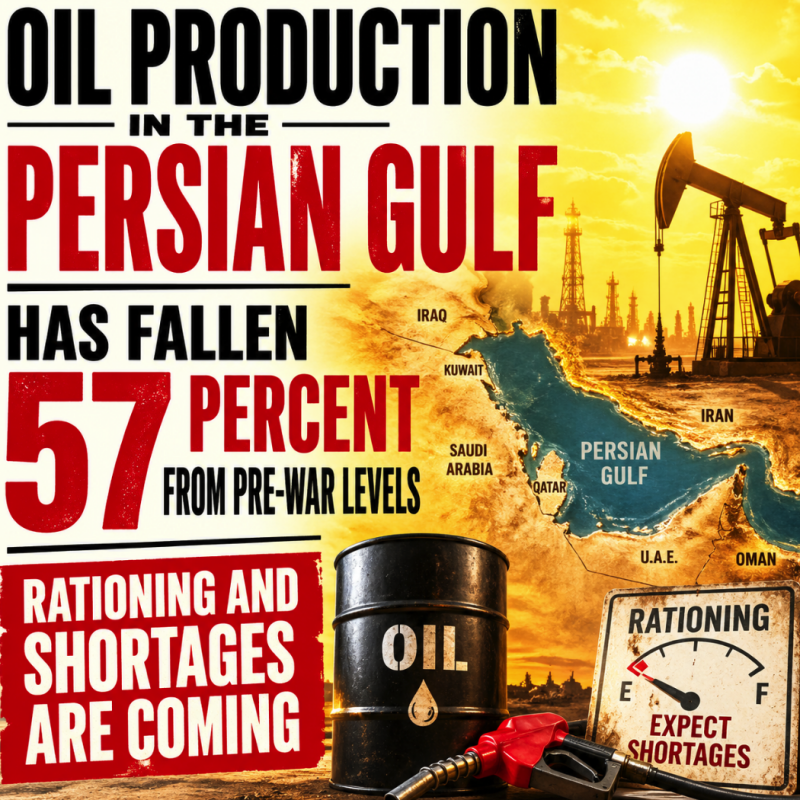
According to Goldman Sachs, oil production in the Persian Gulf has declined by a whopping 57 percent from pre-war levels…
The war with Iran is having an enormous impact on the global oil market. According to an estimate by Goldman Sachs, oil production from the Persian Gulf region is down 57% from its pre-war level, or about 14.5 million barrels per day. The world is currently covering the shortfall by drawing oil from storage, including a record 400 million barrel release by members of the International Energy Agency (IEA).
If the war ends soon, some of that production will be quickly restored.
But there are many oil and gas facilities that have been completely destroyed, and it is being projected that it could take up to 50 billion dollars to rebuild that infrastructure…
Repair and restoration costs for energy-linked infrastructure as a result of war in the Middle East could hit $58 billion, Rystad Energy analysis shows, with the total for oil and gas facilities potentially up to $50 billion. Three weeks after we published an initial estimate of $25 billion in repair costs across Gulf energy infrastructure, the scope of damage has expanded materially. The continuation of military strikes drove up the number of impacted assets across the region before largely subsiding following an 8 April ceasefire between the US and Iran. This pushed the estimate for the average in potential total repair and restoration spending to $46 billion – representing the midway point in the range of $34 billion to $58 billion – across oil and gas infrastructure, inclusive of an average of $5 billion across industrial, power and desalination assets. The ceasefire, combined with stalled negotiations and renewed escalation risk, continues to shape the operating environment, alongside risks of disruption and potential blockades affecting shipping through the Strait of Hormuz.
Even if reconstruction begins immediately, it would likely take until 2029 or 2030 before all of the oil and gas facilities in the region are fully restored.
So what is the rest of the world supposed to do while we wait for that to happen?
At this moment, everyone is running through their strategic reserves.
For some countries those reserves will last for months, but for other countries those reserves will only last for weeks.
Once the reserves are gone, shortages will start making a lot more headlines and prices will escalate significantly.
Of course the price of oil has already risen to very painful levels…
Oil prices climbed almost 3% Monday as hopes for a peace deal between the U.S. and Iran dimmed and energy shipments through the Strait of Hormuz remained extremely constrained.
The price of international benchmark Brent Crude was up about $3, or almost 3%, to $108.36 per barrel early Monday morning, its highest price point in three weeks. U.S. West Texas Intermediate was up 2.6% before U.S. markets opened, at $96.85.
This is going to affect virtually every man, woman and child on the entire planet, because our entire way of life is fueled by energy.
When energy prices go up, our standard of living goes down.
Unfortunately, energy prices have been going way up since the start of the war…
In the United States, the cost of a gallon of gas has increased by over a dollar since the strait closed, and the cost of diesel is up nearly 50 percent. Gas prices in Europe have increased by around 10 percent, and the region is facing a jet fuel shortage and concerns about the flow of liquid natural gas (LNG). Asia is being hit even harder. Roughly 20 percent of the world’s oil and LNG passes through the strait. Over 80 percent of this fuel goes to Asia. Several Asian countries, such as the Philippines, Japan, and South Korea, are now facing a real energy crisis.
Some Americans are now spending more than $100 to fill up their vehicles, and the average price of a gallon of gasoline in the United States has now surpassed the four dollar mark…
The average price of gasoline in the U.S. rose 7 cents over the last week and currently stands at $4.04 per gallon, according to new data released by GasBuddy, an app that tracks gas prices across parts of North America and Australia. Within the U.S., that data comes from more than 12 million price reports at roughly 150,000 gas stations nationwide, according to the company.
What has shocked me is the apathy that I am seeing out there.
Most people just assume that everything is going to work out just fine somehow.
Our attention spans have become so short that most of us can no longer see what is coming just a few months down the road.
Thanks to the crisis in the Middle East, we are facing the worst fertilizer crisis in history.
If nitrogen fertilizer is not applied to annual crops such as wheat and barley each season, yields will be way down…
Nitrogen-based fertilisers such as urea must be applied each season for many crops and directly influence annual yields as well as quality parameters, including protein content in wheat.
Farmers can cut back on other core nutrients, such as phosphate and potash, without immediate yield losses.
Many farmers all over the world will not be applying nitrogen fertilizer this year.
As a result, those particular farmers will be growing a lot less food in 2026.
I don’t know why this is so hard for some people to understand.
Right now, harvest forecasts are being slashed all over the planet…
Agricultural bodies, including the International Grains Council, are already cutting their forecasts for the next harvests, however. And the United Nations, which is trying to negotiate shipping access for fertiliser through the Gulf, has sounded the alarm over food security in developing nations.
This is not a drill.
This is really happening.
What we desperately need is for the Strait of Hormuz to be reopened as soon as possible.
Sadly, we are farther away from an agreement between the U.S. and Iran than ever.
The Iranians feel like they have won the war and have all the leverage, and so at this stage they are not even willing to talk about their nuclear program with the United States at all…
Iran is no longer willing to negotiate over its nuclear program at all, per Tasnim. Discussions will only cover ending the war, sanctions relief, compensation, and lifting the blockade. Nuclear issues “could be addressed later in a separate agreement,” only after the war has ended.
Nuclear was the central issue in the first round of Islamabad talks, with Trump saying it was “the only point that really mattered.” Iran has now removed it from the table entirely.
Trump says the war won’t end without a nuclear deal. Iran says nuclear won’t be discussed until the war ends.
The Iranians expect the Trump administration to give in, and the Trump administration expects the Iranians to give in.
But neither side is going to give in, and it appears that it is just a matter of time before more fighting breaks out.
Meanwhile, the Strait of Hormuz continues to be closed, and it is likely to remain that way for an extended period of time.
Michael’s new book entitled “10 Prophetic Events That Are Coming Next” is available in paperback and for the Kindle on Amazon.com, and you can subscribe to his Substack newsletter at michaeltsnyder.substack.com.

About the Author: Michael Snyder’s new book entitled “10 Prophetic Events That Are Coming Next” is available in paperback and for the Kindle on Amazon.com. He has also written nine other books that are available on Amazon.com including “Chaos”, “End Times”, “7 Year Apocalypse”, “Lost Prophecies Of The Future Of America”, “The Beginning Of The End”, and “Living A Life That Really Matters”. When you purchase any of Michael’s books you help to support the work that he is doing. You can also get his articles by email as soon as he publishes them by subscribing to his Substack newsletter. Michael has published thousands of articles on The Economic Collapse Blog, End Of The American Dream and The Most Important News, and he always freely and happily allows others to republish those articles on their own websites. These are such troubled times, and people need hope. John 3:16 tells us about the hope that God has given us through Jesus Christ: “For God so loved the world, that he gave his only begotten Son, that whosoever believeth in him should not perish, but have everlasting life.” If you have not already done so, we strongly urge you to invite Jesus Christ to be your Lord and Savior today.