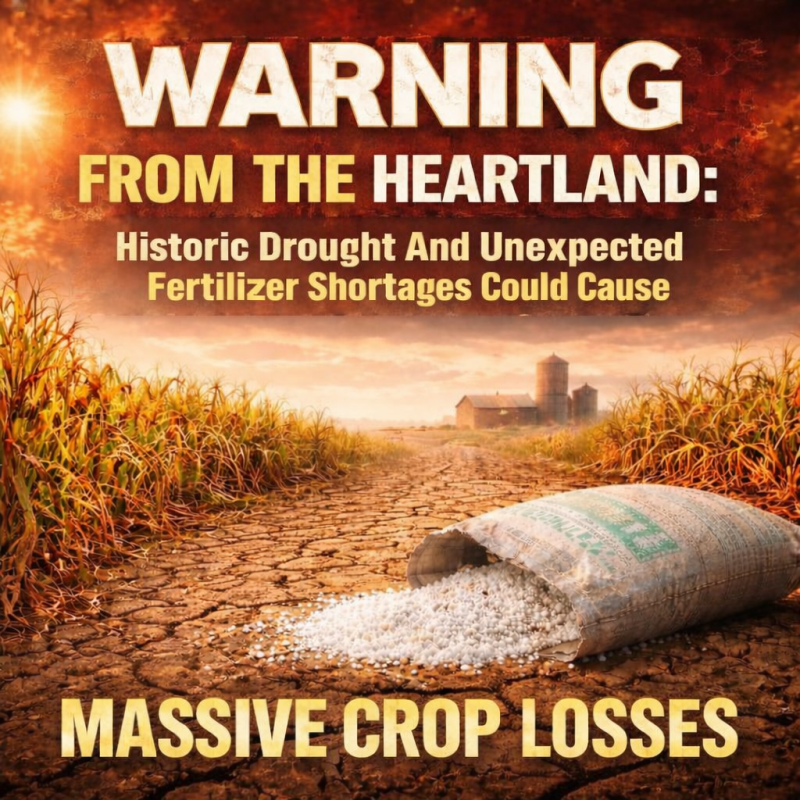
Farmers all over America are on edge right now, and I certainly can’t blame them. The war in the Middle East has created a fertilizer crisis at the worst time possible. As you will see below, if nitrogen fertilizer is not applied to wheat, corn and rice at the proper time, there is no hope of recovery later. Since it does not appear that the Strait of Hormuz will be reopened any time soon, there will be serious crop losses in the United States, and in poorer countries throughout the world it will be even worse.
Meanwhile, most of the country is experiencing at least some level of drought right now. If you check out the latest map from the U.S. Drought Monitor, it looks like a horror show. Even if there was no war going on in the Middle East, farmers in the U.S. would still be facing a nightmarish drought that never seems to end.
In Colorado, one family that had planned to go skiing during spring break decided to go to the beach instead because of the extremely dry conditions…
Stretching out in their beach chairs as the temperature climbed toward 70 degrees, Seth and Renee McLaughlin watched their three kids play in the sand on what was supposed to be a family ski trip.
Booked last November, their spring break vacation to Colorado’s mountains required a hard shift in plans following a historically warm and dry winter: Instead of zipping down the slopes, the couple watched their kids sift sand into colorful toy buckets on the shores of Lake Dillon.
“It’s obviously frustrating. You want to go skiing, and usually we ski until May, and instead we’re at the beach,” said Seth McLaughlin, 44, a nonprofit consultant. “I feel bad for the folks who spent tens of thousands of dollars to come on vacation here.”
There has been so little snow in most of the western half of the nation this winter.
Snowpack levels are historically low, and that means that a very rough summer is ahead.
We are only in March, and we are already seeing severe water restrictions being imposed.
For example, restaurants in Denver are forbidden from serving water unless customers specifically ask for it…
Restaurants in Colorado’s capital are only allowed to serve water to guests if they ask, according to new restrictions by the Denver Board of Water Commissioners.
“Restaurants and catering businesses shall serve water only upon request,” the mandatory irrigation restrictions read.
The rules were issued in the Mile High City after the commissioners declared a Stage 1 Drought and made plans to seek a 20 percent reduction in water use. City officials expect drought conditions to last until April 30, 2027.
That is crazy.
And hotels in Denver are being ordered to “not change sheets more often than every four days for guests staying more than one night”…
“Lodging establishments shall not change sheets more often than every four days for guests staying more than one night, except for health or safety reasons or upon express request of guests,” the Denver Board of Water Commissioners stated.
Drivers who attempt to wash their car are told to use a bucket or a hand-held hose equipped with an automatic shut-off nozzle if they don’t use a commercial car wash.
Residents can water their grass only two days per week, according to the schedule provided by city officials, but it is prohibited between 10 a.m. and 6 p.m., when the sun is up.
If things are this bad now, what will they look like once we get to the dog days of August?
USA Today talked to a water expert named Brad Udall, and he had a difficult time finding the words to describe how severe this crisis has become…
Longtime Western water expert Brad Udall said it’s hard to put into words just how bad things are. He said the early ski area closures will likely be followed by ranchers selling off cattle, and then skies darkened by wildfire smoke as dry vegetation burns.
Farmers in many areas of the Southwest simply are not going to have enough water this year.
So what are they going to do?
At the same time, U.S. farmers are also facing a fertilizer crisis that is unlike anything they have ever experienced before.
One industry insider is projecting that here in the United States there will be a shortage of at least 2 million tons of urea this spring…
“If you had sat us down before and said, ‘Hey, I want you to think of the nightmare scenario for fertilizer. What would it be?’ It would be this exact event during this exact time of year,” said Josh Linville, who oversees the global fertilizer department at the brokerage firm StoneX.
Linville says urea that had been expected to arrive in the United States next month, in the peak of planting season, won’t come.
The Fertilizer Institute predicts that U.S. farmers will be short some 2 million tons of urea this spring.
Of course it isn’t just U.S. farmers that will be dealing with a lack of fertilizer.
As John Rubino has correctly pointed out, much of the world’s fertilizer supply is now trapped behind three locks…
- Lock one: the Strait of Hormuz. The IRGC permissioned corridor allows oil tankers from friendly nations to pay $2 million in yuan and pass. It does not allow fertiliser vessels to pass at any price. Zero approved fertiliser transits in 24 days. The Gulf supplies 49 percent of the world’s exported urea and roughly 30 percent of traded ammonia. That supply is not delayed. It is denied. The gate opens for molecules that fund the gatekeeper. It stays closed for molecules that feed the planet.
- Lock two: Russia. The world’s largest exporter of ammonium nitrate just halted all AN exports until after April 21. Three to four million tonnes per year, gone from global markets at the exact moment the Northern Hemisphere needs it most. The official reason is “domestic priority.” The strategic effect is leverage. Russia earns windfall revenue from the oil price spike its ally’s war created, then removes the fertiliser that farmers need to plant through the crisis. The disease and the cure, again, from the same address.
- Lock three: China. Beijing has banned exports of nitrogen-potassium blends and phosphate fertilisers through August 2026. China is the world’s largest phosphate producer and a major nitrogen supplier. The ban removes the last alternative source that could have compensated for Hormuz and Russia. Three locks. Three countries. Three deliberate decisions timed to the same biological calendar.
None of this is going to change in time to save the spring planting season.
That means that there will be widespread crop losses, and global food supplies will start getting really tight about six months from now.
It will not matter if the Strait of Hormuz opens up in a couple of months. As Rubino has explained, nitrogen fertilizer must be applied at the correct time or it won’t work…
The biological calendar does not negotiate. Corn requires nitrogen at the V6 to VT growth stage or kernel set is permanently reduced. Wheat requires it at tillering and jointing or grain fill collapses. Rice requires it at transplanting or yield drops 20 to 40 percent in low-input systems. These are not economic models. They are cellular processes. The plant either receives nitrogen during the window or it does not. If it does not, no subsequent application, no price increase, no policy reversal can recover what was lost. The damage is written into the biology of the seed.
We desperately need the Strait of Hormuz to be reopened as soon as possible.
If this does not happen, a lot of people in impoverished nations will soon become extremely hungry.
Unfortunately, the Iranians have an extremely tight grip on traffic through the Strait of Hormuz, and they do not intend for that to change…
After a month of fighting, Iran arguably has secured the most significant strategic victory via its tightening grip over traffic through the Strait of Hormuz, Bloomberg reported Monday.
The first full month of the war saw roughly six vessels per day on average traversing the critical waterway in either direction, compared with ~135/day in normal times, according to ship-tracking data compiled by Bloomberg, adding that 80% of the small number of oil tankers exiting the strait have belonged to Iran or countries with which it is on cordial terms.
Either the Trump administration will have to give the Iranians everything that they want, or the Trump administration will have to take control of the Strait of Hormuz by force.
As many have pointed out in recent weeks, taking control of the Strait of Hormuz by force would be an exceedingly difficult thing to do…
Dangers such as cruise and ballistic missiles, fast-attack boats and sophisticated naval mines await any vessel attempting to traverse the vital passage.
With transit lanes in some places only three to four miles from the Iranian shoreline, ships have less than two minutes to react to incoming strikes.
Naval escorts also face the threat of Tehran using remote-controlled boats laden with explosives to strike them.
The oil passage is narrow and shallow, forcing vessels within miles of Iran’s mountainous shores, a landscape that lends itself to asymmetric warfare tactics, in which Tehran deploys weapons that are small, widely dispersed and hard for adversaries to eliminate entirely.
It could take months to resolve this crisis.
Meanwhile, the global energy crisis will just keep getting worse with each passing day.
At this moment, tankers that left the Persian Gulf before the war began are still arriving at their destinations.
But as maritime expert Lars Jensen has pointed out, soon there will be no more tankers loaded with oil arriving, and that is when the real shortages will begin…
‘It would appear we are only at the beginning of those price escalations. We need to keep in mind that a lot of the oil that was loaded in the Persian Gulf prior to this crisis is still right now arriving in some of the refineries around the world. That will soon stop. The oil shortages we are seeing are only going to get worse. Even if magically the Strait of Hormuz would reopen tomorrow’
For some parts of the world, tankers will stop arriving in early April, and for other parts of the world tankers will stop arriving in late April.
Next month is going to be a real turning point.
And it is being reported that preparations are being made for when the price of oil reaches $200 a barrel…
Prediction market site Polymarket on Sunday reported that U.S. officials and Wall Street analysts have begun preparations for oil to top $200 a barrel as the Iran war continues and shows signs of possible escalation.
This occurs as the average price of gas across the United States remains just under $4 a gallon, but in some cities, such as San Francisco, is about to top $6 a gallon, according to data from crowdsourced gas app GasBuddy.
If the price of oil really does reach $200 a barrel, there will be extreme panic in the financial markets and everything will crash.
And the price of gasoline in the United States will be at levels we have never seen before.
If only someone would have warned us about all of this in advance, we could have gotten properly prepared.
But now nations all over the world find themselves completely and utterly unprepared for what is about to happen.
A real life nightmare is playing out right in front of our eyes, and it appears that we are still only in the very early stages.
Michael’s new book entitled “10 Prophetic Events That Are Coming Next” is available in paperback and for the Kindle on Amazon.com, and you can subscribe to his Substack newsletter at michaeltsnyder.substack.com.

About the Author: Michael Snyder’s new book entitled “10 Prophetic Events That Are Coming Next” is available in paperback and for the Kindle on Amazon.com. He has also written nine other books that are available on Amazon.com including “Chaos”, “End Times”, “7 Year Apocalypse”, “Lost Prophecies Of The Future Of America”, “The Beginning Of The End”, and “Living A Life That Really Matters”. When you purchase any of Michael’s books you help to support the work that he is doing. You can also get his articles by email as soon as he publishes them by subscribing to his Substack newsletter. Michael has published thousands of articles on The Economic Collapse Blog, End Of The American Dream and The Most Important News, and he always freely and happily allows others to republish those articles on their own websites. These are such troubled times, and people need hope. John 3:16 tells us about the hope that God has given us through Jesus Christ: “For God so loved the world, that he gave his only begotten Son, that whosoever believeth in him should not perish, but have everlasting life.” If you have not already done so, we strongly urge you to invite Jesus Christ to be your Lord and Savior today.