Man Eats His Way Across America – from Garbage Cans

(YT) Rob Greenfield is a peculiar guy. The 28-year old Californian had a vasectomy a few years ago so as not to contribute to world overpopulation. He despises shoes.
(YT) Rob Greenfield is a peculiar guy. The 28-year old Californian had a vasectomy a few years ago so as not to contribute to world overpopulation. He despises shoes.

“The way to crush the bourgeoisie is to grind them between the millstones of taxation and inflation.” – Vladimir Lenin In an interview between Jim Goddard and David Smith, Senior Analyst for the Morgan Report, Jim Goddard asks:JG:

It has come down to this for Brian Perry: an apple or banana for lunch, Red Sox ballgames on an old Zenith TV and long walks to shake off the blues. At 57, Perry has been unemployed and looking for work for nearly seven years, ever since that winter when the Great Recession hit and he was laid off from his job as a law firm clerk.

Milk futures rose to a record as exports by the U.S. climbed amid shrinking inventories of cheese and butter, signaling higher costs for pizza and pastries.

McDonald’s Corp. (MCD), the world’s largest restaurant chain, posted the worst same-store sales decline in more than a decade, hurt by sluggish demand in the U.S.

According to the Federal Reserve, the percentage of American families that own a small business is at the lowest level that has ever been recorded. In a report that was just released entitled “Changes in U.S.

The United States economy added only 142,000 jobs in August, compared with an average monthly gain of 212,000 over the prior 12 months, dropping 33%. It was the smallest gain since January. The small amount of jobs added occurred in professional and business services and in health care.

Should we be concerned that the percentage of Americans that are either working or looking for work is the lowest that it has been in 36 years? In August, an all-time record high 92,269,000 Americans 16 years of age and older did not “participate in the labor force”. And when you throw in the people that are considered to be “in the labor force” but are not currently employed, that pushes the total of working age Americans that do not have jobs to well over 100 million.
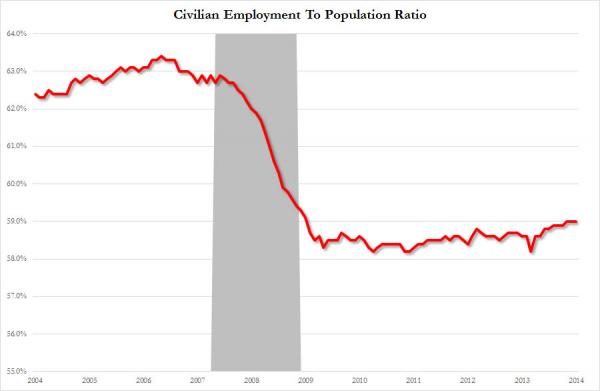
After years of ignoring the obvious, the Federal Reserve has been finally forced to admit that the labor force participation rate matters, and in fact has started to point it out as a clear negative when it comes to Yellen’s “dashboard” of thresholds which will allow the Fed to raise rates (for the obvious reason that the Fed is desperate to delay ZIRP as long as possible and is now highlighting all that is wrong with the economy, contrary to Obama who is still focusing on all the rigged greatness of the US recovery) and to do so is going through Zero Hedge archives to note all those things which everyone had ignored for years and which we have pointed out as structural failures of the so-called recovery. So while we are happy to oblige the Fed with our tens of thousands of articles summarizing what is broken with the US economy thanks to, well, the Fed, here is another one: one which the Fed can use next year when the time to hike rates has come and gone, and when the Fed is once again scratching its head what to blame it on.

A record 92,269,000 Americans 16 and older did not participate in the labor force in August, as the labor force participation rate matched a 36-year low of 62.8 percent, according to the Bureau of Labor Statistics. The labor force participation rate has been as low as 62.